
How to create SEO-friendly WordPress posts automatically
Creating a WordPress post is easy. Creating a WordPress post that is genuinely useful, well organized, relevant to a search query, connected to the rest of the website, and suitable for long-term SEO performance requires much more planning.
For many website owners, this difference is exactly where content production becomes difficult.

A business may be able to publish articles regularly, but regular publishing alone does not guarantee that those articles support organic visibility. An article can be technically published correctly and still fail because the topic is too broad, the search intent is unclear, the title does not match the content, important questions are unanswered, or several articles compete for almost the same keyword.
This is why automatic content creation should focus on quality rules rather than simple text generation.
With the right wordpress plugin and a structured AI workflow, WordPress websites can automatically create posts that are designed around search relevance, useful information, semantic coverage, and GEO principles. PW Feed approaches automated content from this broader perspective, where AI is used as part of an SEO-focused publishing system rather than as a tool for producing random text.
What makes a WordPress post SEO-friendly?
An SEO-friendly post is not simply an article containing a keyword several times.
Modern search optimization requires a much wider set of signals.
The article should clearly answer a specific search intent. Its subject should be understandable from the beginning. Related concepts should appear naturally throughout the content. The article should provide enough detail to satisfy users who searched for that topic, while avoiding unnecessary repetition.
An effective post also needs to fit into the website as a whole.
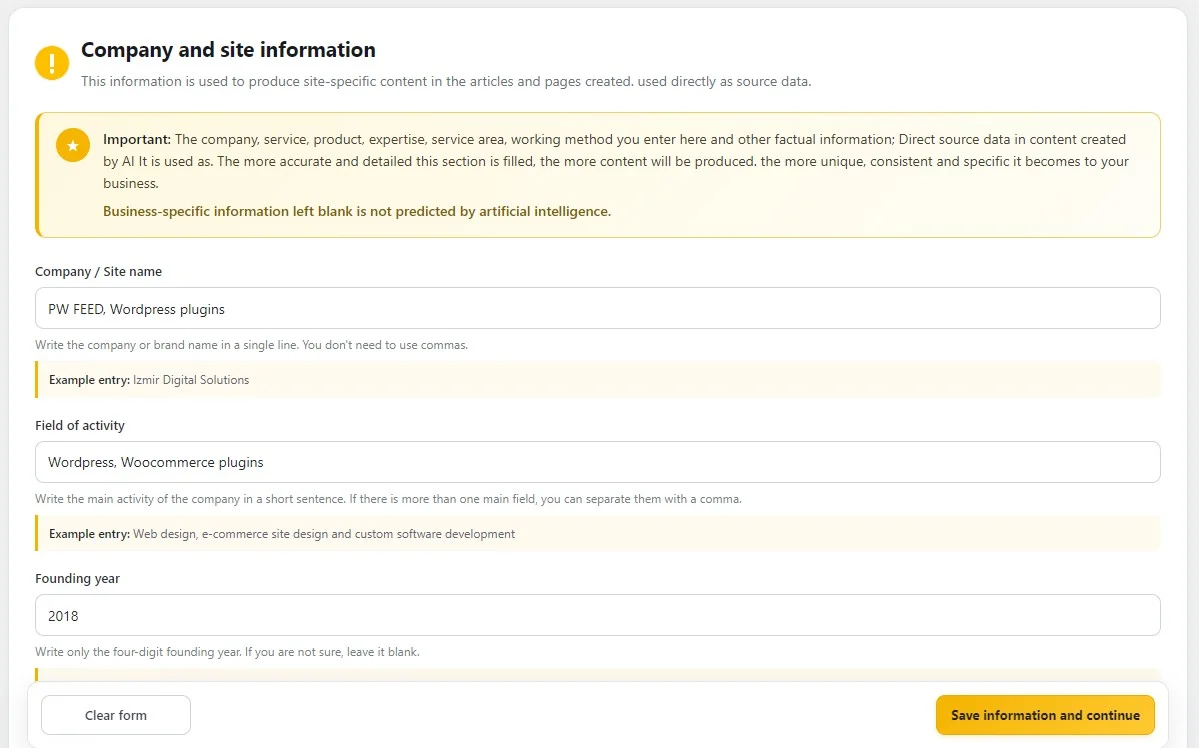
If a website specializes in WordPress automation, for example, its articles should support related subjects such as AI content generation, SEO content workflows, automated publishing, content structure, website optimization, GEO, and wordpress plugin functionality.
This creates a consistent topical environment.
Search engines do not evaluate every page as if it exists completely alone. The relationships between pages, internal links, site structure, and overall topical coverage can also influence how clearly a website communicates its expertise.
For this reason, automatically creating SEO-friendly WordPress posts requires more than writing individual articles. It requires understanding how each article contributes to the larger site.
Search intent should come before content generation
One of the strongest ways to differentiate SEO content is to begin with search intent.
Search intent describes what a person actually wants when entering a query.
Someone searching for how to create SEO-friendly WordPress posts automatically is not necessarily looking for a generic explanation of WordPress.
The person is more likely trying to understand whether content production can be automated without losing SEO quality.
This creates several questions that the article should address.
Can AI create SEO-oriented WordPress posts?
What needs to be automated?
How should keywords be selected?
How can duplicate topics be avoided?

Can metadata be created automatically?
Should content be published immediately or reviewed?
How does GEO fit into the process?
What role does a wordpress plugin play?
An article that answers these questions is far more aligned with search intent than an article that simply repeats phrases such as AI WordPress content generator.
Automation should therefore begin by defining what the target query means to the user.
Keyword selection should be precise rather than excessive
Keywords remain useful because they help define the subject of the page.
However, automated content systems can easily misuse them.
If a keyword is inserted too frequently, the article can become unnatural. If dozens of loosely related keywords are added simply because they have search volume, the article can lose focus.
A better approach is to identify one primary subject and a group of closely related terms.
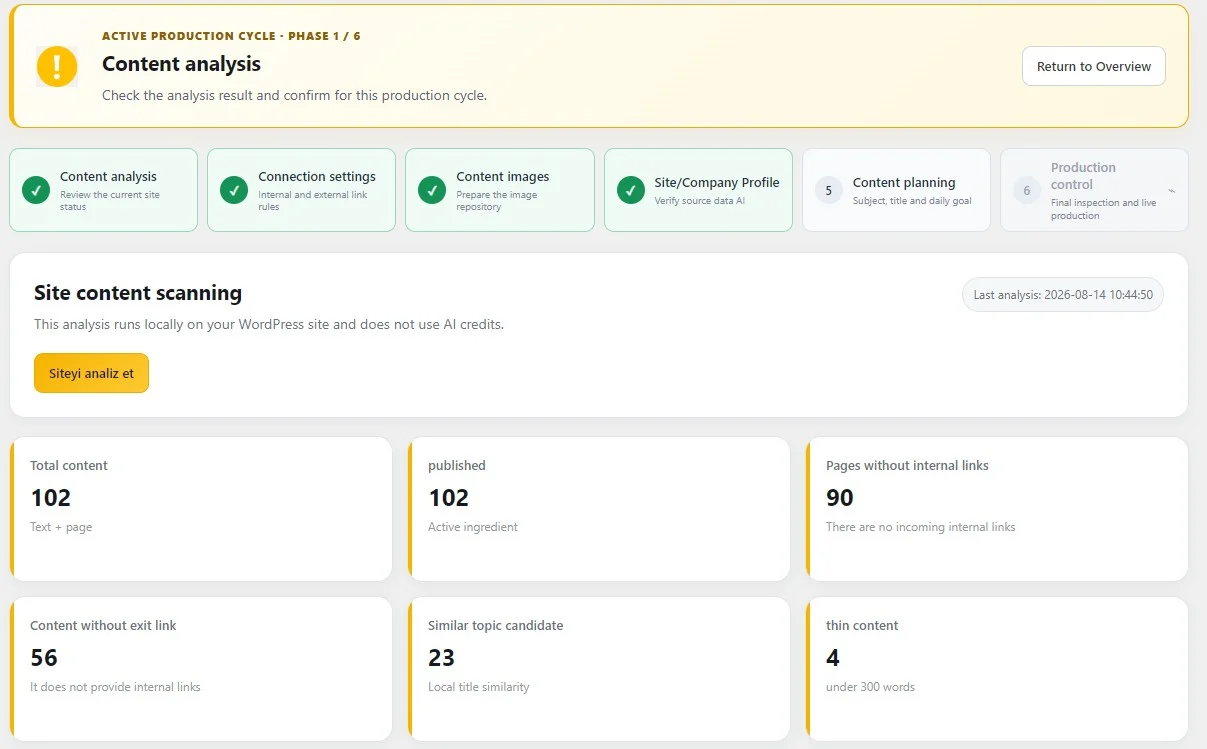
For this topic, natural keyword variations can include:
SEO-friendly WordPress posts
automatic WordPress content creation
AI SEO content generator
WordPress AI content
automated SEO writing
SEO content automation
AI article generation for WordPress
WordPress SEO automation
AI-powered content creation
wordpress plugin for AI content

These expressions do not need to appear in every paragraph.
Their purpose is to help cover the topic naturally from different angles.
Semantic relevance is more valuable than mechanical repetition.
An automated system should therefore understand that keywords are content signals, not a list that must be inserted as often as possible.
One page should have one clear purpose
A common problem in automated content projects is the creation of multiple pages with nearly identical objectives.
For example, imagine a WordPress website publishes these four articles:
How to create SEO content with AI
How to write SEO content automatically
How to generate AI SEO articles
How to automate SEO writing
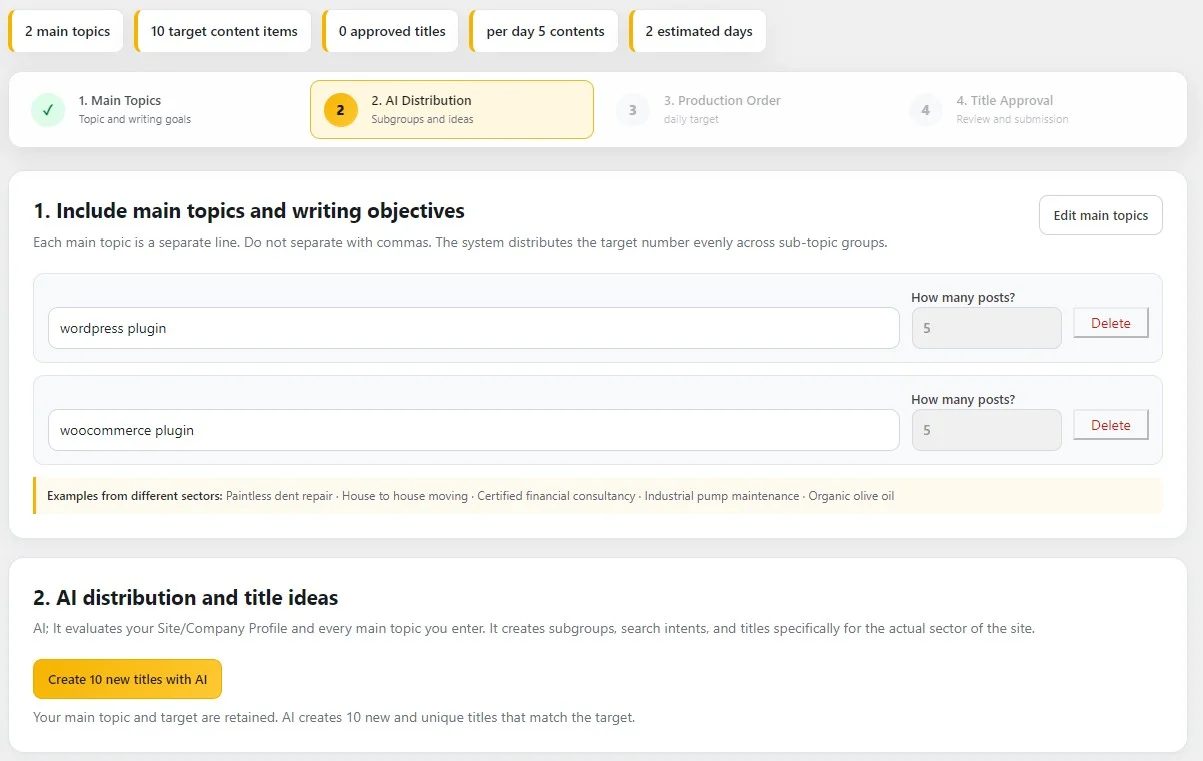
The wording is different, but the search intent may be almost identical.
If every article explains the same process, the website gains very little additional topical coverage.
A better structure separates articles according to distinct user needs.
One page can focus on creating SEO-friendly posts automatically.
Another can focus specifically on automatic blog publishing.
Another can explain unique meta descriptions.
Another can cover internal linking.
Another can discuss GEO.
Another can address duplicate content prevention.
This creates genuine content depth.
PW Feed content automation can be used with this principle in mind: new content should fill a specific informational gap instead of repeating an existing page in slightly different language.

The title should accurately represent the article
Automatic title creation can save time, but titles require careful control.
An effective SEO title should be specific enough to tell both users and search engines what the page covers.
Overly generic titles make differentiation difficult.
For example, AI and WordPress is too broad.
How to create SEO-friendly WordPress posts automatically is much clearer because it defines the platform, the objective, and the automation aspect.
At the same time, titles should not be overloaded with every possible keyword.
A title such as Best AI SEO WordPress Automatic Content Generator Plugin for SEO GEO Content Creation is difficult to read and looks unnatural.
Clarity should come first.
An automated WordPress workflow should therefore generate titles based on the actual purpose of each article rather than simply combining popular keywords.
A strong opening paragraph establishes context quickly
The beginning of an article is important because it establishes relevance.
A reader should not need to scroll through several paragraphs before understanding the subject.

For SEO-friendly automated content, the opening should explain the problem and the purpose of the article.
In this case, the problem is straightforward: website owners want to create WordPress content automatically without sacrificing SEO quality.
This direct approach is also helpful for GEO.
Generative systems often rely on clearly expressed information when interpreting a page. When the main subject is introduced early, the relationship between the query and the content becomes easier to recognize.
This does not mean every article must begin with the exact same formula.
In fact, automated systems should avoid repetitive introductions.
Different articles can begin with a problem, a question, a comparison, an observation, or a practical scenario.
Variety improves readability and helps individual pages feel distinct.
Content depth matters more than artificial word count
Long-form content can be useful when the topic requires detailed explanation.
However, length alone is not an SEO strategy.
An article should be as detailed as necessary to answer the subject properly.
If 1,500 words provide useful explanations, examples, distinctions, and practical guidance, the length has value.
If the same point is repeated in different words simply to reach a target number, the article becomes weaker.
AI automation should therefore use content depth rather than repetition.
A useful article about automatic SEO content creation may discuss search intent, keyword selection, titles, metadata, semantic relevance, internal linking, originality, publishing status, GEO, content gaps, and quality checks.
Each section adds something different.
This creates a comprehensive resource without padding the article unnecessarily.
Automated content should use semantic relevance
Search engines have become much better at understanding concepts rather than relying only on exact-match keywords.
This makes semantic relevance especially important.
An article about SEO-friendly WordPress posts may naturally discuss content structure, indexing, search intent, titles, meta descriptions, topic relevance, AI content generation, publishing workflows, internal links, user value, and generative search.
These concepts help define the subject.
The goal is not to force them into the article.
They should appear because they are genuinely relevant.
This is an area where a carefully configured AI system can be useful.
Instead of generating content around one repeated phrase, it can cover the broader topic in a logical way.
PW Feed can support this approach by combining AI content production with defined subject areas and SEO-oriented rules.
Originality should be measured by purpose, not only wording
When people discuss unique AI content, they often focus only on whether sentences are copied.
That is too narrow.
Two articles can use completely different sentences and still be functionally duplicate content if they answer the same question in the same way.
True originality begins with purpose.
Each article should have its own focus.
For example, this page focuses on the mechanics of creating SEO-friendly WordPress posts automatically.
A separate page about automatic publishing should focus on workflow, scheduling, drafts, and publication control.
A page about internal linking should focus on relationships between pages.
A GEO article should focus on generative discovery.
This distinction makes each article genuinely different even when they belong to the same broader topic cluster.
Automatic content systems should therefore check not only wording but also topic overlap.
SEO titles and meta descriptions should be unique
Metadata is one of the easiest areas to overlook when creating WordPress content automatically.
If every article receives a similar SEO title and description, the pages can become difficult to distinguish.
Each article should have a unique title based on its actual subject.
The meta description should summarize the value of that specific page.
For example, a meta description for this article should emphasize automatic creation of SEO-friendly WordPress posts.
A different article about automated publishing should emphasize publishing workflows.
The distinction may seem small, but it contributes to clearer page differentiation.
Automation makes metadata creation faster, but it also increases the need for duplicate checking.
A good wordpress plugin workflow should therefore consider whether previously used titles or descriptions are too similar before assigning new ones.
Internal links should support the topic naturally
SEO-friendly content should connect with relevant pages inside the website.
Internal links help visitors discover related information and can help search engines understand how pages are organized.
However, automatically adding internal links to every available keyword can create poor results.
Links should be contextual.
If an article discusses automatic publishing, a link to a detailed page about publishing automation may be useful.
If the article discusses GEO, linking to a related GEO resource may make sense.
If the user is reading about a product or service, a commercial page may be appropriate when the context supports it.
The important principle is relevance.
A link should help the reader continue naturally.
Automated internal linking becomes valuable when it understands page relationships rather than merely matching words.
SEO-friendly does not mean written for robots
One of the oldest mistakes in SEO is writing primarily for an algorithm.
Content becomes awkward when every sentence is designed around a keyword.
The reader should remain the primary audience.
A useful article explains the subject clearly, answers likely questions, and avoids unnecessary complexity.
This also supports modern SEO because search engines increasingly attempt to identify content that satisfies real user needs.
AI-generated content should therefore sound natural.
It should use varied sentence structures.
It should explain important concepts.
It should avoid repeating the product name unnecessarily.
It should not force keywords into places where they do not belong.
PW Feed should appear naturally where the product context is relevant, while the article itself should remain informative.
GEO requires clear answers and identifiable concepts
Generative Engine Optimization introduces another reason to prioritize clarity.
AI-powered search systems may interpret pages differently from traditional search engines.
They may identify statements, relationships, entities, definitions, and useful explanations while constructing responses.
Content that is vague can be more difficult to interpret.
For example, saying our revolutionary solution changes everything gives little useful information.
Saying PW Feed supports AI-based WordPress content workflows focused on SEO and GEO provides much clearer context.
Specific language identifies the product, platform, function, and optimization approach.
This type of clarity is useful for human readers as well.
GEO should therefore not be treated as a collection of hidden technical tricks.
Much of its value comes from producing information that is direct, contextual, well organized, and easy to understand.
Automatic content can support content gaps
One of the most useful applications of AI is identifying subjects that a website has not yet covered.
A website may have excellent commercial pages but very little supporting information.
For example, a wordpress plugin website may explain its main product but fail to answer common questions about AI content generation, automatic publishing, SEO structure, metadata, topic selection, internal linking, or GEO.
These missing subjects are content gaps.
Creating articles around them can expand the website’s informational coverage.
The key is selecting gaps that are relevant to the site’s primary subject.
Publishing unrelated high-volume topics may increase page count without improving topical authority.
An automated SEO system should therefore prioritize relevance over popularity.
Quality checks should happen before publishing
Automatic generation should not mean automatic acceptance of every result.
A quality-control stage can help maintain consistency.
The system may evaluate whether the article has a clear topic, whether the title is unique, whether the metadata is duplicated, whether the content is sufficiently detailed, whether important target terms are included naturally, and whether the page overlaps excessively with an existing article.
Business-specific claims may also require verification.
This is particularly important for service descriptions, legal subjects, financial information, health information, prices, or information that changes frequently.
AI can accelerate production, but quality control remains essential.
The most useful automation systems are those that combine speed with rules.
Draft mode can provide additional editorial control
Some WordPress users may prefer to generate SEO content automatically without publishing it immediately.
Draft mode provides this option.
The article can be created, structured, and prepared in WordPress while remaining unpublished until a person reviews it.
This workflow can be especially useful during the early stages of AI automation.
The website owner can evaluate generated articles, adjust instructions, refine target topics, and establish quality expectations.
Once the workflow becomes predictable, selected categories of content may be suitable for more automated publishing.
Different businesses require different levels of control.
A professional wordpress plugin should support this flexibility.
Automatically generated content should evolve with the website
A content strategy is not permanent.
Websites change.
New products are launched.
Services expand.
Some topics become less important.
Search behavior changes.
New technologies influence how information is discovered.
An AI content system should therefore respond to the current state of the website.
A list of article topics created two years ago may no longer represent current priorities.
Content automation works best when topics can be reviewed and adjusted.
For PW Feed users, this means AI-generated WordPress content should remain connected to actual website goals rather than following an inflexible publishing queue indefinitely.
SEO and GEO create complementary visibility opportunities
SEO remains critical for traditional organic search.
GEO provides an additional framework for AI-driven discovery.
Creating SEO-friendly WordPress posts automatically can support both when the content follows sound principles.
The article should be focused.
The subject should be clear.
Terminology should be relevant.
Information should be useful.
Pages should be differentiated.
Relationships between topics should make sense.
Links should be contextual.
Important entities should be identifiable.
These characteristics help create content that is easier for both search engines and AI systems to interpret.
Rather than producing separate articles for SEO and GEO, websites can build content that considers both from the beginning.
Where PW Feed fits into automated SEO content creation
PW Feed is intended for WordPress users who want a more systematic way to create content with AI.
Instead of treating every article as an isolated writing task, businesses can approach content generation as part of a wider SEO and GEO workflow.
This can reduce repetitive work while helping maintain consistency across titles, topics, publishing decisions, and overall content direction.
Website owners interested in learning more about PW Feed, AI-powered content creation, and WordPress automation can visit the PW Feed contact page.
Users who want to review purchase options can continue directly to the PW Feed buy page.
Creating better content automatically requires better rules
The quality of automated content depends heavily on the instructions behind it.
A system told simply to write about SEO may produce broad and repetitive articles.
A system given a clear topic, target intent, content rules, website context, related terminology, originality requirements, and publishing preferences can produce much more focused results.
This is one of the most important principles of AI content automation.
Better automation does not necessarily mean less control.
In many cases, it means defining control more precisely before generation begins.
The website owner establishes the rules.
AI performs the repetitive production work.
WordPress provides the publishing environment.
SEO defines traditional search relevance.
GEO helps prepare content for generative discovery.
Together, these elements create a structured content workflow.
Final thoughts on automatic SEO-friendly WordPress content
Creating SEO-friendly WordPress posts automatically is possible, but successful automation requires more than connecting AI to a publishing button.
Each article needs a clear purpose.
Search intent should define the subject.
Keywords should support meaning rather than dominate the writing.
Titles and metadata should remain unique.
Content should provide real depth.
Related concepts should appear naturally.
Internal links should make sense.
Existing pages should be considered before new topics are generated.
SEO and GEO should be part of the same planning process.
Most importantly, automation should create pages that strengthen the website rather than simply increase the number of published posts.
PW Feed brings AI content creation into the WordPress environment with this structured objective in mind.
For website owners, the real advantage of AI is not the ability to produce unlimited text. It is the ability to turn a carefully defined content strategy into a more efficient and consistent publishing process.
When automation is guided by relevance, originality, SEO, GEO, and clear website context, WordPress content can scale without every article becoming a variation of the page that came before it.