
Automatic WordPress publishing: draft or publish directly?
AI content automation gives WordPress website owners an important choice: should newly generated content be saved as a draft for review, or should it be published directly without manual intervention?
There is no single answer that works for every website.

A small business may want to review every article before publication. A publisher with a mature content workflow may prefer direct publishing for approved topics. An agency may use different rules for different clients. A professional services website may allow informational content to publish automatically while keeping sensitive or commercial pages in draft status.
The correct decision depends on content risk, website maturity, publishing volume, business requirements, SEO objectives, GEO strategy, and the level of control the website owner wants to maintain.
PW Feed can support both approaches within an AI-powered WordPress content workflow. Instead of forcing every website into the same publishing model, a structured wordpress plugin can allow content generation and publication rules to reflect the needs of each site.
The important question is therefore not whether draft mode or direct publishing is universally better.
The important question is when each method should be used.
What is draft publishing in WordPress?
Draft publishing means that AI creates the article and places it inside WordPress without making it publicly accessible.
The content exists in the WordPress dashboard, but visitors cannot see it until an authorized user publishes it.
This gives the website administrator an opportunity to review the article.
The reviewer can check factual information, brand terminology, internal links, SEO elements, GEO clarity, business-specific statements, and overall quality.
Changes can be made before the page becomes public.
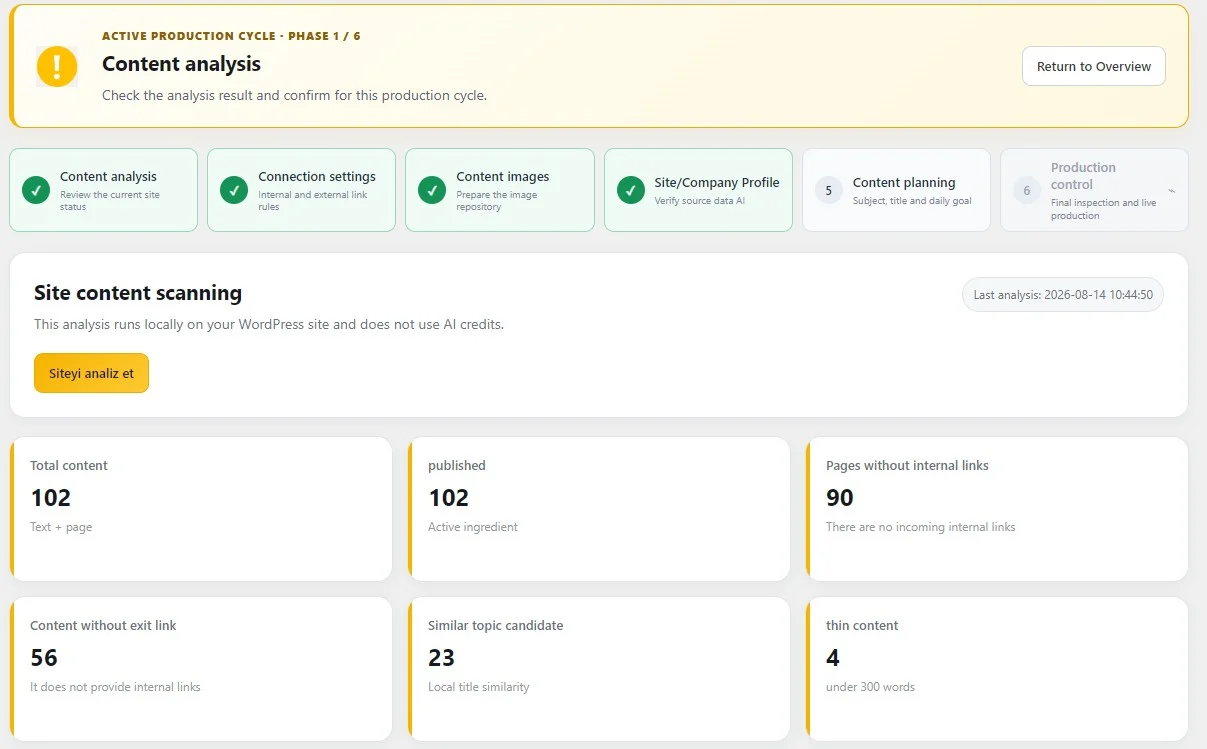
Draft mode therefore adds an editorial stage between AI generation and publication.
For businesses that are beginning to use AI content automation, this additional step can be particularly valuable.
It provides an opportunity to understand how the AI behaves before granting it greater publishing freedom.
What does direct publishing mean?
Direct publishing removes the manual approval stage.
The AI generates the article and publishes it according to predefined rules.
Once the content is created successfully, it becomes publicly accessible without requiring someone to open the WordPress dashboard and press the publish button.
This can significantly reduce repetitive work.
A website that publishes several articles every week may save considerable administrative time by removing manual approval from low-risk content.
Direct publishing can also help maintain a regular publishing schedule.
The system does not depend on someone remembering to review and publish every article.

However, this increased efficiency comes with additional responsibility.
The automation rules must be reliable.
Topics must be controlled.
Business information should be accurate.
Publishing volume should have limits.
Content quality requirements should be clearly defined.
Direct publishing works best when the workflow itself has already been tested.
Draft mode provides greater editorial control
The most obvious advantage of draft mode is control.
The website owner has the final decision.
Nothing becomes public until someone approves it.

This can be important when content includes business-specific information.
For example, an article may discuss a service, product capability, operating area, pricing factor, process, or company policy.
AI may understand the general topic correctly but still require adjustment to match the exact business.
Draft mode gives the company an opportunity to make those corrections.
It also allows the reviewer to decide whether the article should be published at all.
Sometimes a generated topic may turn out to overlap too much with an existing page.
Instead of publishing another similar article, the business may choose to improve the existing content.
This type of judgment is easier to apply when content remains in draft status.
Direct publishing reduces repetitive administration
The main advantage of direct publishing is efficiency.
When AI content has already been generated according to reliable rules, manually opening every article and clicking publish may provide little additional value.
For websites with larger publishing schedules, this repetitive task can become significant.
Suppose a website publishes twenty informational articles per month.
If the content workflow has been tested, topic selection is controlled, SEO and GEO rules are already defined, and business claims are restricted, direct publication may simplify operations substantially.
The system can create and publish according to schedule.
The administrator can focus on monitoring the overall strategy rather than approving every individual article.
This is one of the areas where automation can provide real operational value rather than simply speeding up writing.
The decision should begin with content risk
Not all content carries the same level of risk.
This is one of the most useful ways to decide between draft and direct publishing.
A general educational article may carry relatively low risk.
A page discussing legal, financial, health, safety, regulatory, or highly technical information may require much more careful review.

Commercial claims can also require attention.
Information about pricing, guarantees, product capabilities, geographic service areas, and contractual conditions should accurately reflect the business.
A WordPress content strategy can therefore divide articles into risk categories.
Low-risk informational content may be eligible for direct publishing.
Higher-risk content can remain draft-only.
This creates a more sophisticated workflow than applying one rule to every article.
New AI workflows should usually begin with drafts
When an AI content system is first introduced to a website, draft mode provides a useful testing period.
The business can observe how the AI handles different subjects.
Does it understand the product correctly?
Does it use the right terminology?
Does it repeat certain introductions?
Are articles sufficiently different from each other?
Does it create accurate internal links?
Does it follow SEO requirements?
Does it apply GEO principles clearly?
These questions are difficult to answer before seeing actual results.
A draft-first implementation allows the website owner to identify patterns without affecting the live site.
Instructions can then be improved.
Once the generated content becomes predictable, selected categories can move toward direct publishing.
This gradual approach reduces unnecessary risk.
Direct publishing requires stronger topic controls
If AI can publish directly, topic selection becomes extremely important.
The website should not allow unrestricted content generation.

Approved topics can come from a planned list, defined content clusters, keyword research, customer questions, or identified content gaps.
The system should know what it is allowed to write about.
It should also understand what has already been published.
Without these controls, direct publishing can create duplicate or irrelevant pages quickly.
For example, several keyword variations may appear different while representing almost the same search intent.
AI could create a new article for each one.
This may result in multiple pages competing for the same query.
A direct publishing workflow therefore needs stronger protection against topic duplication than a manual editorial process.
Draft review can help prevent keyword cannibalization
Keyword cannibalization occurs when several pages on the same website compete for similar search intent.
AI makes this risk more important because content can be produced quickly.
Consider these potential pages:
Automatic WordPress publishing with AI.
How to publish AI content automatically in WordPress.
AI automatic WordPress post publishing.
Direct AI publishing for WordPress.
If each page answers the same question, publishing all of them may create unnecessary overlap.
Draft mode gives an editor time to identify this before publication.
However, a well-designed direct publishing system can also reduce the problem if it checks existing topics and search intent before generating a new article.
The best protection is therefore not manual review alone.
It is good content architecture.
SEO requirements should apply to both models
Whether an article is saved as a draft or published directly, SEO standards should remain the same.
The topic should have a distinct purpose.
The title should reflect search intent.
Relevant terminology should appear naturally.
The article should provide sufficient depth.
SEO titles and meta descriptions should remain unique.
Internal links should support useful relationships.
The page should not duplicate an existing article.
A direct publishing system should not be allowed to bypass these requirements simply because no human approval stage exists.
In fact, automatic publication makes consistent rules even more important.
PW Feed can be used within a structured WordPress AI workflow where SEO considerations are incorporated before content reaches the publishing stage.
GEO should also be included before publication
Generative Engine Optimization should not depend on whether content is manually reviewed.
The article should already be clear enough for generative systems to interpret.
Important concepts should be defined.
Business relationships should be understandable.
Products and services should be described accurately.
Relevant entities should remain consistent.
For PW Feed content, the relationship between PW Feed, WordPress, AI content generation, SEO, GEO, automated publishing, and wordpress plugin functionality should remain clear.
This consistency is important whether an editor publishes the article manually or the system publishes it automatically.
GEO should therefore be part of content generation, not a separate stage performed only during review.
Draft mode is valuable when brand voice matters heavily
Some businesses have strict communication standards.
They may use specific terminology.
They may avoid certain expressions.
Their tone may be formal, technical, conservative, or highly specialized.
AI can follow style rules, but important content may still benefit from human review.
Draft mode gives the business an opportunity to ensure that every article sounds appropriate.
The editor can remove generic AI language.
Unnecessary promotional phrases can be changed.
Technical terms can be standardized.
Examples can be adjusted.
This can be particularly important for premium brands, professional services, and specialist industries.
Direct publishing can still preserve brand consistency
Direct publishing does not automatically mean generic content.
Brand rules can be included in the generation process.
The system can receive a defined business profile.
Preferred terminology can be established.
Prohibited expressions can be identified.
Important products, services, and links can be included as structured information.
This reduces the need for manual editing.
A mature AI workflow should therefore move as much brand control as possible into the generation rules.
The better the initial instructions, the safer direct publishing becomes.
Publishing frequency should be controlled
Direct publishing introduces another important issue: volume.
AI can create articles much faster than human writers.
Without limits, a website could publish excessive amounts of content.
This is rarely necessary.
Publishing frequency should reflect the actual number of useful topics available.
A website may define a daily maximum.
Another may work with a monthly content allowance.
Some sites may publish only a few articles each month.
The correct volume depends on the business.
The ability to publish automatically does not mean the website should publish continuously.
Controlled frequency protects content quality and gives new pages time to become part of the site’s wider structure.
Draft queues also need limits
Draft mode can create a different volume problem.
Instead of publishing too much, the system may generate too many unpublished articles.
A dashboard containing hundreds of unreviewed drafts is not an efficient workflow.
The business should generate drafts at a rate that matches its review capacity.
For example, if the team can realistically review five articles per week, there may be little benefit in generating fifty.
Automation should remove workload, not create a backlog.
Generation limits are therefore useful in both publishing models.
Direct publishing can support consistent schedules
One reason businesses stop blogging is inconsistency.
Content production depends on staff availability.
An article may be ready but remain unpublished because no one completes the final administrative step.
Direct publishing can remove this dependency.
The system can follow an approved schedule.
This is particularly useful for evergreen informational content.
A site may publish one article on selected days.
The content is generated from an approved topic list.
The publication occurs automatically.
This creates a predictable rhythm without requiring constant dashboard management.
Consistency can support long-term content development.
However, the quality of each topic remains more important than maintaining an arbitrary schedule.
Draft mode supports strategic scheduling
Draft mode also offers scheduling advantages.
Several articles can be prepared in advance.
The business can review them together.
Publication dates can then be assigned strategically.
This can help balance topics.
For example, the website may avoid publishing several similar articles consecutively.
One week may focus on WordPress AI publishing.
The next may focus on SEO.
Another may cover GEO.
Another may address content planning.
Preparing drafts in advance creates more editorial visibility.
The business can see what is coming before deciding the order.
Different WordPress content types can use different rules
A sophisticated publishing strategy does not need to choose between drafts and direct publication for the entire site.
Different content types can follow different rules.
Blog articles may be eligible for automatic publishing.
Service pages may remain draft-only.
Product-related content may require review.
General educational articles may publish automatically.
Sensitive topics may always require approval.
This hybrid model can offer the strongest balance.
AI handles routine publishing where risk is low.
Human judgment remains involved where accuracy or commercial importance is high.
A flexible wordpress plugin should make this kind of separation possible.
Small businesses may prefer a hybrid approach
For a small business, fully manual content creation can consume too much time.
Fully automatic publishing may feel too uncontrolled.
A hybrid workflow solves both problems.
The AI creates routine informational content.
Some articles can be published automatically according to strict rules.
More important pages can be saved as drafts.
The business owner only spends time reviewing content where review adds meaningful value.
This creates greater efficiency without abandoning control.
Agencies may need client-specific publishing rules
Digital agencies often manage several WordPress websites.
Each client may have different preferences.
One client may require approval for every article.
Another may allow direct publishing.
A third may permit automatic publication only within specific categories.
A structured AI content system can support these differences through separate site profiles.
This is important because content automation should not force agencies into a single workflow.
Each website has its own risk tolerance, brand requirements, and publishing strategy.
Direct publishing should include quality gates
A strong automatic publishing system should not publish every generated output blindly.
Quality gates can determine whether the content satisfies minimum requirements.
The system can check whether the article reaches the required depth.
It can verify that a valid topic was assigned.
It can confirm that essential terms are present.
It can check whether the title is available.
It can prevent publication when licensing or publishing conditions are not satisfied.
More advanced workflows can also evaluate duplicate topics or metadata similarity.
The principle is simple.
Direct publishing should mean automated approval according to rules, not the absence of approval standards.
Draft publishing also benefits from automated checks
Human review should not require the editor to identify every basic problem manually.
AI and automated rules can perform preliminary checks before the draft is presented.
The editor then focuses on higher-level questions.
Does the article reflect the business accurately?
Is the information genuinely useful?
Does the tone fit the brand?
Is the search intent strategically valuable?
This creates a more efficient review process.
Automation handles predictable checks.
People handle judgment.
Commercial links should remain natural
Whether content is published automatically or manually, commercial links should fit the article naturally.
An informational page should primarily answer the user’s question.
Readers who want to learn more about PW Feed, WordPress AI content creation, SEO, GEO, or publishing workflows can continue through the PW Feed contact page.
Users who have already evaluated the product and want to review available purchase options can proceed to the PW Feed buy page.
These actions provide clear next steps without making the entire article promotional.
The same principle should apply to automatically published content.
Automation should not turn every page into an aggressive sales message.
Monitoring becomes more important with direct publishing
Manual review happens before publication.
Direct publishing shifts more attention toward monitoring after publication.
Website owners should periodically examine the content being generated.
Are topics still relevant?
Has article quality changed?
Are certain phrases becoming repetitive?
Are new pages overlapping older ones?
Are internal links functioning correctly?
Is the publishing schedule appropriate?
Automation should not become invisible.
Periodic monitoring helps ensure that the system continues to support the website’s strategy.
Draft workflows need monitoring too
Draft mode may appear safer, but it still requires management.
A draft can remain unpublished for months.
Older drafts may become irrelevant.
Several drafts may cover similar topics.
The review queue should therefore be maintained.
Articles that are no longer useful can be removed.
Overlapping drafts can be merged.
Important topics can be prioritized.
Draft status is a workflow stage, not permanent storage.
Direct publishing is strongest for predictable content
Some content types are easier to automate than others.
Evergreen educational articles around well-defined subjects can be good candidates.
The website already knows the topic.
The information is relatively stable.
The article does not contain sensitive claims.
The generation rules have been tested.
Under these conditions, direct publishing may provide substantial efficiency.
The more unpredictable or sensitive the subject becomes, the more valuable draft review may be.
Draft mode is strongest when judgment adds value
Human review is useful when the editor can genuinely improve the content.
For example, an expert may add a real business observation.
A manager may correct a specific product statement.
An SEO specialist may identify overlap with another page.
A local business owner may correct geographic context.
These are meaningful editorial contributions.
If the reviewer does nothing except press publish every time, the draft stage may eventually become unnecessary for that content type.
This is a useful way to evaluate whether direct publication is appropriate.
PW Feed can support controlled AI publishing
PW Feed can help WordPress users move beyond a simple choice between manual writing and unrestricted automation.
AI content generation can operate within defined publishing rules.
Content can be created as drafts when review is required.
Approved types of content can follow more automated publishing workflows.
SEO can be incorporated into topic and content generation.
GEO can improve clarity for emerging AI-driven discovery systems.
Business profiles can help preserve context.
WordPress provides the content management environment.
The wordpress plugin becomes the connection between these elements.
The result is a workflow that can adapt to different levels of control.
The best publishing model can change over time
A website does not need to make one permanent decision.
It can begin conservatively.
All AI-generated articles may initially be saved as drafts.
After reviewing twenty or thirty pieces of content, the business may identify categories that consistently require little editing.
Those categories can become candidates for direct publication.
Other content may remain draft-only.
Later, the rules can be adjusted again.
This gradual development is one of the strongest ways to implement automation safely.
Confidence is built from actual results rather than assumptions.
SEO performance should not determine automation alone
It can be tempting to judge publishing models purely by rankings.
However, SEO performance depends on many factors beyond whether a human clicked the publish button.
The more useful comparison is operational.
Does the workflow maintain quality?
Does it avoid duplication?
Does it support distinct search intent?
Does it produce accurate content?
Does it remain manageable?
Does it help the website build useful topical coverage?
If direct publishing satisfies these conditions, it can be valuable.
If draft review consistently catches important problems, keeping that review stage is justified.
GEO increases the importance of consistency
AI-powered search environments make consistent business information increasingly important.
Automatically published articles should not introduce conflicting descriptions of the same product or service.
Draft review can catch such inconsistencies manually.
Direct publishing requires stronger contextual rules.
In both cases, the goal is the same.
The website should present clear and reliable relationships between entities, services, products, subjects, and locations.
This contributes to GEO while also improving general user understanding.
The right choice is usually content-specific
The most practical conclusion is that draft versus direct publishing should rarely be treated as an all-or-nothing decision.
Different content has different requirements.
A high-value commercial page deserves more attention than a routine informational article.
A regulated subject deserves more review than an evergreen explanation.
A new AI workflow deserves more oversight than a mature one.
A website with carefully defined business data can automate more safely than one relying on generic prompts.
The publishing model should reflect these differences.
Final thoughts on draft versus direct AI publishing
Automatic WordPress publishing creates an opportunity to reduce repetitive content work, but the level of automation should match the website’s needs.
Draft publishing provides maximum editorial control.
It is useful during initial implementation, for sensitive subjects, for important commercial content, and whenever human expertise materially improves the article.
Direct publishing provides greater efficiency.
It can be effective for predictable, low-risk informational content when topics, quality standards, SEO rules, GEO requirements, publishing limits, and business context have already been established.
For many WordPress websites, the strongest approach is a hybrid model.
Some content can be generated and published automatically.
Other content can be generated automatically but remain in draft status until reviewed.
PW Feed can support this structured approach by combining AI content generation with SEO, GEO, WordPress publishing control, and wordpress plugin functionality.
The objective should not be maximum automation.
It should be appropriate automation.
A good content system removes manual work where manual work adds little value and preserves human review where judgment still matters.
When this balance is achieved, AI publishing can become faster without becoming uncontrolled, and WordPress websites can maintain a more consistent content strategy without sacrificing quality or editorial responsibility.