
PW SEO Content, AI-Powered SEO and GEO Content Automation for WordPress
PW SEO Content is a WordPress AI SEO content plugin developed to help website owners plan, create, analyse and improve content through a controlled production workflow.
Instead of treating artificial intelligence as a simple text-generation box, PW SEO Content brings the important stages of content production together. It helps users define their company and website, organise content topics, review title suggestions, manage internal links, select appropriate images, schedule production and monitor completed operations.

The plugin is designed for websites that need to publish useful content consistently without losing control over topics, URLs, internal links, publishing decisions or AI usage costs.
PW SEO Content supports two different production models: Luna and Terra. The appropriate model is assigned centrally for each licensed user. Luna is the standard and more economical option, while Terra is intended for more comprehensive content requirements.
The result is a structured WordPress content workflow in which automation supports the administrator instead of making uncontrolled decisions.
What Is PW SEO Content?
PW SEO Content is an AI-assisted content planning, production and optimisation system that works inside WordPress.
Its purpose is to help users manage the complete content lifecycle:
- Define company and website information
- Identify main content topics
- Generate relevant article ideas
- Review and approve proposed titles
- Plan internal links
- Produce content through an authorised AI model
- Use existing WordPress media where appropriate
- Save articles as drafts or publish them according to the selected workflow
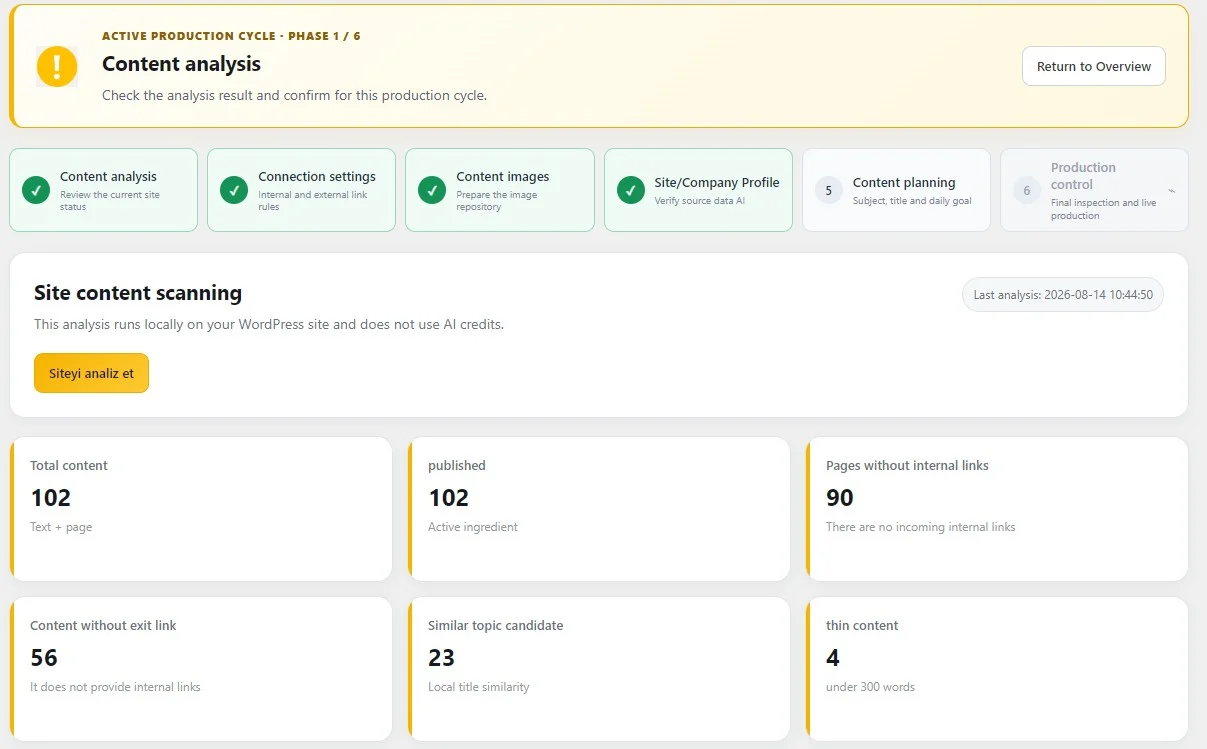
- Analyse existing content
- Detect possible topic similarity
- Improve approved content
- Monitor monthly content usage and remaining credits
The plugin does not guarantee search rankings, traffic, sales or inclusion in AI-generated answers. No responsible SEO tool can promise these outcomes.
PW SEO Content instead provides the planning, production and control tools needed to create clearer, more organised and more useful website content.
How Does PW SEO Content Work?
PW SEO Content follows a structured process rather than generating unrelated articles one by one.
A typical workflow includes the following stages:
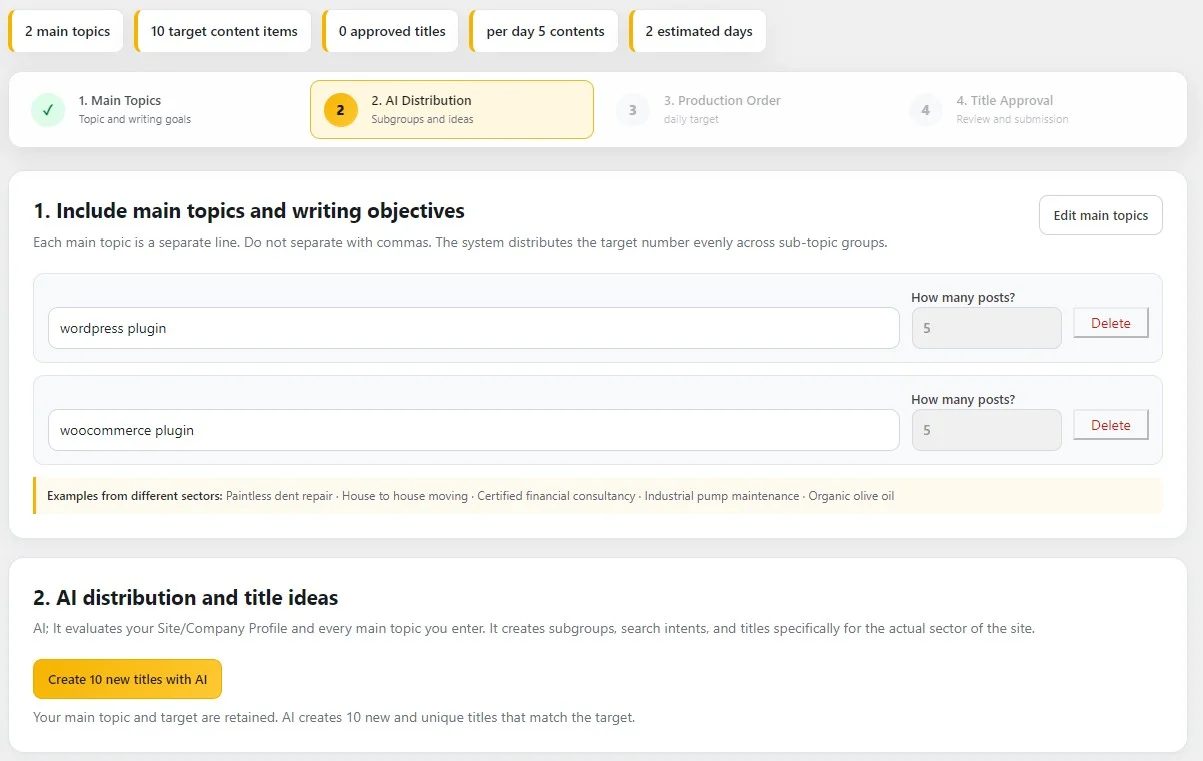
1. The administrator enters accurate company and website information.
2. The main topics relevant to the website are defined.
3. The plugin produces title and content suggestions based on that context.
4. The user reviews, removes or approves the proposed titles.
5. Relevant internal-link targets are selected.
6. Images and publishing preferences are configured.
7. Approved content is added to the production queue.
8. The assigned Luna or Terra model generates the content.
9. Completed operations can be reviewed through reports and history records.
10. Existing content can be analysed and improved through a separate controlled process.
This approach makes the production process easier to inspect. The website owner can see which subjects are planned, which articles are waiting, which operations are completed and how much monthly capacity remains.
Why Company and Site Information Matters
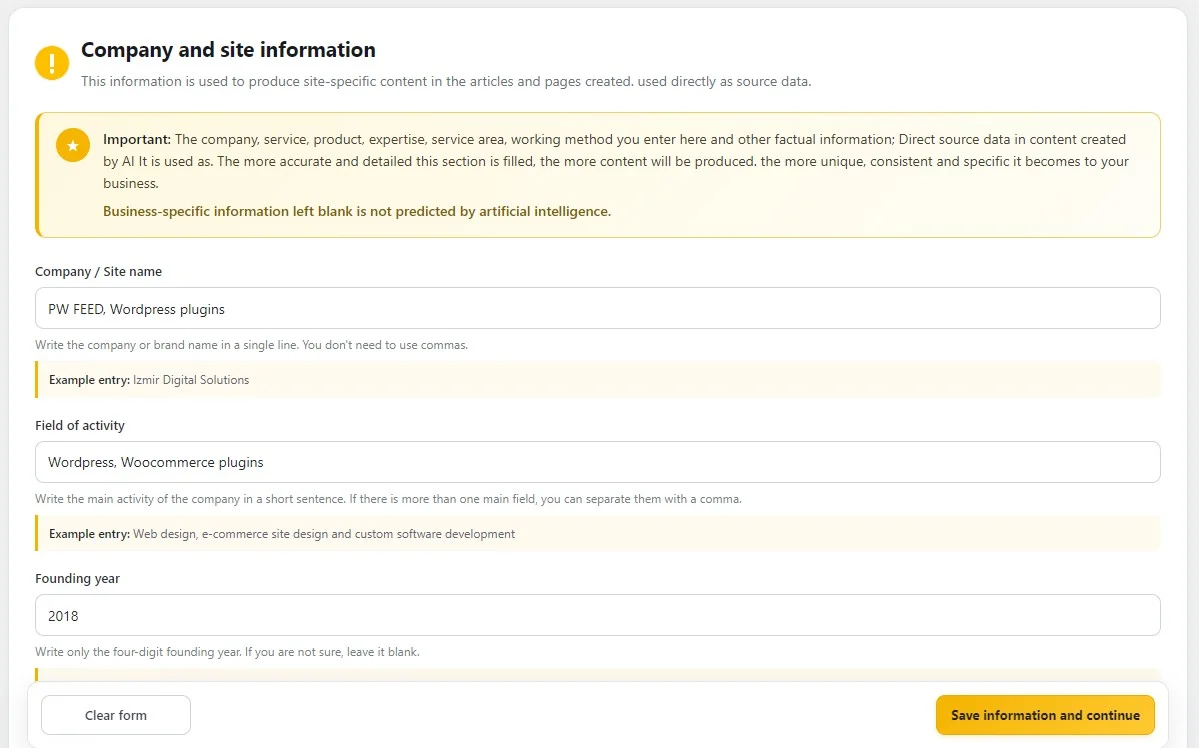
The “Company and Site Information” section provides the factual foundation for content production.
This section should describe:
- What the company does
- Which products or services it provides
- Who its customers are
- Which industries or markets it serves
- Which geographical regions it covers
- What makes its products or services different
- Which subjects the website should focus on
- Which claims, subjects or expressions should be avoided
The information should be specific, factual and easy to verify.
For example, “We provide excellent solutions for everyone” offers very little useful context. A clearer description would be:
PW Feed develops WordPress and WooCommerce plugins for product-data management, content operations, website security and business automation. Its solutions are designed for store owners, website administrators, agencies and e-commerce teams that need controlled workflows inside WordPress.
PW SEO Content is designed to use the facts provided in this section. Missing company details should not be replaced with invented addresses, certifications, customer numbers, awards or business claims.
Accurate input helps the system produce content that better reflects the real company, audience and website.
Luna and Terra AI Content Models
PW SEO Content supports Luna and Terra as two separate content-production options.
Luna

Luna is the standard model and the more economical choice. It is suitable for websites that need direct, focused and regularly produced articles.
A typical Luna article is approximately 600–800 words, depending on the subject and required structure.
Luna may be suitable for:
- Supporting blog posts
- Focused questions and answers
- Product-category explanations
- Short guides
- Local service subjects
- Regular content schedules
- Websites with controlled production budgets
Terra
Terra is intended for subjects that require greater depth and broader coverage.
A typical Terra article is approximately 1,000–1,200 words, although the final length can vary according to the topic.
Terra may be suitable for:
- Detailed guides
- Competitive search subjects
- Comprehensive product explanations
- Educational resources
- Multi-section technical articles
- Cornerstone or supporting authority content
Can Users Switch Between Luna and Terra?
No. Luna and Terra are not uncontrolled front-end preferences.
The authorised model is assigned to the customer’s licence by the PW SEO Super Admin system. Once a model has been assigned, the plugin uses that model throughout the relevant production, planning, analysis and improvement operations.
A Luna-authorised account cannot submit a Terra production request simply by changing a browser value or a saved setting. The model assignment is verified during the operation.
This protects the agreed package structure and helps prevent unexpected AI usage costs.
Luna is the standard option. Terra can be assigned as an optional higher-capacity model when the customer’s plan requires it.
Customer-Specific Monthly Content Limits
Different websites do not always need the same amount of content.
For this reason, PW SEO Content supports customer-specific monthly limits. A licensed customer may be assigned a monthly capacity such as 50, 100, 150 or 200 content credits, depending on the selected package.
The limit is managed centrally rather than being permanently fixed inside every installation.
The system can display:
- The customer’s monthly limit
- Used credits
- Remaining credits
- Current period information
- Production history
- Operation status
This structure allows different packages to be created without distributing a separate plugin version for every monthly limit.
It also helps agencies and service providers match content capacity to the actual requirements of each website.
SEO Content Planning Instead of Random Article Generation
Publishing more pages is not automatically an effective SEO strategy.

A website can contain hundreds of articles and still perform poorly if those articles repeat the same search intent, target irrelevant subjects or fail to connect with important commercial pages.
PW SEO Content is built around planned production.
The administrator can define main topics and review suggested titles before production begins. This provides an opportunity to remove unsuitable ideas, identify repeated subjects and prioritise content that supports the website’s real purpose.
A useful content plan should include different search intentions, such as:
- Informational questions
- Product or service comparisons
- Problem-solving guides
- Commercial investigation topics
- Installation and usage questions
- Industry terminology
- Customer concerns
- Maintenance and troubleshooting subjects
The goal is not to insert the same keyword into every article. The goal is to create a useful group of related pages that answer different questions clearly.
SEO and GEO Content Optimisation
SEO helps search engines understand, index and evaluate website content. GEO, or generative engine optimisation, helps content become easier for AI-powered search and answer systems to interpret and reference.
These disciplines overlap, but they are not identical.
A page prepared for both SEO and GEO should:
- Answer the main question early
- Use clear and descriptive headings
- Define products, companies and technical terms explicitly
- Separate important subjects into logical sections
- Provide concise answers to specific questions
- Use natural language instead of keyword repetition
- Include relevant examples and limitations
- Maintain consistent entity and product names
- Link to useful supporting pages
- Avoid unsupported claims
- Remain understandable when a section is read independently
PW SEO Content supports this approach by organising content around a defined company profile, approved topics, structured headings and relevant internal links.
However, GEO should not be interpreted as guaranteed inclusion in ChatGPT, Google AI Overviews, Gemini, Copilot or another answer engine. These platforms control their own crawling, retrieval, evaluation and citation processes.
The practical objective is to publish content that is clear, factual, well organised and easy for both people and machines to understand.
Internal Link Management
Internal links help visitors and search engines discover related pages. They also explain how different subjects, services, products and resources are connected.
PW SEO Content can use existing WordPress resources as internal-link targets, including:
- Posts
- Pages
- Categories
- Relevant website sections
Administrators can search and filter available targets, define their priority, enter appropriate anchor text and control how frequently links may be used.
This is important because uncontrolled automatic linking can create poor results. The same commercial page may be linked too often, an unsuitable anchor may be repeated across many articles or unrelated pages may be connected simply because they share one word.
A controlled internal-link plan should answer three questions:
1. Is the destination genuinely relevant to the current article?
2. Does the anchor text explain what the visitor will find?
3. Does the link help the visitor continue the subject logically?
PW SEO Content assists with the workflow, but the administrator remains responsible for reviewing important link relationships.
Content Similarity Analysis
Websites often publish overlapping articles without realising it.

For example, “How to create SEO content with AI” and “How AI can generate SEO articles” may target nearly the same search intention. If both pages offer substantially similar answers, they can compete with each other or create an unclear content structure.
PW SEO Content includes local similarity analysis to help identify this type of risk.
The analysis can display:
- A similarity-risk percentage
- Related content
- Possible reasons for the result
- Subjects that may require review
- A similarity percentage is a decision-support indicator. It is not a Google penalty score, a plagiarism verdict or a final search-engine decision.
A high similarity result does not always mean that one page must be deleted. The pages may serve different audiences, locations, products or stages of the customer journey.
The administrator should compare:
- Primary search intent
- Target audience
- Main answer
- Page structure
- Keyword context
- Internal-link purpose
- Conversion objective
The analysis helps users locate possible overlap more efficiently, while the final editorial decision remains with the website owner.
Improve Existing WordPress Content
Content improvement should not mean replacing a live article without review.
PW SEO Content provides a controlled improvement workflow for existing WordPress content. The user can analyse an article, review the suggested changes and decide whether an improved version should replace the current text.
During this process, important WordPress page properties can be preserved, including the existing URL structure, publication information and relevant media associations.
This is valuable because changing a successful URL unnecessarily can create broken links, lost references or avoidable SEO migration work.

Existing content may require improvement when:
- Information has become outdated
- The main answer is unclear
- Important subtopics are missing
- Headings do not reflect user questions
- The article overlaps with another page
- Internal links are weak
- The introduction is too general
- The content no longer matches the company’s services
- The page needs a clearer FAQ section
AI-generated improvements should still be reviewed by a person who understands the business and subject.
WordPress Media and Image Control
Images can improve readability, illustrate processes and help readers understand complex subjects.
PW SEO Content can work with the WordPress media environment so that suitable existing images can be considered during content production.
Using the existing media library offers several advantages:
- Brand-approved images can be reused
- Duplicate uploads can be reduced
- Existing media management remains inside WordPress
- Administrators retain greater control
- Previously prepared product or interface images can support relevant articles
Images should be selected for relevance rather than decoration alone. File names, alternative text and surrounding explanations should describe the real image accurately.
Alternative text should not be filled with unrelated keywords. Its primary purpose is to explain meaningful visual content to users who cannot see the image.
Production Queue and Scheduling
Producing many long articles in a single browser request is unreliable. Server limits, network interruptions or timeouts can stop the process.
PW SEO Content uses a queue-oriented workflow for approved production plans. Content operations can be processed in controlled stages, with daily limits and scheduled WordPress tasks supporting continuity.
This approach helps administrators:
- Approve titles before production
- Control the daily workload
- Monitor active jobs
- Review completed and unsuccessful operations
- Avoid repeating completed work unnecessarily
- Track start and completion information
Because WordPress scheduling depends on the website environment, reliable cron execution, HTTPS communication and adequate server resources remain important.
Websites with very low traffic may benefit from a properly configured server cron system instead of depending only on traffic-triggered WordPress cron events.
Secure Licence and Operation Verification
PW SEO Content uses a central licence and credit-management structure.
Sensitive operations are not intended to rely only on a visible form field or a locally stored preference. Requests can include security controls such as signed communication, timestamps, unique request values and payload verification.
The plugin also includes a controlled connection-repair process. Repairing a licence connection should not silently create a new free allowance, replace the customer’s authorised package or erase valid usage history.
A secure production workflow should preserve:
- Licence identity
- Assigned AI model
- Monthly capacity
- Used and remaining credits
- Current production records
- Relevant operation history
These controls are particularly important when Luna and Terra have different operating costs.
Who Should Use PW SEO Content?
PW SEO Content may be useful for:
- WordPress website owners
- WooCommerce businesses
- Content teams
- SEO consultants
- Digital agencies
- Local businesses
- Publishers
- Service companies
- Product-focused websites
- Organisations managing several WordPress sites
The plugin is particularly relevant when a business needs regular content but also wants central control over model selection, monthly usage, approved topics and publishing operations.
It is not a replacement for business knowledge, legal review, medical review, technical verification or professional editorial responsibility.
Best Practices for Better Results
For the strongest results with PW SEO Content:
1. Complete the company profile with accurate and specific facts.
2. Define a clear audience for the website.
3. Separate the main commercial subjects from supporting informational topics.
4. Review every proposed title before production.
5. Remove titles that target the same search intent.
6. Assign internal links according to relevance.
7. Use Luna for focused and economical production.
8. Use Terra when a subject genuinely requires greater depth.
9. Review generated claims, names, numbers and technical instructions.
10. Save sensitive or important articles as drafts first.
11. Monitor remaining monthly credits.
12. Analyse existing pages before creating similar new ones.
13. Improve useful URLs instead of publishing unnecessary replacements.
14. Update articles when products, services or industry rules change.
15. Measure content quality through relevance and usefulness, not word count alone.
Frequently Asked Questions
Is PW SEO Content a WordPress AI article generator?
Yes, but it provides more than a basic article-generation form. PW SEO Content combines company information, topic planning, title approval, internal links, production queues, content analysis and improvement tools in one WordPress workflow.
What is the difference between Luna and Terra?
Luna is the standard, economical option for focused content and typically produces approximately 600–800 words. Terra is intended for more comprehensive subjects and typically produces approximately 1,000–1,200 words.
Can a customer switch from Luna to Terra inside WordPress?
No. The authorised model is assigned centrally. A Luna customer cannot independently activate Terra through the plugin interface or by modifying a local request.
Can every customer have a different monthly limit?
Yes. Monthly content capacity can be assigned separately for each licensed customer. Packages can therefore support different limits such as 50, 100, 150 or 200 credits.
Does PW SEO Content publish articles automatically?
It supports planned and scheduled production workflows. Depending on the selected settings, completed content can be handled as a draft or through the authorised publishing process. Important content should be reviewed before public publication.
Can the plugin improve existing articles?
Yes. Existing WordPress content can be analysed and improved through a controlled workflow. The administrator reviews the operation and decides whether the revised content should replace the current version.
Does similarity analysis detect Google penalties?
No. Similarity analysis identifies possible overlap between website content. Its risk percentage is not a Google penalty score or a final search-engine judgment.
Does PW SEO Content support internal links?
Yes. Relevant WordPress posts, pages and categories can be selected as internal-link targets. Administrators can control priority, anchors and usage conditions.
Does the plugin guarantee Google rankings?
No. PW SEO Content does not guarantee rankings, traffic, conversions or inclusion in AI-generated answers. It helps website owners create and manage clearer, more structured content.
Is PW SEO Content suitable for GEO?
The plugin supports many practices useful for generative engine optimisation, including clear company context, structured answers, descriptive headings, factual language, FAQs and connected subject coverage. Final visibility remains under the control of each search or AI platform.
Build a More Controlled WordPress Content Workflow
Artificial intelligence can make content production faster, but speed alone does not create a useful website.
Businesses need accurate company context, relevant subjects, controlled model access, sensible internal links, clear publishing decisions and measurable monthly usage.
PW SEO Content brings these requirements together inside WordPress.
With Luna as the standard economical model, Terra as an optional comprehensive model, customer-specific monthly limits, structured planning, similarity analysis, internal-link management and controlled content improvement, the plugin helps website owners move from random AI generation to an organised content-production system.
The objective is straightforward: create content that answers real questions, supports the website’s purpose and remains under the control of the people responsible for the business.