
AI-powered content workflow for WordPress websites
A successful WordPress content strategy depends on much more than writing articles. Website owners must decide what to publish, which topics matter, how content should support existing pages, when articles should go live, how SEO elements should be handled, and how each new page contributes to the wider structure of the site.
When these tasks are performed manually, content production can become slow and inconsistent.

An AI-powered content workflow changes this process by organizing several stages of content creation into a repeatable system.
Instead of treating every article as a separate project, a WordPress website can use defined rules for topic selection, writing, SEO, GEO, publishing, and quality control. This creates a more structured process where AI performs repetitive tasks while the website owner maintains strategic control.
PW Feed is designed around this type of workflow. By combining AI content generation with a wordpress plugin environment, businesses can simplify content production while keeping their SEO and GEO objectives connected to the broader structure of the website.
What is an AI-powered content workflow?
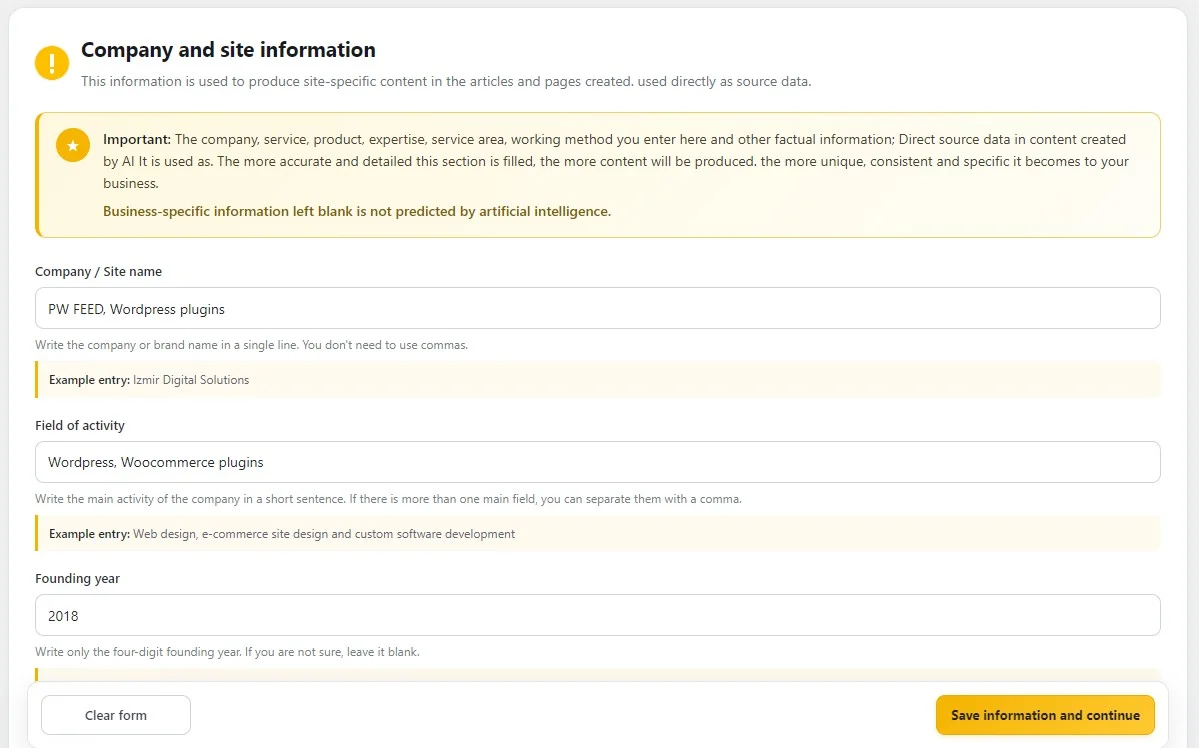
An AI-powered content workflow is a structured sequence of steps used to plan, generate, optimize, review, and publish content with the assistance of artificial intelligence.
The important word is workflow.
AI itself is only one part of the process.
A complete workflow can include:
Topic discovery.
Keyword planning.
Search intent analysis.
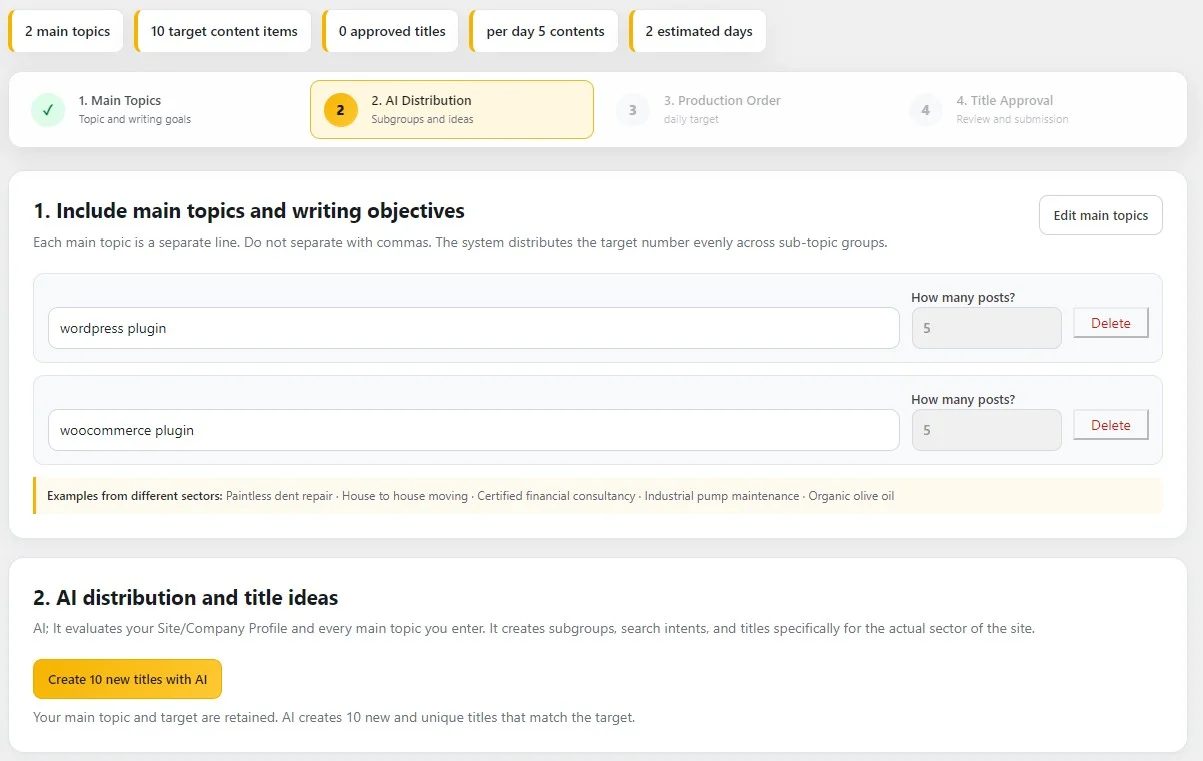
Content generation.
SEO title creation.
Meta description creation.
Internal linking decisions.
Draft or publish selection.
Content review.
Publication scheduling.
Performance monitoring.
Each stage solves a different problem.
When these steps are connected, content production becomes more predictable.
For example, instead of manually choosing a new subject every week, the system may work from a predefined set of relevant topics. Instead of writing every article from the beginning, AI can generate the first complete version. Instead of manually preparing metadata, the workflow can create SEO elements based on the article.

The result is a repeatable content process rather than a collection of disconnected tasks.
Why WordPress is suitable for AI content workflows
WordPress already contains many of the components required for structured content management.
Posts can be created as drafts or published immediately.
Pages can be organized by category.
Publication dates can be controlled.
Users can manage content roles.
Internal links can connect related resources.
SEO metadata can be associated with individual pages.
A wordpress plugin can integrate AI functionality directly into this environment.
This is important because the content does not need to be created in one application and transferred manually to another.
The entire process can remain closer to the WordPress publishing environment.
For businesses that publish regularly, removing unnecessary steps can save significant time.
The easier the workflow becomes, the more realistic it is to maintain long-term consistency.
A workflow should begin with content objectives
Before AI generates anything, the website should define what it wants to achieve.
Different websites have different content goals.
A local business may want to answer common customer questions.
A software company may need educational content around product features.
An agency may want to publish articles that demonstrate expertise.
An e-commerce website may need informational content that supports product categories.
A niche publisher may want to cover a subject more comprehensively.

The workflow should reflect these objectives.
Without a clear objective, AI may generate content that is technically correct but strategically useless.
For example, if a WordPress website focuses on AI automation, articles about unrelated technology news may add little value.
A stronger content workflow keeps the subject area controlled.
PW Feed content can therefore remain connected to topics such as WordPress, AI content creation, SEO, GEO, publishing automation, content strategy, search visibility, and wordpress plugin functionality.
Topic selection should be systematic
Choosing the next article topic manually can be one of the most time-consuming parts of content production.
An AI-powered workflow can make topic planning more systematic.
Instead of selecting topics randomly, the website can build a structured content map.
This map may include broad subjects, supporting articles, user questions, commercial pages, informational pages, and related subtopics.
For example, a WordPress AI content project may include separate subjects such as automatic blog publishing, SEO-friendly post creation, content workflows, metadata generation, internal linking, duplicate content prevention, GEO, content clusters, and AI search visibility.

These topics belong to the same general field but answer different questions.
This distinction is important for SEO.
If several articles target nearly identical search intent, they may compete with each other.
A structured workflow helps prevent this by assigning a clear purpose to each topic before content generation begins.
Search intent should guide every article
Search intent describes what a user expects to find when searching for a particular phrase.
This should influence both the title and the content.
Someone searching for an AI-powered content workflow for WordPress websites is likely interested in the process itself.
That person may want to know:
How AI fits into WordPress publishing.
Which stages can be automated.
How to maintain content quality.
How SEO can be included.
How GEO affects the workflow.
Whether content should be saved as a draft.
How internal links can be managed.
How the process can scale.
The article should therefore focus on workflow design rather than simply explaining what AI is.
This distinction makes the content more relevant.
Search intent also helps prevent repetitive pages.
Two articles may include similar keywords but still serve different users if their intent is different.
AI should work from website context
Generic AI content is easy to produce.
Relevant AI content requires context.

A useful workflow should provide the AI system with information about the website.
This may include the business type, products, services, target audience, preferred terminology, geographic relevance, content categories, and existing pages.
The more relevant context the system has, the more consistent the output can become.
For example, an article written for a local service company should not sound like content for a global software platform.
A page for an e-commerce website should not use the same structure as a professional consulting site.
AI should adapt to the environment in which the content will be published.
This is also important for GEO.
Generative systems benefit from clear entity relationships.
When content consistently connects a business name, product, service, platform, and subject area, the information becomes easier to interpret.
PW Feed can support a content process where WordPress context remains central to article generation.
Content generation should follow defined rules
AI content becomes more consistent when the workflow includes clear writing rules.
These rules can define:
Minimum content depth.
Preferred tone.
Target keywords.
Topics that should be avoided.
Required business terminology.
Linking preferences.
Publishing status.
SEO requirements.
GEO requirements.
The goal is not to make every article look identical.
In fact, excessive template use can make a website feel repetitive.
The purpose of rules is to maintain quality while still allowing each article to develop naturally around its specific subject.
A strong workflow controls the important elements but leaves enough variation for originality.
SEO should be built into the workflow
SEO should not be added after the article is finished.
It should influence the process from the beginning.
The topic should be selected with search relevance in mind.
The title should match user intent.
The article should cover related concepts.
Keywords should appear naturally.
Metadata should be unique.
Internal links should support related pages.
The content should be useful enough to justify its existence.
This approach is much stronger than writing an article first and then trying to insert SEO elements afterward.
An AI-powered WordPress workflow can automate parts of this process.
For example, it can create a draft title based on the topic, generate a relevant meta description, identify supporting keyword variations, and prepare content around the intended search question.
A wordpress plugin can help connect these stages directly with the WordPress publishing system.
GEO should also be part of the workflow
Generative Engine Optimization adds another layer to content planning.
Search behavior increasingly includes AI-generated answers, conversational search, and generative discovery systems.
These systems often depend on content that is clear, direct, well organized, and easy to interpret.
A GEO-oriented workflow should therefore encourage:
Clear definitions.
Direct explanations.
Consistent terminology.
Logical relationships between concepts.
Identifiable entities.
Useful factual statements.
Natural question-and-answer coverage.
This does not require making content robotic.
The opposite is often true.
Clear human-readable explanations can also be easier for AI systems to understand.
For PW Feed, SEO and GEO can be treated as complementary goals.
SEO helps connect content with traditional search queries.
GEO helps prepare the same content for generative search environments.
Draft mode creates a safer workflow
Many businesses prefer to review AI-generated content before publication.
Draft mode makes this possible.
The AI system can prepare the article automatically and save it inside WordPress without making it public.
The website owner can then review the result.
This stage is useful for checking:
Business-specific statements.
Brand terminology.
Links.
Examples.
SEO titles.
Meta descriptions.
Content overlap.
Accuracy.
Once the content is approved, it can be published manually.
Draft-first workflows are especially useful during the early stages of AI content automation.
They allow the business to refine its instructions before moving toward greater automation.
Automatic publishing can increase efficiency
Once a workflow becomes reliable, some websites may choose to publish selected content automatically.
This can reduce administrative work.
For example, informational articles in approved topic categories may be generated and published according to predefined limits.
The system may publish a certain number of articles per day or per month.
This creates consistency without requiring manual action for every post.
However, automatic publishing should not mean unlimited publishing.
The workflow should still include controls.
A website should avoid producing more content than it can justify.
Quality and relevance remain more important than volume.
Content review should be built into automation
AI-generated content should not be assumed to be perfect.
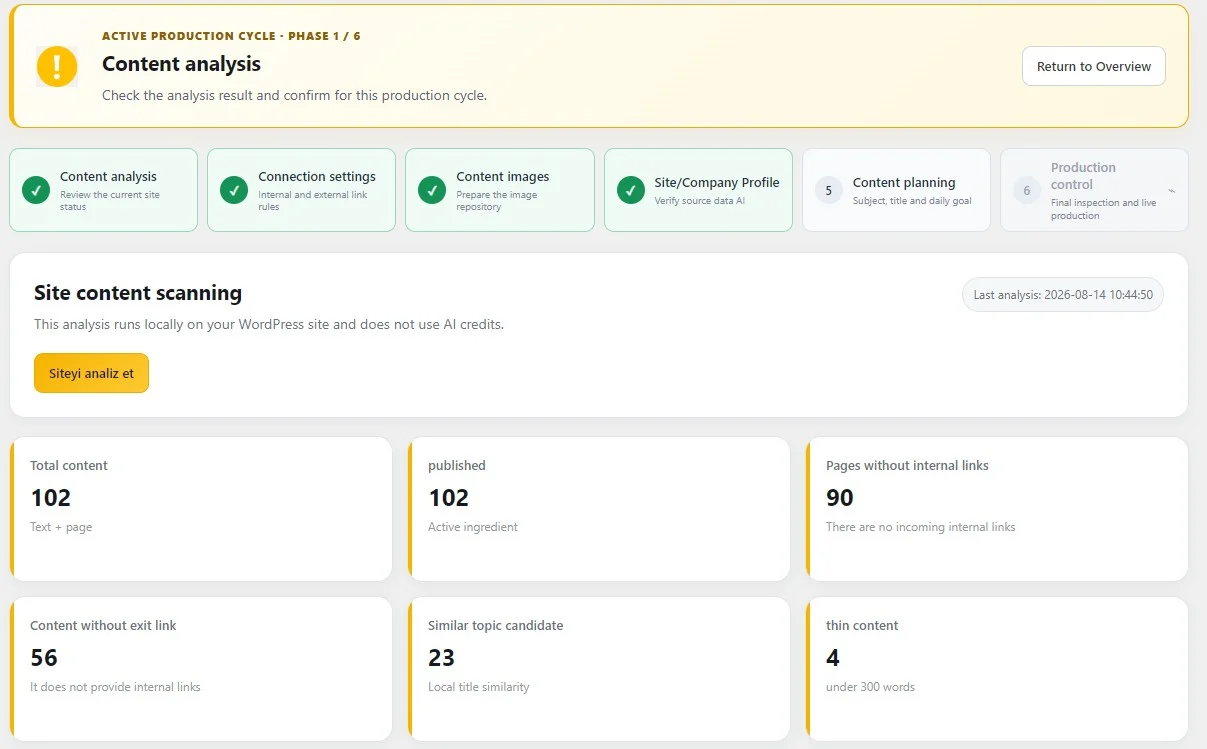
Even when articles are generated automatically, quality checks remain important.
A structured workflow can include several review criteria.
Does the article match the assigned topic?
Is the title unique?
Does the content overlap with another page?
Are the target terms used naturally?
Does the article contain enough depth?
Are the links relevant?
Is the information consistent with the website?
Does the content support SEO and GEO goals?
These checks reduce the risk of publishing weak content at scale.
The faster a system can create articles, the more important these controls become.
Internal linking should happen strategically
Internal links help connect content across a website.
An AI-powered workflow can assist with this process, but it should avoid random linking.
Links should support the user journey.
For example, an article about WordPress content workflows may link naturally to pages about automatic publishing, SEO-friendly content generation, or AI search optimization.
These connections create a stronger site structure.
Search engines can use internal links to understand relationships between pages.
Users can discover additional information.
Generative systems may also benefit from a clearer content network.
The best internal links are those that genuinely help the reader continue exploring the subject.
Metadata should be generated with each page
SEO titles and meta descriptions should be part of the workflow.
Creating them separately for every article can become repetitive.
AI can assist by generating metadata based on the actual subject of the page.
However, metadata should remain unique.
If multiple articles use nearly identical titles and descriptions, page differentiation becomes weaker.
The workflow should therefore treat uniqueness as a requirement.
A page about AI-powered WordPress content workflows should not use the same description as a page about automatic blog publishing.
Each page should communicate its specific value.
Workflow automation can improve consistency
One of the strongest advantages of a structured AI process is consistency.
Human teams can experience changes in workload, writing style, availability, and priorities.
A well-designed workflow can maintain stable rules.
Every article can follow the same basic quality expectations.
This does not mean every article should sound identical.
Consistency refers to standards, not sameness.
Topics can vary.
Introductions can vary.
Examples can vary.
Article structures can vary.
But the overall level of relevance, clarity, SEO quality, GEO readiness, and publishing discipline should remain stable.
Content workflows can scale more easily
Manual content production becomes difficult when the number of websites or articles increases.
An agency managing ten WordPress websites faces a different challenge from a business managing one site.
AI workflows can help scale repeated tasks.
The same system can apply different business profiles, topic lists, and publishing rules to different websites.
Each site can maintain its own context while benefiting from automated production.
This makes AI especially useful for agencies, multi-site operators, niche publishers, and businesses with multiple brands.
Scalability should not mean copying the same article across different websites.
Each site should maintain unique content based on its own context.
A content workflow should avoid duplication
Automation can create duplication if it is not controlled.
Two different topics may accidentally produce similar articles.
This is especially common when keyword lists are too narrow.
The workflow should therefore consider existing content before creating new pages.
If a topic has already been covered, the system can choose a different angle or avoid generating another article.
This helps reduce keyword cannibalization.
It also improves user experience because visitors do not encounter multiple pages containing nearly the same information.
Originality should be measured by search purpose as well as sentence structure.
A workflow should adapt over time
Content strategies change.
A business may launch a new product.
A service may become more important.
Search demand may shift.
New AI search systems may emerge.
Old content may need updating.
The workflow should be flexible enough to respond.
Topic lists should not remain fixed forever.
Website profiles may need adjustment.
Publishing frequency may change.
SEO and GEO priorities may evolve.
AI automation works best when it supports an active strategy rather than replacing one.
The system should make changes easier to implement across the publishing process.
PW Feed and structured content automation
PW Feed supports the idea that AI content generation should operate as part of a structured WordPress workflow.
The objective is not simply to create text.
The objective is to connect content creation with WordPress, publishing control, SEO, GEO, website context, and long-term content development.
Businesses interested in learning more about WordPress AI content workflows and PW Feed can visit the PW Feed contact page.
Users who want to review available purchase options can continue to the PW Feed buy page.
Why workflow design matters more than individual prompts
Many people begin AI content creation by experimenting with prompts.
Prompts are useful, but they are only one part of the system.
A good prompt may generate one strong article.
A good workflow can generate consistent results over time.
The workflow defines:
What should be written.
When it should be written.
Why the article exists.
Which keywords are relevant.
Which site information must be considered.
Whether the article should be a draft.
How SEO elements should be handled.
How GEO principles should be applied.
How duplication should be prevented.
This broader structure creates reliability.
The website owner no longer depends on inventing a new prompt every time content is needed.
AI automation should reduce complexity
Technology should make content publishing easier.
If an AI system adds more steps than it removes, the workflow may not be efficient.
A useful WordPress setup should reduce repetitive actions.
Topic information, business context, publishing preferences, and content rules can be defined once and reused.
The website owner can focus on strategy while the system handles repeated production tasks.
This is one of the strongest practical benefits of integrating AI through a wordpress plugin.
The content stays close to the publishing environment.
The process becomes easier to manage.
SEO, GEO, and automation should support the same goal
It is easy to treat SEO, GEO, and AI automation as separate subjects.
In practice, they can support the same objective.
The website wants its information to be discovered, understood, and useful.
SEO supports visibility in traditional search.
GEO supports visibility and interpretation in generative environments.
Automation supports the production process.
When these areas are planned together, the result can be stronger than using them independently.
A content workflow can create pages that are useful for users, understandable to search engines, and clearer for AI systems.
Final thoughts on AI-powered WordPress content workflows
An AI-powered content workflow for WordPress websites is not simply a faster way to write articles.
It is a method for organizing the entire content production process.
The strongest workflows begin with clear objectives.
They use website context.
They define separate search intents.
They generate content according to quality rules.
They integrate SEO and GEO.
They create unique metadata.
They support internal linking.
They allow draft review or controlled automatic publishing.
They prevent unnecessary duplication.
They adapt when business priorities change.
PW Feed brings these principles into the WordPress environment through an AI-focused wordpress plugin approach.
For website owners, the real benefit is not only speed.
The larger advantage is consistency.
A structured workflow can turn content production from an irregular manual activity into a controlled system that supports long-term organic visibility and AI-driven discovery.
When AI is used within a clear process, each article can contribute to a broader content strategy instead of existing as an isolated piece of text.