
How AI can improve content consistency across a WordPress site
A WordPress website can contain hundreds of individual pages, blog posts, service descriptions, product explanations, guides, and informational resources. Each page may be useful on its own, but the website becomes significantly stronger when those pages also feel like parts of the same information system.
Content consistency helps create that connection.

A consistent website uses recognizable terminology, maintains a stable level of quality, presents products and services accurately, follows similar editorial standards, and avoids contradicting information between different pages.
This becomes increasingly difficult as a WordPress site grows.
Several people may create content at different times. Older articles may use terminology that is no longer preferred. New pages may describe the same service differently. SEO titles can become repetitive. Articles may overlap in search intent. Important business information can gradually become inconsistent.
Artificial intelligence can help reduce these problems when it is used within a controlled content framework.
PW Feed can support WordPress website owners who want to combine AI content generation with SEO, GEO, business context, editorial rules, and wordpress plugin functionality. Instead of using AI only to create additional articles, the same technology can help maintain greater consistency across the entire content environment.
The objective is not to make every page identical.
The objective is to make every page belong clearly to the same website.
What does content consistency actually mean?
Content consistency is broader than writing style.
It includes several different elements.
The website should describe the business accurately.
Product names should remain stable.
Services should use recognizable terminology.
Important facts should not change from one article to another without a reason.
The tone should remain appropriate for the brand.
SEO principles should be applied consistently.
GEO-oriented entity relationships should remain clear.
New articles should not unnecessarily repeat older pages.
Calls to action should lead users toward appropriate destinations.
Together, these elements create a coherent experience.
A visitor moving between several pages should not feel that each article belongs to a completely different company.
Search engines should also be able to identify stable relationships between topics.

AI-powered discovery systems benefit from the same clarity.
Consistency is not the same as duplication
This distinction is essential.
A website can be consistent without repeating the same content.
In fact, excessive repetition is one of the problems a good consistency strategy should prevent.
Suppose a WordPress site uses the same explanation of AI content generation in twenty articles.
The terminology may be consistent, but the information has become repetitive.
A stronger approach keeps important definitions stable while allowing each article to explore a different subject.
For example, one article may focus on automatic drafts.
Another may discuss internal linking.
Another may explain GEO.
Another may focus on content freshness.
The language describing PW Feed can remain accurate across all of them, but the purpose of each article is different.
Consistency provides common foundations.
Originality provides individual value.
Both are necessary.
Why large WordPress sites often become inconsistent
Content inconsistency usually develops gradually.
A website may begin with ten carefully prepared pages.
Several months later, new blog articles are added.
A new employee writes some of them.
An agency creates others.

An older product name remains in historical content.
A new service description appears on the homepage but not in related articles.
Different authors use different terms for the same feature.
No single mistake appears serious.
Over time, however, the website begins to contain conflicting signals.
This problem becomes even more important when content production increases.
AI can generate articles quickly, which means inconsistency can also scale quickly if rules are not defined.
The solution is not simply producing less content.
The solution is establishing a stable content framework.
A central business profile can create a common foundation
One of the strongest ways to improve consistency is to maintain a defined source of business information.
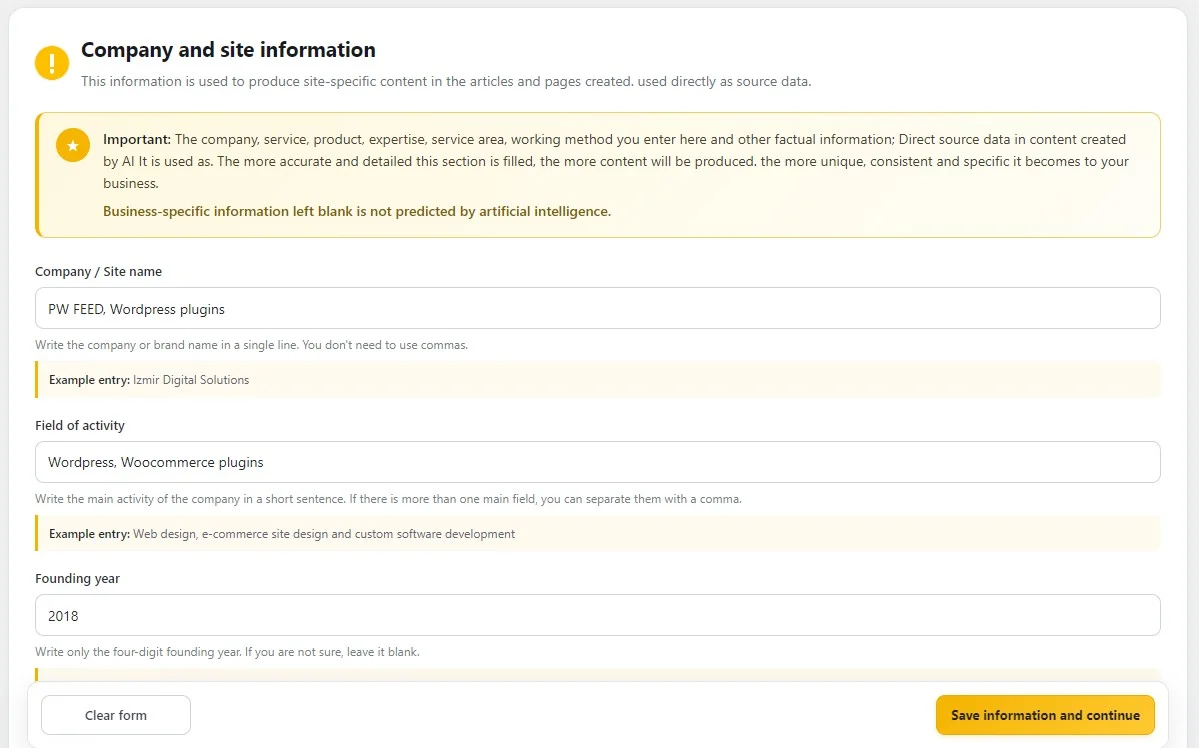
This profile may contain:
Business name.
Product names.
Primary services.
Target customers.
Important terminology.
Geographic information.
Core features.
Commercial links.
Statements that should not be made.
Preferred brand descriptions.

AI can use this information during content generation.
Instead of reconstructing the business context for every article, the system begins from the same verified foundation.
This reduces variation in important facts.
For PW Feed-related content, the consistent relationship between PW Feed, WordPress, AI content generation, SEO, GEO, automation, and wordpress plugin functionality helps build a clearer identity across the site.
Preferred terminology should be defined
Many companies use several possible expressions for the same concept.
Some variation is natural.
Too much variation can create confusion.
Suppose one article describes a function as automatic content generation.
Another calls it autonomous website writing.
Another calls it automated editorial intelligence.

A fourth uses AI article production.
If these expressions refer to exactly the same feature, users may wonder whether they describe different things.
A content framework can define preferred terminology.
The main phrase remains stable.
Related variations can still appear where they help SEO or readability.
This creates semantic consistency without forcing every sentence to use identical wording.
AI can apply terminology rules automatically
Applying terminology manually across dozens of articles is difficult.
Editors may forget.
Freelance writers may not know the preferred wording.
Older posts may follow a different standard.
AI can reduce this burden.
Preferred product names, service terms, abbreviations, and descriptions can become part of the generation instructions.
Every new article begins with these rules.
The editor does not need to correct the same terminology repeatedly.
This becomes increasingly valuable as publishing volume grows.
The purpose of automation is not only to write faster.
It can also make recurring editorial rules easier to enforce.
Consistent content begins with consistent topic planning
Website inconsistency is not only about language.
It can also appear in the subjects being published.
A WordPress site may produce many articles around one small area while ignoring other important topics completely.
Another site may publish unrelated subjects simply because individual keywords appear attractive.
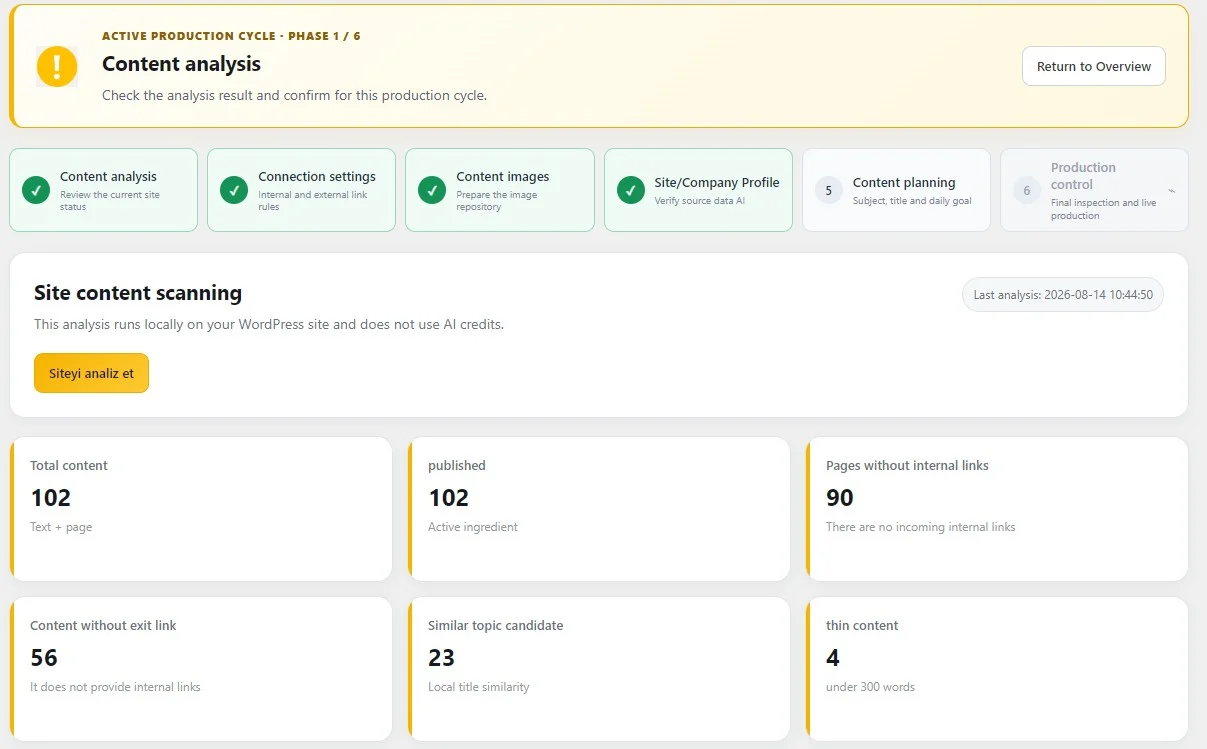
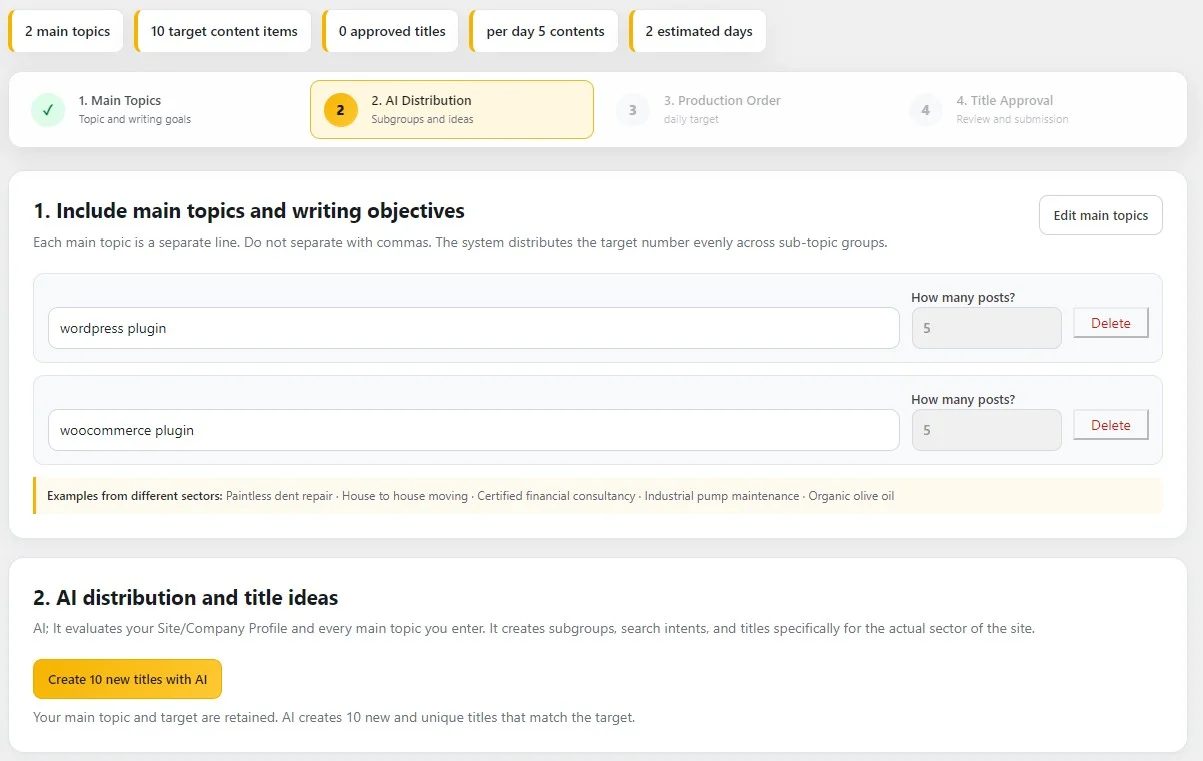
A stronger content strategy organizes topics into defined groups.
For PW Feed, these groups might include WordPress AI content, publishing automation, SEO, GEO, content strategy, internal linking, metadata, and AI search visibility.
New articles can be assigned to one of these areas.
This creates a recognizable editorial direction.
The website develops depth rather than randomness.
Search intent should remain distinct across pages
Content consistency can be damaged when multiple articles target the same user intention.
The site may look active, but its information architecture becomes confusing.
For example:
How to automate WordPress content.
WordPress automatic content with AI.
AI automation for WordPress publishing.
Automated WordPress AI content.
These phrases may support one or several distinct pages depending on their actual purpose.
If all four articles answer exactly the same question, they create unnecessary overlap.
A consistent site architecture separates search intent.
Each page should have a clear role.
AI can assist with this process by using predefined topic lists and checking whether similar subjects have already been assigned.
Consistent quality matters as much as consistent terminology
A website can also feel inconsistent when content depth changes dramatically.
One article may provide 2,000 words of detailed information.
Another important page may contain only three vague paragraphs.
A third may be filled with generic marketing language.
This variation affects user experience.
A content standard can establish minimum expectations.
Articles may need to answer the primary query clearly.
Important terminology should be explained.
The article should provide enough depth for the subject.
SEO and GEO should be incorporated naturally.
Business claims should remain accurate.
These standards create a more predictable quality level.
AI can apply them repeatedly.
AI can help maintain a consistent tone
Brand tone does not need to be rigid.
Different subjects may require different levels of technical detail.
However, the overall communication style should remain recognizable.
A professional software website may prefer clear, informative, direct language.
A technical audience may expect greater detail.
A consumer-oriented website may need simpler explanations.
AI can work with a defined tone profile.
This helps reduce abrupt differences between articles produced at different times.
The system can avoid overly promotional phrases if the brand prefers an educational style.
It can also maintain a similar degree of formality.
This is particularly useful when several contributors are involved.
Consistency should extend to SEO titles
SEO titles are small elements with a large structural role.
A growing WordPress website may accidentally create titles that are too similar.
For example:
AI WordPress content automation.
WordPress AI content automation guide.
AI content automation for WordPress.
The pages may be different, but the titles make their purposes difficult to distinguish.
A consistent SEO strategy should create clear differentiation.
Each title should communicate what is unique about the page.
AI can help generate titles based on the specific search intent rather than simply repeating the site’s main keyword.
This improves both consistency and originality.
Meta descriptions should reflect individual page purposes
Meta descriptions can suffer from the opposite problem.
Automated websites sometimes use highly similar descriptions for many pages.
This creates a repetitive search presentation.
A better approach keeps the style consistent while changing the message according to the page.
An article about automatic drafts should describe draft generation.
A page about content consistency should describe consistent terminology, quality, or site-wide content control.
A GEO article should emphasize generative search visibility.
The brand voice remains recognizable, but the informational purpose changes.
AI can generate these descriptions as part of the same content workflow.
Internal linking can create structural consistency
A coherent WordPress site is not simply a collection of pages.
The pages should relate to each other.
Internal links help express these relationships.
A broad article can link to detailed supporting pages.
A discussion about SEO can connect to a page explaining metadata.
A GEO article can link to content about AI search visibility.
This creates pathways.
Users can continue exploring the subject.
Search engines can better understand the hierarchy.
Generative systems can encounter repeated relationships between entities and concepts.
Internal linking therefore contributes to consistency at the website level.
Internal links should not be added mechanically
Automation can make internal linking easier, but it can also create excessive links.
A keyword should not automatically become a link every time it appears.
The destination should add useful information.
Context matters.
A good AI workflow can identify relevant page relationships while limiting unnecessary repetition.
This produces a cleaner structure.
Consistency comes from logical relationships, not from turning every article into a dense network of links.
GEO depends heavily on consistent entity descriptions
Generative Engine Optimization introduces another reason to maintain stable business information.
AI-powered systems may encounter multiple pages from the same website.
If each page describes the company differently, the relationships can become harder to interpret.
Consistent entity descriptions help.
The website should communicate clearly:
What the company is.
What the product is.
What services or functions it provides.
Which platform it works with.
Which areas of expertise are relevant.
For PW Feed, content can consistently reinforce that PW Feed operates in the WordPress ecosystem and relates to AI content creation, SEO, GEO, content automation, and wordpress plugin workflows.
The surrounding article can change completely.
The underlying entity relationship remains stable.
Geographic information should also remain consistent
Local and regional websites need particular care.
One page may list a business as operating in a specific city.
Another may describe a broader service region.
A third may introduce a location that is not genuinely served.
These inconsistencies can confuse users.
They can also weaken GEO clarity.
Approved geographic information should therefore become part of the content profile.
AI should use only verified locations when business geography is relevant.
This is especially important when automatically creating local content.
The system should not expand geographic claims simply because location keywords exist.
AI can reduce conflicting service descriptions
Services often evolve.
A company may change the scope of a product or introduce a new feature.
Older articles can remain online with outdated descriptions.
This creates inconsistency.
AI can help identify content that references older terminology or outdated service information.
The website can then prioritize updates.
This turns AI from a pure content-generation tool into a content-maintenance assistant.
For established WordPress sites, maintenance can become as important as new production.
New content should consider old content
A consistent website treats every new article as part of an existing system.
Before a page is created, several questions are useful.
What has already been published?
Which terminology is currently used?
Which page owns the main search intent?
Where will the new article fit?
Which existing content should it support?
This prevents each article from starting from zero.
AI generation can be informed by the website’s existing context.
The result is more likely to complement older content rather than compete with it.
Old content should not be frozen forever
Consistency does not mean preserving outdated pages because they were written first.
A content framework should evolve.
If terminology changes, important older pages can be updated.
If the product develops, descriptions can be revised.
If two older articles overlap, they can be consolidated.
If GEO becomes a larger strategic priority, important content can be improved to provide clearer entity relationships.
Consistency is an active process.
It involves keeping the site aligned with its current reality.
A wordpress plugin can bring content rules closer to publishing
Manual consistency becomes harder when the content process happens across many separate tools.
The writer creates an article externally.
Someone else prepares SEO.
Another person adds it to WordPress.
Business rules may be lost during the transfer.
A wordpress plugin can simplify this process by bringing AI content generation closer to the publishing environment.
PW Feed can help apply predefined content rules during generation.
The article can already reflect the site’s terminology, SEO requirements, GEO principles, and intended workflow before it reaches publication.
This reduces opportunities for inconsistency.
Draft mode can protect consistency
Saving AI-generated articles as drafts gives editors an opportunity to compare new content with existing standards.
The reviewer can check:
Does the product description match the rest of the website?
Is the terminology correct?
Does the article overlap with another page?
Is the tone appropriate?
Are locations accurate?
Do links make sense?
Does the SEO title distinguish this page?
Draft review can be particularly useful while a site’s AI rules are still being refined.
Once the rules become reliable, some categories may be suitable for more automation.
Direct publishing requires stronger consistency rules
If articles publish automatically, the system has less opportunity for human correction.
The content profile therefore becomes even more important.
Approved terminology should be clear.
Topic lists should be controlled.
Business facts should come from reliable sources.
Publishing volume should have limits.
Content should be checked against predefined standards before publication.
Automatic publishing can work well, but only when automation applies rules consistently.
The absence of manual review should not mean the absence of editorial standards.
Content consistency can reduce editing costs
Repeated corrections consume time.
If every AI-generated article uses the wrong product term, someone must fix it.
If every writer creates a different service description, an editor must standardize it.
If links are added inconsistently, another review is required.
A well-configured AI system moves these corrections earlier in the process.
Instead of editing the same issue after every article is created, the rule is defined once.
Future content follows it.
This creates operational efficiency.
For agencies and larger WordPress sites, these savings can become significant.
Agencies benefit from site-specific consistency
Agencies managing several WordPress sites have an additional challenge.
Each client requires consistency within its own website, but clients should remain different from one another.
The solution is separate site profiles.
One client may use formal terminology.
Another may have a conversational brand voice.
One may serve a local market.
Another may operate internationally.
One may allow direct publishing.
Another may require approval for every article.
AI can apply consistent rules inside each client site without making all clients sound the same.
This is a crucial distinction for scalable agency content production.
Consistency can strengthen user trust
Users may not consciously analyze terminology across a website, but inconsistencies can still affect trust.
If one page describes a product one way and another page makes a different claim, the visitor may become uncertain.
Stable information creates confidence.
The business appears organized.
The content feels maintained.
The product or service becomes easier to understand.
This is especially important for companies selling technical products where users may research several pages before making a decision.
Consistent information reduces unnecessary confusion during that research.
Consistency helps commercial and informational pages work together
Blog articles and product pages often serve different purposes.
They should not be identical.
However, they should agree on important facts.
An informational article can explain a problem.
The product page can describe the solution.
A comparison article can discuss different approaches.
A contact or purchase page can provide the next step.
The information should connect naturally across these stages.
Readers who want additional information about PW Feed and its WordPress AI content capabilities can continue through the PW Feed contact page.
Users who are ready to evaluate purchasing options can proceed to the PW Feed buy page.
These commercial paths can remain consistent without turning every informational article into a sales page.
Consistency can improve the content review process
A defined standard makes review easier.
Editors no longer need to judge every article from a completely blank framework.
They know the expected terminology.
They know which topics belong on the site.
They know how the product should be described.
They know what geographic claims are permitted.
They know the desired tone.
This makes content approval faster.
AI can handle many standard requirements automatically.
Human review can focus on the parts that genuinely need judgment.
Content rules should be documented rather than assumed
Businesses often rely on unwritten knowledge.
One employee knows which term should be used.
Another knows the correct product description.
A third knows which service areas are real.
When these people create content manually, the system may work.
As soon as production is automated or distributed to more contributors, unwritten rules become a problem.
The important rules should therefore be made explicit.
AI automation creates a strong incentive to formalize them.
Once documented, they can guide every future article.
This is valuable even outside AI.
The business gains a clearer editorial standard.
Consistency makes large content libraries easier to maintain
A website with several hundred pages can become difficult to manage.
Clear topic categories, stable terminology, logical internal links, and predictable metadata make maintenance easier.
The site owner can identify which subject each page belongs to.
Updates can be applied more systematically.
Outdated terminology can be located.
Duplicate content can be consolidated.
Content gaps can be recognized.
AI can assist with this organizational work as the site grows.
The benefit of consistency therefore extends beyond initial publishing.
It affects the long-term maintainability of the entire website.
SEO benefits from a cleaner information structure
SEO is often discussed at the individual page level.
Site-wide consistency also matters.
A clean information architecture can reduce cannibalization.
Stable topic relationships can strengthen clusters.
Internal links can support priority pages.
Unique titles and descriptions make individual pages easier to distinguish.
Semantic terminology remains connected.
This creates a more organized search presence.
AI can support these principles if the system is designed around the whole website rather than isolated content generation.
GEO benefits from repeated clarity, not repeated text
This distinction is especially important.
Generative systems may benefit when important relationships appear consistently across several pages.
However, this does not require copying the same paragraph repeatedly.
The business can express the same underlying relationship in natural ways.
PW Feed is associated with WordPress.
PW Feed supports AI-driven content workflows.
SEO and GEO are important elements of the content approach.
A wordpress plugin connects functionality with the WordPress environment.
These concepts can appear where relevant while each article remains unique.
Consistency is conceptual.
Duplication is textual.
A strong GEO strategy should favor the first without creating the second.
PW Feed and site-wide content consistency
PW Feed can support WordPress website owners who want AI content generation to operate within stable rules.
The site can define business information.
Content topics can be organized.
SEO requirements can remain part of every article.
GEO relationships can be expressed consistently.
Draft and direct publishing rules can be controlled.
A wordpress plugin can reduce the repetitive work required to apply these standards manually.
For businesses, this can transform AI from a simple text generator into part of a wider content management strategy.
The website grows while important foundations remain stable.
Consistency should still allow the website to evolve
A content standard should not become a restriction that prevents improvement.
Products change.
Brands evolve.
SEO priorities shift.
GEO becomes more important.
New terminology appears.
Customer behavior changes.
The content framework should adapt.
When an important rule changes, the system can be updated so future articles follow the new standard.
Older high-value pages can then be revised progressively.
This creates controlled evolution rather than uncontrolled inconsistency.
The best consistency rules reduce decisions, not originality
The purpose of content rules is to remove unnecessary repeated decisions.
The writer should not need to decide the official product name every time.
The AI should not guess which service areas are real.
The editor should not reinvent the required SEO standard.
These are fixed elements.
The creative and informational parts of the article can remain flexible.
How the subject is introduced can change.
The examples can change.
The structure can change.
The user problem can change.
The main search intent can change.
This allows a website to remain recognizable without becoming monotonous.
Final thoughts on improving WordPress content consistency with AI
AI can improve content consistency across a WordPress site when it is used to apply stable editorial and business rules rather than simply to generate more text.
A consistent website uses accurate business information.
Product and service terminology remains recognizable.
Search intent keeps individual pages distinct.
SEO titles and metadata follow clear standards.
Internal links reflect genuine relationships.
Geographic claims remain accurate.
GEO-oriented entity relationships are understandable.
Content quality stays within a defined range.
New articles consider what has already been published.
Older pages can be updated when business information changes.
PW Feed can bring these elements together within an AI-assisted WordPress content workflow.
The wordpress plugin environment provides a practical place to connect generation with actual publishing.
SEO supports traditional search visibility.
GEO prepares information for increasingly important generative discovery environments.
AI reduces the repetitive work required to maintain the rules across a growing site.
The goal is not for every page to sound the same.
A healthy WordPress website needs variety.
Different articles should answer different questions, use different approaches, and provide different information.
What should remain consistent is the foundation underneath them.
The business should remain the same business.
The product should remain the same product.
The terminology should remain understandable.
The information should not contradict itself.
The overall level of quality should remain dependable.
When AI is used to protect these foundations while allowing every article to remain genuinely distinct, content automation can help a WordPress website become larger without becoming fragmented.