
How to prevent duplicate AI content in WordPress
AI makes it possible to create WordPress content faster than ever, but speed introduces a new challenge: duplication.
Duplicate AI content does not always mean that two articles contain exactly the same sentences. In many cases, the wording may be completely different while the purpose, search intent, structure, and information remain almost identical.

This is especially important for websites that publish AI-generated articles regularly.
A site may begin with a useful group of articles and gradually create multiple pages around similar keyword variations. Each title appears different, but the articles answer the same question. Instead of expanding the website’s topical coverage, the new pages begin competing with existing content.
Preventing this requires more than a plagiarism check.
A strong WordPress AI content strategy needs to identify duplicate ideas, overlapping search intent, repeated metadata, similar titles, duplicated internal structures, and unnecessary pages before publication.
PW Feed can support this approach by combining AI content creation with SEO, GEO, content planning, originality rules, and wordpress plugin functionality.
The objective is not simply to ensure that every sentence is unique.
The objective is to ensure that every page has a unique reason to exist.
What duplicate AI content actually means
Duplicate content is commonly associated with copied text.
That is only one form of duplication.
AI-generated websites can experience several different types of overlap.
Two pages may use almost identical wording.
Two pages may use completely different wording but answer the same search query.
Several articles may target variations of the same keyword.
Multiple posts may have nearly identical SEO titles.
Meta descriptions may repeat the same message.
The same explanation may appear in many articles.
Several pages may target the same audience at the same stage of the customer journey.
These problems are different, but they can all weaken the overall content structure.
AI makes them easier to create because production is fast.
This is why duplication prevention should begin with content planning rather than after articles have already been published.
Different wording does not always mean unique content
Consider two hypothetical articles.
The first is titled How to automate WordPress content with AI.

The second is titled How AI can automatically create WordPress content.
The sentences inside the two articles may be entirely different.
However, if both pages explain the same process to the same audience and answer the same questions, they may have almost identical search intent.
From a strategic perspective, the website may not need both.
One strong article could target both keyword variations naturally.
The second content opportunity could then be used for a different subject such as automatic drafts, metadata, internal linking, or GEO.
This is a much stronger way to build topical coverage.
Originality should therefore be evaluated at the idea level as well as the sentence level.
Search intent is the most important duplication check
Search intent describes what a user wants when entering a query.
Two keywords can look different while serving the same intent.
For example:
AI WordPress article generator.
Generate WordPress articles with AI.
WordPress AI article creation.
AI content generator for WordPress.
Depending on the context, these phrases may belong to one primary page.
Creating a separate long-form article for every variation can create internal competition.
Before generating new content, the website should ask:
What does the user actually want?
Does an existing page already satisfy that need?
Would the new article provide a substantially different answer?

If not, another page may not be necessary.
This simple check can prevent a large amount of AI-generated duplication.
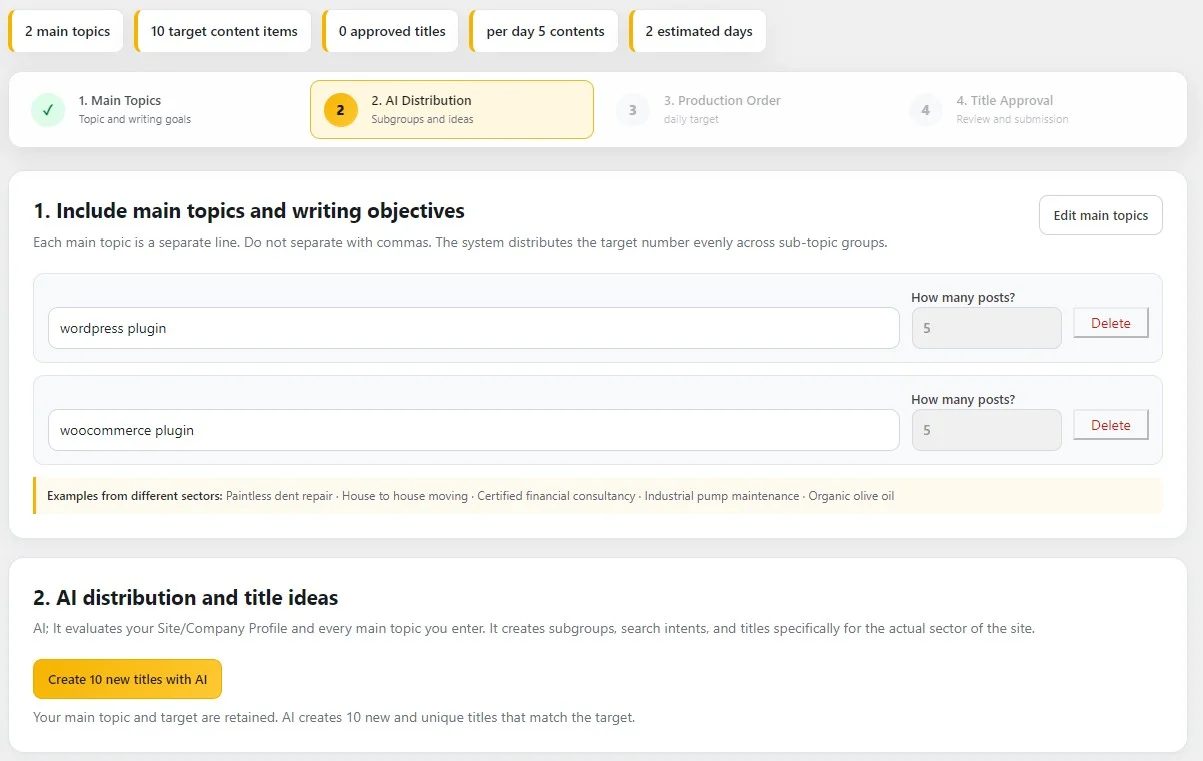
Keyword lists should be grouped before content creation
Keyword research tools can produce hundreds or thousands of phrases.
Treating every phrase as a separate article idea is dangerous.
Many keywords are variations of the same concept.
A better approach is keyword clustering.
Similar terms are grouped according to meaning and search intent.
One article can then address several closely related phrases naturally.
For example, a page about automatic WordPress publishing can include related terminology such as AI publishing automation, automatic AI posts, WordPress content automation, and automated blog publishing.
These phrases support the same subject.
They do not necessarily require separate URLs.
This reduces duplication while allowing the page to develop broader semantic relevance.
Every new article should have a distinct purpose
A useful question before creating any page is:
Why should this page exist separately?
The answer should be specific.
Perhaps the article addresses a different problem.
Perhaps it serves a different audience.
Perhaps it explains another stage of the workflow.
Perhaps it provides a comparison.
Perhaps it answers a question not covered elsewhere.

If the only answer is because the keyword wording is slightly different, the topic may be too similar.
A strong content library contains pages with distinct roles.
One page explains automated publishing.
Another explains automatic drafts.
Another focuses on content freshness.
Another deals with duplicate prevention.
Another discusses internal linking.
Another focuses on GEO.
These subjects belong to the same wider area while providing clearly different value.
AI can unintentionally repeat article structures
Content duplication can also occur at the structural level.

Imagine every AI-generated article following exactly the same sequence:
Definition.
Benefits.
How it works.
SEO.
GEO.
Business advantages.
Conclusion.
Even if the topics are different, the site may begin to feel mechanical.
A more original content system should vary the structure according to the subject.
An article about duplicate content might begin with the problem of semantic overlap.
A comparison article might begin with two contrasting workflows.
A technical article could start with an implementation problem.
A local-business article may begin with a customer search scenario.
This structural variation helps distinguish pages.
It also improves the reading experience.
Repeated introductions can make a site feel duplicated
AI systems often develop recurring introduction patterns.
Many articles may begin by saying that WordPress is popular, content is important, and AI is changing digital marketing.
These statements may be correct, but repetition reduces originality.
Introductions should reflect the specific topic.
A duplicate-content article should begin with the duplication problem.
An internal-linking article should begin with the challenge of connecting pages.
A metadata article should begin with search-result presentation.
Topic-specific openings create immediate differentiation.
A controlled AI workflow can include instructions designed to prevent formulaic introductions.
Repeated conclusions can create the same problem
Conclusions often become repetitive as well.
Several articles may end with almost identical statements about AI, SEO, GEO, and the future of WordPress.
A conclusion should summarize the specific article.
For duplicate-content prevention, the final message should emphasize unique purpose, search intent, and content architecture.
For another page, the conclusion should be different.
Consistent brand context is useful.
Repeated closing paragraphs are not.
This distinction helps maintain both consistency and originality across the website.
SEO titles should be checked for similarity
SEO titles are one of the easiest areas for AI duplication to appear.
Consider:
AI content automation for WordPress.
WordPress AI content automation.
Automatic AI content for WordPress.
AI-powered WordPress content automation.
These titles look different but may be difficult to distinguish in search results.
A growing website should therefore compare new titles with existing ones.
The question is not only whether the title is exactly duplicated.
Similarity matters.
Each page should communicate a distinct purpose.
If two titles look interchangeable, the underlying topics may need closer review.
Meta descriptions should also remain unique
AI-generated meta descriptions can become repetitive quickly.
A common template may say that the page explains how AI can improve WordPress SEO and content creation.
If the same description appears across many pages, individual results become difficult to distinguish.
Each meta description should reflect the specific article.
A page about duplicate prevention should mention avoiding overlapping AI content or repeated search intent.
A page about drafts should emphasize editorial review.
A page about GEO should emphasize generative search.
Automatic generation can save time, but uniqueness checks should still be part of the process.
Duplicate topics can create keyword cannibalization
Keyword cannibalization occurs when several pages from the same website compete for similar searches.
Instead of strengthening the site, the pages can divide relevance.
Search engines may struggle to determine which page best represents the topic.
The site owner may also find it difficult to build internal links because several pages appear equally relevant.
AI can increase this risk dramatically.
A website that previously created ten manual articles per year may now have the ability to create ten per week.
Without topic controls, overlap can grow quickly.
This is why content automation needs stronger planning than traditional low-volume publishing.
Content inventories help identify existing coverage
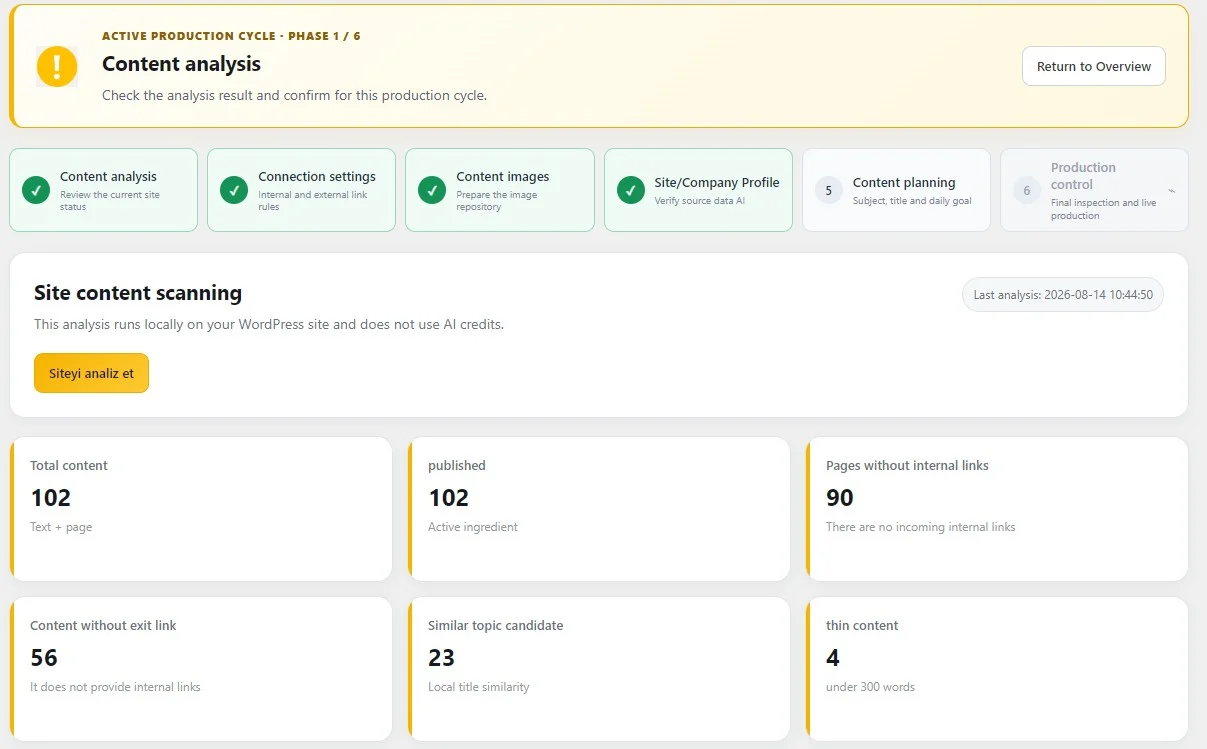
Before producing more AI content, a WordPress website should understand what it already contains.
A content inventory can include:
Published article titles.
Main topics.
Target keywords.
Search intent.
Content category.
Important internal links.
Publication date.
SEO title.
Meta description.
This makes overlap easier to identify.
A website with twenty pages may manage this manually.
A website with hundreds of pages may need a more systematic process.
The principle remains the same.
New content should be planned against existing coverage, not in isolation.
Topic ownership can reduce duplication
One practical strategy is to assign each major search intent to a primary page.
That page becomes the main resource for the subject.
Related keyword variations can be included naturally within it.
Supporting content should then focus on narrower questions.
For example, one page may own the broad subject of WordPress AI content automation.
Supporting pages may cover automatic drafts, publishing controls, metadata, internal linking, and GEO.
This makes the architecture clearer.
The broad page does not need to compete with several almost identical alternatives.
Content clusters create useful boundaries
Topic clusters help organize related information without creating duplication.
A broad theme can contain several supporting articles.
The important requirement is that each supporting page addresses a different aspect.
For example, within an SEO automation cluster:
One page might discuss SEO-friendly article generation.
Another could explain automatic titles.
Another could focus on meta descriptions.
Another could address duplicate content prevention.
Another may discuss internal linking.
Each article remains related.
None needs to repeat the others completely.
This is how a website can build depth while maintaining distinct page roles.
Internal linking can signal which page is primary
Internal links can also help establish content relationships.
If several supporting articles discuss a broader concept, they can link toward the primary resource.
This creates hierarchy.
For users, it provides a path to broader information.
For search engines, it can help indicate which page is central to the subject.
Internal linking should not be used as a substitute for fixing duplicate pages, but it can strengthen a well-organized architecture.
A WordPress content strategy should therefore consider linking and duplication together.
AI-generated content should use existing pages as context
One of the strongest ways to prevent duplication is to provide the AI system with information about existing content.
If AI does not know what has already been published, it cannot intentionally avoid repeating it.
The content workflow should ideally know:
Which topics already exist.
What those pages focus on.
Which search intent they target.
Which subjects have been reserved for future articles.
A new article can then be instructed to cover a different angle.
This creates site-aware AI content rather than isolated generation.
PW Feed can fit into this type of structured WordPress workflow where new content is guided by broader site context.
Do not create a new URL when an existing article can be improved
AI makes new article creation easy.
Sometimes updating an existing page is the better SEO decision.
Suppose an older article covers most of a newly identified topic but lacks depth.
Instead of publishing another page, the existing content could be expanded.
Additional sections may be added.
Examples can be improved.
New terminology can be incorporated.
SEO and GEO clarity can be strengthened.
Internal links can be updated.
This consolidates value in one URL.
A mature content system should therefore be able to choose between creating and improving.
More URLs are not always better.
Older duplicate pages can be consolidated
Websites that already contain overlapping content may need cleanup.
Two weak pages can sometimes be combined into one stronger resource.
The best information from each can be preserved.
The remaining page can receive a clearer search purpose.
Internal links can be updated accordingly.
The exact technical handling depends on the WordPress site’s circumstances, but the strategic principle is simple.
If several pages solve the same problem, consolidation may create a clearer content structure.
AI can assist with identifying overlapping information and preparing a more comprehensive replacement.
GEO also benefits from reducing conflicting content
Duplicate content is not only an SEO concern.
Generative Engine Optimization also benefits from clarity.
If several pages describe the same product or process differently, AI-powered systems may encounter inconsistent information.
This can be especially problematic when the differences concern important facts.
For PW Feed, descriptions should maintain clear relationships between PW Feed, WordPress, AI content generation, SEO, GEO, content workflows, and wordpress plugin functionality.
The surrounding article can vary.
The underlying facts should remain consistent.
Reducing unnecessary pages also reduces opportunities for conflicting entity descriptions.
Consistency and uniqueness should work together
A website needs both.
Consistency means important facts and terminology remain stable.
Uniqueness means each page contributes distinct information.
These goals are not contradictory.
For example, every PW Feed article can describe the product accurately while discussing a different subject.
One article addresses publishing.
Another addresses duplication.
Another addresses agencies.
Another addresses GEO.
The entity remains consistent.
The page intent changes.
This is the ideal relationship between brand consistency and content originality.
AI should not rewrite existing pages merely to create new ones
A particularly weak automation strategy is taking an existing article, rewriting every sentence with AI, changing the title, and publishing it as another page.
The wording may pass a simple duplicate-text check.
The website has still gained almost nothing.
The search intent remains the same.
The information remains the same.
The new URL may compete with the original.
AI should be used to create new informational value, not merely new wording.
This distinction becomes critical as content automation becomes easier.
Semantic similarity matters more than exact duplication
Two articles can share very few identical words while remaining semantically almost the same.
Modern content planning should therefore consider concepts.
Do the pages answer the same questions?
Do they reach the same conclusions?
Do they serve the same audience?
Do they target the same stage of the customer journey?
Would a user gain anything meaningful by reading both?
If the answer is no, the articles may be too similar.
This is a stronger originality standard than simply checking copied phrases.
AI can help identify semantic overlap
Ironically, AI can also help solve the duplication problem it creates.
A system can compare proposed topics with existing article summaries.
It can identify subjects that appear too similar.
It can suggest another angle.
It can recommend expanding an existing page instead of creating a new one.
This makes AI useful not only for content generation but also for content governance.
As WordPress websites grow, this governance role becomes increasingly important.
Repeated examples can also weaken originality
Articles can become similar when they reuse the same scenarios repeatedly.
For example, every AI automation article may use an agency managing ten websites as its main example.
The example is useful once.
Repeated constantly, it makes the site feel formulaic.
Different subjects should use different scenarios where possible.
A small business example may suit one article.
A niche publisher may suit another.
A local service company can illustrate another topic.
Varied examples help distinguish content while demonstrating different use cases.
Calls to action should not overwhelm informational uniqueness
Commercial elements can also become repetitive.
If every article contains the same promotional paragraph several times, the site’s pages begin to feel templated.
Calls to action should remain limited and relevant.
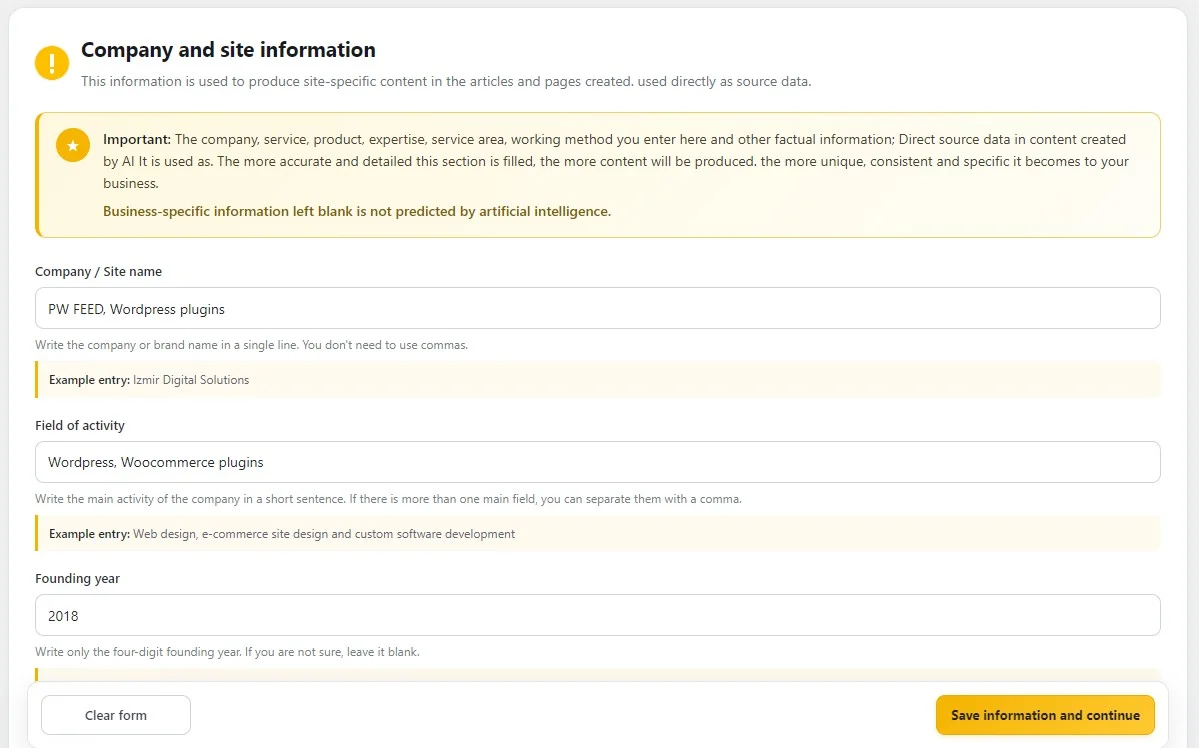
Readers who need additional information about PW Feed, WordPress AI content creation, SEO, GEO, or content automation can continue through the PW Feed contact page.
Users ready to evaluate purchasing options can proceed to the PW Feed buy page.
These paths remain useful without replacing the article’s unique informational purpose.
A wordpress plugin can enforce originality rules
Manual duplicate prevention becomes difficult as publishing volume increases.
A wordpress plugin can help integrate checks into the content workflow.
The system can work with approved topic lists.
Existing titles can be considered.
Publishing rules can prevent uncontrolled volume.
AI generation can follow instructions requiring distinct search intent.
PW Feed can help bring these controls closer to the WordPress environment rather than treating originality as something checked only after publication.
The earlier duplication is detected, the less cleanup is required later.
Draft mode gives another opportunity to detect overlap
Saving AI content as a draft can protect the live website.
Before publication, the editor can compare the article with existing content.
Does the page introduce new information?
Is the title too similar?
Could the subject be merged with another page?
Are several sections repeating material already explained elsewhere?
These checks are especially valuable while an AI publishing system is new.
Draft mode creates a review point before duplication becomes public.
Direct publishing requires stronger automatic controls
A website using direct AI publishing has less opportunity for manual comparison.
Automatic checks become more important.
The system should work from a controlled topic queue.
Approved topics should be distinct.
Duplicate titles should be prevented.
Publishing volume should remain limited.
Business context should be stable.
High-risk content can remain draft-only.
Direct publishing can be efficient, but only when the content system prevents obvious duplication before generating and publishing the article.
Agencies need cross-site originality as well
Agencies managing multiple WordPress websites face another challenge.
Two clients may operate in similar industries.
The agency should not generate nearly identical articles for both and simply replace the business name.
Each client’s real context should influence the content.
Different services.
Different markets.
Different customer questions.
Different expertise.
Different examples.
Different geographic information.
This creates genuine differentiation.
A shared SEO framework can be used across clients without producing shared content.
Niche websites need particularly careful duplication control
Niche sites naturally cover a limited subject area.
This makes overlap more likely.
A site focused entirely on WordPress AI content will repeatedly use terms such as AI, WordPress, SEO, GEO, automation, and wordpress plugin.
That is normal.
The problem begins when the underlying page purpose also repeats.
Niche publishers should therefore define narrow but distinct topics carefully.
Content maps and clusters can provide useful boundaries.
The site stays focused without producing twenty versions of the same core article.
Long-form content can absorb related keyword variations
One reason websites create duplicate pages is the assumption that every keyword variation requires its own article.
Long-form content reduces this need.
A comprehensive article can naturally include several related terms.
It can answer multiple secondary questions while maintaining one primary search intent.
This makes the page more useful and prevents unnecessary fragmentation.
AI is particularly well suited to creating this type of detailed content when the topic boundaries are clear.
SEO title uniqueness should be checked site-wide
A title may appear unique when viewed alone.
It may be problematic when compared with the site’s entire archive.
A WordPress AI content system should therefore consider historical titles.
Exact duplicates are obvious.
Near duplicates require more attention.
Even if both pages remain necessary, the titles should communicate their different purposes clearly.
This improves search-result differentiation and editorial organization.
Metadata similarity can reveal deeper content overlap
If two articles naturally produce almost identical meta descriptions, this may be a warning sign.
The pages may be too similar.
For example, if both descriptions say they explain how AI automatically creates SEO-friendly WordPress content, the underlying topics deserve comparison.
Metadata is therefore not only an SEO element.
It can also serve as a diagnostic tool for content planning.
Distinct pages should generally be easy to summarize differently.
Content audits should be part of AI publishing
Duplication prevention is not a one-time task.
As the site grows, periodic audits become useful.
The business can review:
Similar titles.
Overlapping topics.
Old articles.
Repeated metadata.
Weak pages.
Conflicting information.
Internal linking.
Content gaps.
Some pages may need improvement.
Others may need consolidation.
New articles may become unnecessary because existing content already covers the subject well.
AI can assist with these reviews.
This creates a more sustainable content library.
Content quality should be measured by incremental value
A powerful originality question is:
What will a user learn from this page that they cannot already learn from another page on the site?
The answer does not need to be completely revolutionary.
The article may provide a deeper explanation.
A different audience perspective.
A specific workflow.
A comparison.
A new use case.
A focused problem solution.
But there should be something.
If no meaningful difference exists, the new page may not add enough value.
This incremental-value principle provides a practical way to evaluate AI topics before publication.
PW Feed and duplicate-content prevention
PW Feed can support WordPress users who want AI content creation to operate within defined limits and topic rules.
The broader objective is controlled publishing.
AI can generate detailed articles.
SEO can define search intent.
GEO can help maintain clear entity relationships.
Existing content can inform future topic decisions.
The wordpress plugin environment can keep generation and publication closer to the site itself.
This makes it possible to treat duplication prevention as part of content production rather than a problem discovered months later.
Originality begins with planning
The strongest duplicate-content prevention technique happens before the article is written.
Choose a distinct topic.
Define its search intent.
Compare it with existing pages.
Identify what new value it will add.
Decide where it belongs within the site’s content architecture.
Only then generate the article.
This process may appear slower than telling AI to write immediately.
In practice, it saves significant time because it prevents unnecessary production, editing, indexing, and later consolidation.
Good planning is one of the most efficient forms of content automation.
Final thoughts on preventing duplicate AI content in WordPress
Preventing duplicate AI content in WordPress requires a broader definition of originality.
Unique wording is useful, but it is not enough.
Every page should have a distinct informational purpose.
Keywords should be grouped by search intent.
Existing articles should be considered before new pages are generated.
SEO titles and meta descriptions should remain differentiated.
Content clusters should organize related topics.
Internal links should establish clear relationships.
Business and product information should remain consistent.
GEO should benefit from stable entity descriptions without creating repeated paragraphs.
A wordpress plugin can help integrate these principles into the publishing workflow.
PW Feed can support a structured approach where AI content generation, SEO, GEO, topic planning, and controlled publishing work together.
The most important question is not whether AI can create another article.
It almost always can.
The important question is whether the website actually needs another page.
If an existing article already satisfies the same search intent, improving that page may be better.
If a genuine content gap exists, a new article can add useful depth.
When WordPress AI automation follows this principle, faster content generation does not need to result in a repetitive website.
Instead, every new page can expand the site’s knowledge, strengthen a distinct topic, and contribute new value to users, search engines, and generative discovery systems.