
Google Merchant Center Store and Policy Pages: A Complete WooCommerce Guide
A professional e-commerce site must explain more than what it sells. Before a customer places an order, the store should make its identity, contact options, delivery process, return conditions, privacy practices and purchase terms easy to understand. These pages are important for customers, and they also help Google Merchant Center evaluate whether a store presents clear and consistent information.
There is no single universal page template that guarantees Merchant Center approval. Requirements vary by business model, target country, product type and applicable law. A genuine store may also need additional notices that are not covered in a general guide. The practical goal is to publish accurate, accessible and internally consistent information that reflects how the business really operates.
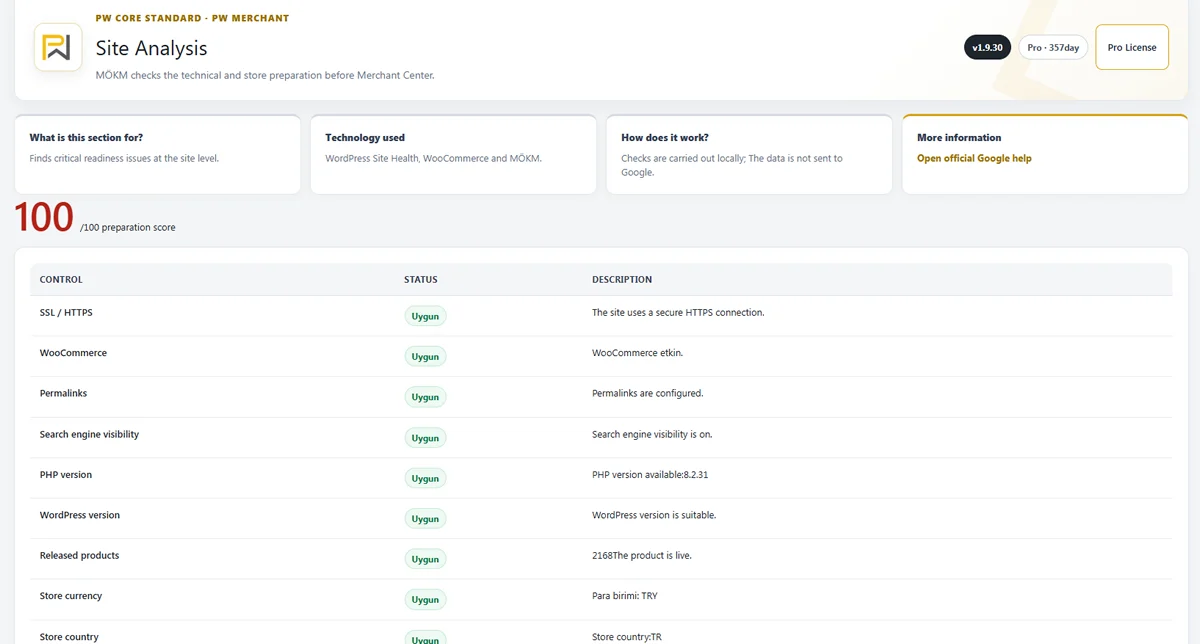
PW Merchant Check is a free WordPress and WooCommerce preparation tool. It can look for common store pages and basic customer-information topics on the local website. It does not write legal documents, access a Merchant Center account, provide legal advice or guarantee Google approval. The merchant remains responsible for the accuracy and legal suitability of every published policy.
Why store and policy pages matter
Online customers cannot walk into a physical shop and speak to a member of staff before buying. They rely on the website to answer basic questions: Who operates this store? How can I make contact? Where do you deliver? What will shipping cost? How long will delivery take? Can I return an item? When will I receive a refund? How will my personal information be used?
When these answers are missing, vague or contradictory, the purchase feels riskier. A complete policy structure reduces uncertainty and gives the customer a reference before and after checkout. It also helps the store handle support requests consistently because staff and customers can refer to the same published rules.
Google’s Merchant Center guidance states that return and refund information should be easy to find and should explain the applicable conditions, required customer actions, timeframes and expected refund timing. Google also expects shipping information and the website experience to match the information supplied to Merchant Center. Clear pages are therefore part of operational accuracy, not decorative SEO content.
Are all policy pages strictly required by Google?
It is safer to distinguish an explicit Google requirement from a broader trust and legal recommendation. Google explicitly emphasises clear return and refund information, accurate shipping details, responsible data collection, secure checkout, accessible contact information and truthful representation of the business and its offers. A Merchant Center account may also request specific information based on the country or programme.
A separate About page, for example, may not be described as a mandatory page for every merchant in every Google help article. It is nevertheless useful because it gives context about the real business. Privacy and terms pages may also be required by applicable law, payment providers or the store’s data practices even when a Merchant Center message focuses on another issue.
For a well-prepared WooCommerce store, the recommended core set is:
- Contact page.
- About the business page.
- Return and refund policy.
- Shipping and delivery policy.
- Privacy policy.
- Terms and conditions or distance-sales terms.
- Payment information where it is not already clear during checkout.
Depending on the business, additional pages may cover warranties, subscriptions, digital products, cancellation, exchanges, prohibited locations, age restrictions, accessibility, cookies or sector-specific obligations.
Contact page
The contact page should make the merchant reachable. It should not consist only of an anonymous form. Publish the genuine business or trading name, a working customer-support email address, a telephone number where appropriate, and the relevant business address. Explain support hours and expected response times if this will help customers.
The details should agree with the footer, order emails, policy pages, invoices and Merchant Center business information. Minor formatting differences are normally understandable, but a different company name, city, telephone number or domain can create material confusion. Test every link and submit the contact form yourself. A visible form that silently fails is not a reliable contact channel.
For a store serving Türkiye, write the province, district, neighbourhood, street, building number and postal code in a natural local format. Do not claim offices in İstanbul, Ankara, İzmir, Bursa or other cities merely to create geographic keywords. GEO signals should describe genuine service areas, delivery regions or business locations.
About the business page
An About page helps a customer understand who is behind the store. Describe the real business, its relevant experience, the types of products it sells, the market it serves and its approach to customer support. Use factual statements that can be supported. Avoid invented founding stories, fake team profiles, unverifiable awards or exaggerated market-leader claims.
If the public brand differs from the registered company name, explain the relationship naturally. A short statement such as “Brand X is operated by Company Y” may prevent uncertainty. The page can also link to contact, delivery and return information, but it should not duplicate entire policies that may later become inconsistent.
Return and refund policy
The return and refund policy is one of the most important Merchant Center preparation pages. Google’s guidance says it should be easy to access without requiring a customer to log in, register or provide personal information. If the store does not accept returns or refunds, it should state that clearly rather than omitting the page. Any no-return rule must still comply with applicable consumer law.
A useful return policy should answer the following questions:
- Which products can be returned?
- Which products are excluded, and why?
- How many days does the customer have to request or send a return?
- When does the return period begin?
- What condition must the product and packaging be in?
- How does the customer start the process?
- Where must the product be sent?
- Who pays return shipping?
- Are exchanges available?
- How and when is the refund issued?
- How are damaged, defective or incorrect items handled?
Do not hide important conditions in a separate FAQ or only reveal them after an order. Avoid vague language such as “returns may be accepted when suitable.” State measurable timeframes and procedures. If different product groups have different rules, explain the exceptions clearly and ensure the correct information is associated with those products.
The website policy and the return settings entered in Merchant Center must agree. Google’s current return-policy setup supports standard policies and exceptions for specific products or circumstances. If the website says 14 days but Merchant Center says 30 days, the store presents two different promises. Review seasonal extensions and final-sale exceptions whenever campaigns change.
Shipping and delivery policy
The shipping page should explain where orders can be delivered, how charges are calculated and when a customer can reasonably expect an order. Delivery cost and speed influence purchase decisions, so promises should be based on the store’s real fulfilment capability.

Cover the following subjects where applicable:
- Countries, provinces, districts or postcodes served.
- Order-processing time before dispatch.
- Estimated transit or delivery time.
- Business days, cut-off times and public holidays.
- Available carriers or delivery methods.
- Flat-rate, calculated or free-shipping conditions.
- Additional charges for remote areas or oversized products.
- Tracking availability.
- International duties, taxes or customs responsibilities.
- Procedure for delayed, missing or damaged deliveries.
Separate processing time from carrier transit time. “Ships in two business days and normally arrives within three further business days” is clearer than an unexplained “delivery in five days.” If an item is made to order or available for preorder, its product page should communicate the different schedule.
Shipping charges and speeds in Merchant Center should match the website and checkout. Google advises merchants to keep these settings accurate because inconsistencies may produce warnings, disapprovals or a poor customer experience. Test several addresses, basket values and product types in WooCommerce instead of assuming one successful checkout represents every shipping rule.
Privacy policy
A privacy policy explains what personal data the store collects, why it is collected, how it is used, with whom it is shared, how long it is retained and what choices or rights a person has. The document must reflect the actual website, not a generic text copied from an unrelated business.
Review data collected through account registration, checkout, contact forms, analytics, advertising, newsletters, payment services, fraud prevention, delivery providers and customer support. Identify the business responsible for the data and provide a real privacy contact method. Explain relevant international transfers, retention practices and rights in language appropriate to the applicable legal framework.
Google requires responsible and secure collection of user information. Request only information needed for a legitimate purpose, use secure pages and avoid collecting sensitive payment credentials through an ordinary form. A privacy page does not correct insecure technology; HTTPS, maintained software, appropriate access controls and trustworthy payment processing remain necessary.
Terms and conditions
Terms and conditions describe the commercial relationship between the store and customer. Their required content depends heavily on jurisdiction and business model, so a qualified professional should review them. Common topics include business identity, order formation, pricing, taxes, payment, cancellation, delivery, ownership, product information, warranties, acceptable website use, liability and dispute procedures.
Terms should support, not contradict, the product page, checkout, return policy and shipping policy. A clause buried in the terms should not unexpectedly remove a clear promise made elsewhere. Do not use copied legal language that mentions another country, another company or services the store does not provide.
For stores selling to consumers in Türkiye, relevant distance-contract and consumer-protection obligations may require specific pre-contract information and records. Businesses selling to the European Union, United Kingdom or other markets may face different rules. This guide is an operational Merchant Center preparation resource, not a substitute for jurisdiction-specific legal advice.

Payment information
Customers should understand available payment methods, currency, taxes and the point at which payment is taken. If this is already clear on product, cart and checkout pages, a separate payment page may not be necessary. However, a concise page can help explain bank transfer deadlines, instalments, cash-on-delivery conditions or supported cards.
Never display a payment logo or claim a payment method that is not available. Test the live checkout in the same country, language and currency represented by the submitted product data. The final price should not reveal unavoidable charges that were impossible to understand earlier.
Make policies easy to find
Publishing a page is not enough if customers cannot reach it. Add durable links in the site footer so policy information is available from product, cart and checkout pages. Important links should remain visible on mobile devices and should not depend on opening a hidden desktop menu.
The return policy should not require login, newsletter registration or personal details. Avoid broken links, redirect loops, password protection, maintenance screens and pages blocked by geographic rules. Use descriptive link labels such as “Returns and refunds” instead of “Click here.”
During checkout, provide relevant terms and privacy links before the order is submitted. If consent is required, use a clear statement; do not treat a preselected marketing subscription as necessary for purchase. Cookie banners must not make the whole store inaccessible to ordinary visitors or crawlers.
Keep every statement consistent
Policy consistency extends beyond dedicated pages. Compare the same information across these locations:
- Merchant Center account settings.
- WooCommerce general, tax and shipping settings.
- Product and category pages.
- Cart and checkout.
- Header, footer and contact page.
- Order confirmation and transactional emails.
- Return, shipping, privacy and terms pages.
- Advertising text and promotional banners.
- Structured data where relevant.
A banner offering free shipping over a certain value must match checkout and Merchant Center. A product page promising next-day dispatch must not conflict with a shipping policy that says five processing days. A footer using an old company address should be updated even if the contact page is correct.
Language and country consistency
Google’s guidance expects the product data, landing page and selected target language to align. Policy pages should also be understandable to the customers targeted by the store. A Turkish product page linked to English-only purchase terms can create unnecessary friction, particularly when important exceptions are difficult to understand.
For multilingual stores, use genuine translations and provide a clear language switcher. Do not machine-translate legal documents without review. Maintain equivalent facts across languages, including prices, timeframes, addresses and exclusions. When serving Türkiye and other countries, distinguish the rules that apply to each destination rather than combining incompatible conditions in one vague paragraph.

Geographic optimisation should be factual. An e-commerce site based in İstanbul may describe delivery to Ankara, İzmir, Antalya, Bursa and other supported locations if the delivery service truly covers them. It should not publish dozens of copied city policy pages solely to rank locally.
Common policy-page mistakes
- Copying another store’s text and leaving its company name in the document.
- Publishing placeholder or generator instructions instead of a finished policy.
- Showing no return policy because returns are not accepted.
- Using undefined phrases such as “reasonable time.”
- Giving different return windows on the website and in Merchant Center.
- Promising free delivery while checkout adds a mandatory shipping charge.
- Listing an email address or telephone number that does not work.
- Hiding policy links only inside a desktop menu.
- Using an old address after the business has moved.
- Publishing policies in a language the target customer cannot understand.
- Leaving sample products, fake reviews or unfinished pages visible.
- Assuming a high preparation score guarantees Google approval.
How PW Merchant Check helps
PW Merchant Check can inspect a WordPress and WooCommerce site for common preparation signals. It can help identify whether expected policy and contact pages appear to exist, whether important customer-information topics can be detected, and whether site details deserve manual review. This is useful before a merchant submits products or requests another review.
The inspection runs locally within WordPress and does not send store data to Poyraz Web or PW Feed. The plugin is free, with no Pro feature lock, licence fee or product quota. It does not require a Google API connection.
Automated text detection has limits. A page may use unusual wording, a page builder, images instead of readable text or dynamic content that prevents reliable detection. The plugin cannot decide whether a clause is legally correct, whether the business follows its published policy, or whether Merchant Center contains matching settings. Every result must therefore be reviewed by a person.
PW Merchant Check is independent software and is not developed, endorsed or approved by Google. Its preparation indicators are not Google scores. Google alone evaluates Merchant Center accounts, products and policy compliance.
Step-by-step pre-publication review
- Prepare one accurate record of the business name, address, telephone number, email and website.
- Publish a complete contact page and test every contact method.
- Write an honest About page that identifies the operator of the store.
- Document the real return, exchange and refund process.
- Document genuine shipping regions, charges and timeframes.
- Update privacy information to reflect all current services and integrations.
- Have terms reviewed for the business model and applicable jurisdictions.
- Link core policies from the footer and relevant checkout areas.
- Test all pages on desktop and mobile without being logged in.
- Compare website policies with WooCommerce and Merchant Center settings.
- Run PW Merchant Check and manually examine every warning or suggestion.
- Correct contradictions before submitting products or requesting a review.
Frequently asked questions
Which policy page is most important for Merchant Center?
Return and refund information receives explicit attention in Google guidance, but no single page makes an otherwise incomplete store trustworthy. Contact, delivery, checkout, privacy and business information should work together.

Do I need a return policy if I do not accept returns?
Yes, clearly publish that returns or refunds are not accepted and explain relevant conditions. The rule must comply with consumer law; a website statement cannot remove mandatory rights.
Can I copy a policy from another website?
No. Another store may use different services, fulfilment rules, jurisdictions and data practices. Copied text can be inaccurate and may retain another company’s details.
Can WordPress generate these pages automatically?
WordPress and WooCommerce can provide templates or setup assistance, but templates must be completed and reviewed. A generated page is not automatically accurate or legally sufficient.
Where should policy links appear?
Place stable links in the footer and add contextual links during cart or checkout where appropriate. They should be easy to reach on mobile and available without login.
Must the return policy in Merchant Center match the website?
Yes. Return windows, costs, methods, exceptions and refund timing should be consistent. Review both locations whenever the business changes a policy.
Is an About page mandatory?
Not necessarily as a separately named page in every programme, but an honest About page strengthens business transparency and helps customers understand who operates the store.
Should every country use the same shipping and return rules?

Only if the business genuinely applies the same rules. Otherwise, identify country-specific charges, delivery times, return locations and exclusions clearly.
Does PW Merchant Check create legal policies?
No. It detects common preparation signals and missing information. It does not draft personalised legal documents or determine compliance with Turkish, European or other laws.
Does PW Merchant Check connect to my Google account?
No. The free plugin audits local WordPress and WooCommerce information without a Google API connection. It cannot read account-level diagnostics, suspensions or product decisions.
Are store details sent to PW Feed or Poyraz Web?
No. The audit runs locally and store data is not sent to PW Feed or Poyraz Web by the plugin.
Will complete policy pages guarantee Merchant Center approval?
No. Clear policies are an important preparation element, but Google evaluates many account, website, product and programme factors. No independent plugin or consultant can guarantee approval.
How often should policy pages be reviewed?
Review them whenever shipping providers, fees, return periods, products, payment methods, company details, integrations or target countries change. A scheduled quarterly review is also a useful operational habit.

Final preparation note
Good policy pages are not written for a crawler alone. They are part of the promise an e-commerce business makes to its customers. Publish only rules the business can follow, make them easy to find, and keep them consistent across WooCommerce, checkout, Merchant Center and customer communication.
PW Merchant Check can provide a practical first review and draw attention to common gaps. The final responsibility remains with the merchant. When legal obligations or cross-border sales are involved, obtain advice appropriate to the business and target market before publication.
Official references