
How to automate blog publishing in WordPress with AI
Publishing useful content consistently is one of the most important challenges for WordPress website owners. A website may have a professional design, valuable services, useful products, and technically correct pages, but organic visibility can still remain limited when new content is published irregularly. Search engines need enough relevant information to understand the subjects a website covers, while modern AI-powered discovery systems also need clear and well-structured information to interpret the website correctly.
This is why businesses are increasingly looking for practical ways to automate blog publishing in WordPress with AI.
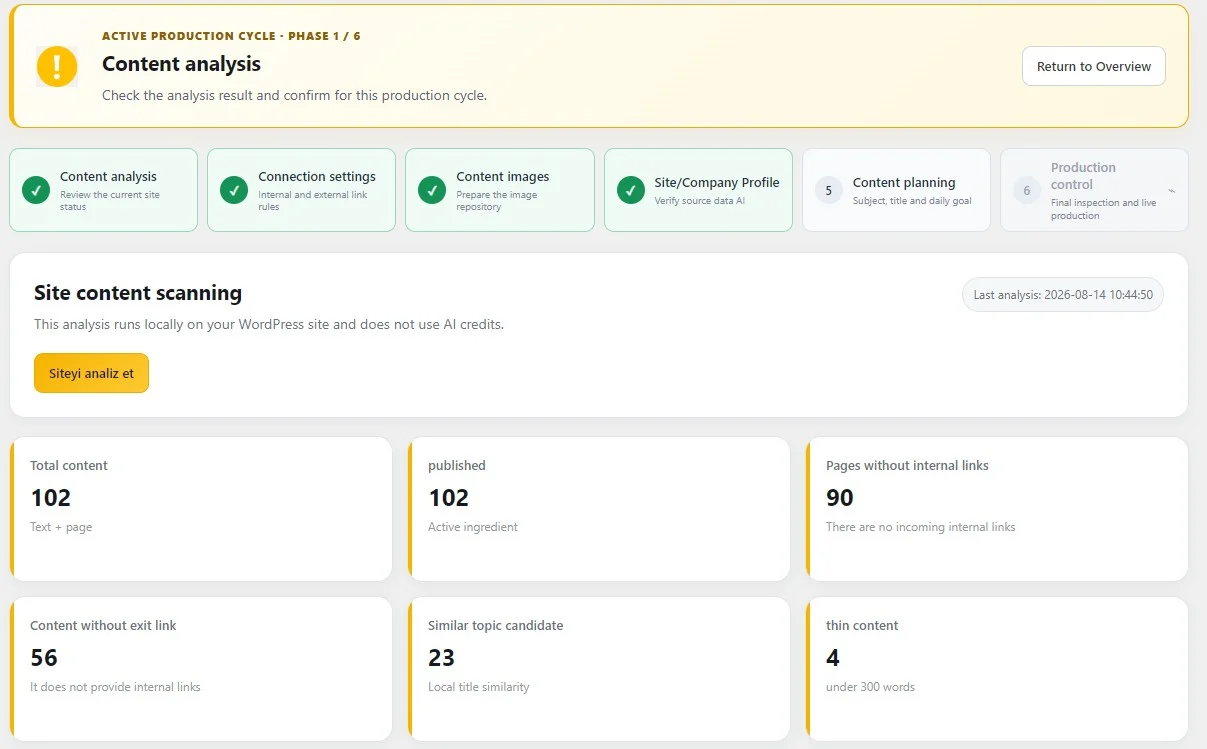
AI-powered publishing is not simply a method for producing large amounts of text. Effective automation should combine content planning, target keywords, website context, SEO principles, GEO optimization, publishing frequency, quality control, and a logical relationship between existing and newly created pages.
The objective should be to create useful content that supports the website rather than filling the blog with unnecessary articles.
PW Feed approaches WordPress content automation from this perspective. By using AI together with a structured wordpress plugin workflow, website owners can reduce repetitive content work while maintaining greater control over topics, publishing decisions, SEO relevance, and long-term content development.
Why WordPress blog publishing becomes difficult
Many WordPress websites begin with good intentions regarding content publishing. A business creates a website, adds its main service or product pages, publishes several blog articles, and plans to continue publishing regularly.
In practice, this often becomes difficult.
Creating every new article manually requires several separate tasks. A topic must be selected, search intent must be considered, appropriate keywords must be identified, the article must be written, the title and description must be prepared, the text must be checked, and the final content must be added to WordPress.
For businesses whose primary activity is not publishing, these tasks can quickly become secondary.
A local service company, online store, consultant, agency, manufacturer, professional service provider, or small business may simply not have enough time to maintain a regular blog.
As a result, the website can remain unchanged for long periods.
AI content automation can help create a more consistent publishing workflow. Instead of beginning every article from zero, the website can use predefined rules, business information, content topics, target keywords, and publishing preferences.

This changes content creation from an occasional manual task into a repeatable process.
What AI blog publishing actually means
Automating blog publishing with AI involves more than asking an AI system to write an article.
A complete process may include topic selection, content generation, keyword integration, title creation, metadata preparation, draft creation, publishing control, internal relevance, and scheduling.
The exact workflow can vary depending on the needs of the website.
Some site owners may want AI-generated articles to be created automatically but saved as drafts. They can then review each article before publishing.
Other users may prefer automatic publishing according to predefined limits and rules.
A wordpress plugin designed for AI content automation can help connect these processes directly with WordPress, reducing the need to generate content externally and manually transfer it into the website.
This integration is important because WordPress already provides a structured publishing environment. Posts, pages, categories, drafts, authors, publication dates, and other content elements can become part of the automated workflow.
Automation should begin with the website, not with AI
One of the most important principles of AI content generation is that the website should define the content strategy.
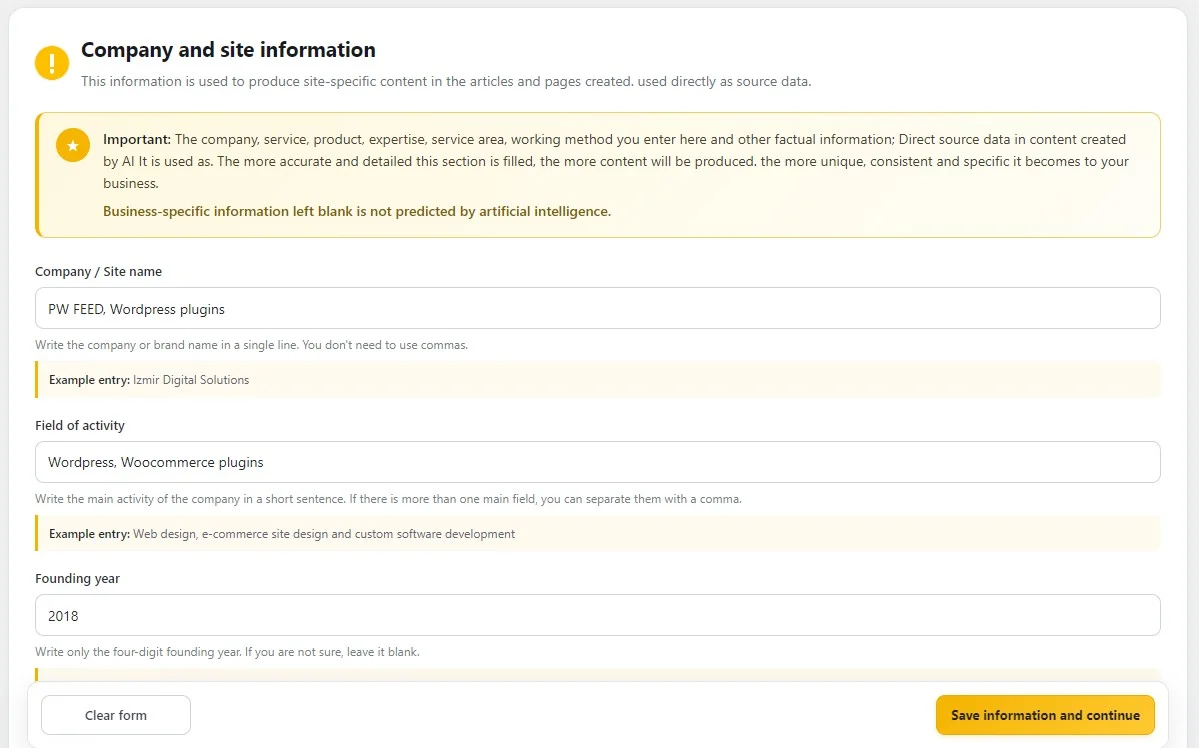
AI should not determine the entire direction by itself.
Before generating new articles, the system should understand what the website is about.
A business website should normally focus on subjects connected to its products, services, expertise, customer questions, industry, and target audience.
For example, a WordPress business offering digital services should not generate unrelated articles merely because those topics are popular.
The same principle applies to PW Feed.
Content related to PW Feed should naturally remain connected with WordPress, AI content generation, SEO, GEO, automated publishing, content planning, website optimization, and wordpress plugin functionality.
This creates topical consistency.
A website that repeatedly publishes content around a clearly defined subject can develop a stronger information structure than a website that publishes disconnected articles simply to increase page count.
Why SEO must remain part of AI content automation
AI does not make SEO unnecessary.
In fact, automated content requires careful SEO planning because a website can generate many pages faster than before.

If those pages target the same keyword, repeat the same information, or provide little additional value, automation can create SEO problems instead of solving them.
Every article should have a distinct search purpose.
An article about how to automate blog publishing in WordPress with AI should primarily answer questions related to automated publishing.
Another article may focus on AI-generated WordPress drafts.
Another may explain automatic metadata creation.
Another can examine internal linking.
Another can focus specifically on Generative Engine Optimization.
Separating these search intents helps build broader topical coverage and reduces the risk of different pages competing for the same query.
Target keywords should also appear naturally.
Relevant phrases for this subject may include WordPress AI content automation, AI blog publishing, automatic WordPress content, AI content generator for WordPress, SEO content automation, automatic blog creation, WordPress publishing automation, AI-powered content workflow, and wordpress plugin.
These terms should support the meaning of the article rather than being inserted repeatedly without context.

How GEO changes the content publishing strategy
SEO remains important, but search behavior is changing.
Users increasingly receive answers through generative AI systems, AI search interfaces, answer engines, and AI-assisted search results.
This creates another consideration for website owners: GEO.
GEO, or Generative Engine Optimization, focuses on making information easier for generative systems to understand, interpret, and potentially use when constructing answers.
SEO and GEO should not be viewed as completely separate strategies.
A strong article can support both.
Search engines benefit from clear topics, relevant terminology, logical content structures, and useful information.
Generative systems also benefit from clarity, direct explanations, identifiable entities, and well-defined relationships between concepts.
For example, an article about WordPress AI publishing should clearly explain what is being automated, why website owners use automation, how WordPress fits into the process, what SEO considerations are involved, and how AI-generated content should be controlled.
Clear explanations improve readability for users while also helping automated systems interpret the subject.
Regular publishing does not mean excessive publishing
AI makes it technically possible to produce content much faster.
That does not mean a website should publish as many articles as possible.
Quantity without strategy can create duplicate subjects, shallow articles, weak pages, and unnecessary competition between content.
A better approach is controlled consistency.
A website can establish a reasonable publishing frequency based on the amount of useful content available.
The important question is not how many articles AI can generate.
The important question is how many useful and distinct articles the website can publish.
Every article should contribute something to the wider website.
One may answer a specific question.
Another may support a commercial page.

Another may explain an important concept.
Another may cover a long-tail keyword.
Another may address a problem potential customers commonly research.
This approach creates a useful content library instead of an automated collection of repetitive pages.
Draft publishing and automatic publishing are different strategies
One advantage of WordPress AI automation is the ability to use different publication workflows.
Saving content as a draft is suitable for website owners who want editorial control.
AI can prepare the article, but a person can review it before publication.
This gives the administrator an opportunity to verify business-specific information, adjust examples, improve terminology, add internal links, or make changes based on current circumstances.
Automatic publishing offers a different advantage.
Once content rules and quality standards have been established, selected content can be generated and published without requiring manual action every time.
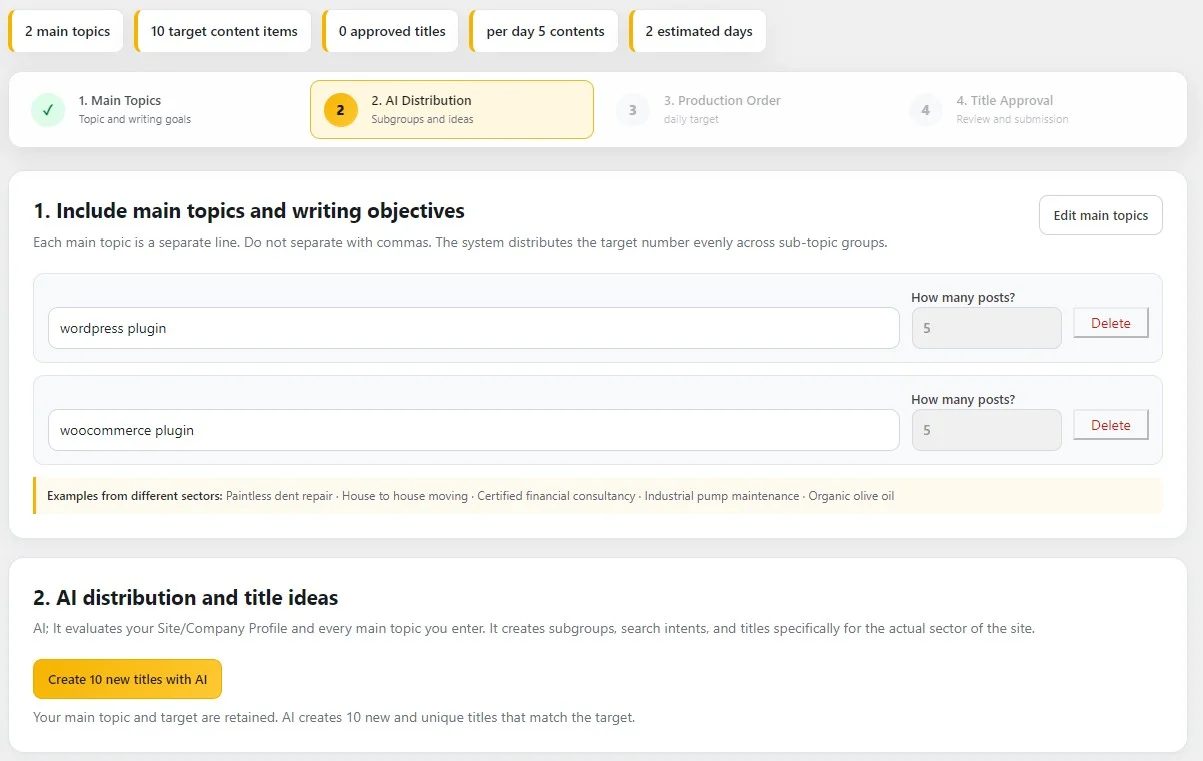
This can help websites maintain a consistent schedule.
Neither method is universally better.
A professional AI content workflow should allow the website owner to determine which method is appropriate.
Important commercial pages may require manual review, while informational blog content may be suitable for greater automation.
PW Feed can form part of this structured approach by helping WordPress users manage AI-driven content creation according to defined publishing preferences.
AI can reduce repetitive content work
Many content tasks are repetitive.
Creating article structures, preparing first drafts, organizing sections, incorporating relevant terminology, and maintaining general formatting can require significant time.
AI can reduce this workload.
This does not necessarily eliminate human involvement.
Instead, it can shift human effort toward decisions that provide greater value.

The website owner can spend more time determining which topics matter, which services should receive more visibility, which content gaps need attention, and how the overall website should develop.
AI can then assist with the repetitive production stage.
For a small business, this can make regular content publishing more practical.
For an agency managing several WordPress websites, automation can improve scalability.
For a niche publisher, it can make it easier to expand coverage without writing every article manually.
Content should reflect real business context
Generic AI content is one of the biggest risks in automated publishing.
An article can be grammatically correct and still be unsuitable for a particular website.
The content may use terminology that does not match the business, describe services that are not offered, or make assumptions that are inaccurate.
This is why website context matters.
An AI publishing system should work with information about the website, company, services, audience, and intended content areas.
When new content reflects this context, the website becomes more consistent.
This also supports GEO because entities and their relationships become clearer.
If PW Feed is mentioned, for example, the surrounding content should clearly connect PW Feed with WordPress, content automation, SEO, GEO, and AI-powered publishing.
Consistent context helps both users and machine-based systems understand what the product relates to.
Unique topics help prevent content cannibalization
One of the risks of automated publishing is producing several pages that target almost the same keyword.
Consider these hypothetical article ideas:
AI content generator for WordPress.
Best AI content generator for WordPress.
WordPress AI content generator plugin.
AI WordPress content generation tool.
Although the titles are different, the search intent may be nearly identical.
Publishing separate articles for all of them could result in content cannibalization.
A stronger strategy is to divide articles by purpose.
One article can focus on automated publishing.
Another can explain AI drafts.
Another can address content consistency.
Another can focus on service-page generation.
Another can explain SEO metadata automation.
Another can discuss GEO.
Another can address AI search visibility.
This allows the website to cover a wider range of relevant searches while maintaining a clear purpose for each page.
Metadata should not be ignored
Automated publishing should include more than article text.
SEO titles and meta descriptions also contribute to how pages are presented in search results.
Each page should have metadata that accurately represents its specific topic.
Using the same or nearly identical metadata for many AI-generated pages reduces differentiation.
Unique SEO titles can help search engines understand that each page serves a different purpose.
Unique meta descriptions can also provide users with a clearer reason to choose a particular search result.
An intelligent WordPress content workflow should therefore consider metadata as part of the publishing process rather than treating it as an afterthought.
AI publishing can support topical authority
A website usually has several core subjects.
Building useful content around these subjects can help create topical depth.
For example, a website focused on WordPress AI content may gradually publish articles covering automatic blog publishing, SEO content generation, GEO, content planning, metadata, internal links, duplicate content prevention, content clusters, AI search visibility, and automated drafts.
Each article addresses a different subject but remains connected to the same broader topic.
Over time, this creates a stronger content network.
Search engines can identify relationships between pages.
Visitors can move from introductory topics to more specific information.
AI systems can also find multiple pages that consistently define the website’s area of expertise.
This is more useful than publishing a large number of unrelated posts.
Internal linking strengthens automated content
New articles should not exist in isolation.
Internal links can help connect related subjects across the website.
For users, these links provide useful navigation.
For search engines, they help indicate relationships and site structure.
For GEO, they can contribute to a clearer network of related concepts and entities.
An article about automated WordPress publishing might connect naturally with articles about AI SEO content, automatic metadata, WordPress AI writers, or generative search optimization.
The objective should not be to insert links randomly.
Links should exist because another page genuinely provides useful additional information.
A planned internal linking strategy can make automated content significantly more valuable.
Who can benefit from AI blog publishing in WordPress
AI content automation can support many types of WordPress users.
Small businesses may use it because they do not have an internal content team.
Digital agencies may use automation to manage content production across multiple sites.
Consultants and professional service providers may use AI to create educational articles around their expertise.
E-commerce websites may publish informational content that supports product categories and customer questions.
Local businesses may create useful pages around services and common customer needs.
Niche websites may expand their topical coverage systematically.
In each case, the value comes from combining AI with clear rules.
Simply generating text is not enough.
The content must be relevant to the website, useful to the reader, and connected to a wider SEO and GEO strategy.
Why a WordPress plugin can simplify the workflow
Using a wordpress plugin for AI content generation has an important practical advantage.
The content process can remain inside WordPress.
Without integration, a website owner may need to use an external AI platform, generate an article, copy it, open WordPress, create a new post, paste the content, adjust formatting, create metadata, choose publication settings, and repeat the same process every time.
A wordpress plugin can reduce these steps.
AI content generation can become part of the normal publishing environment.
This is particularly valuable when content needs to be created regularly.
The simpler the workflow becomes, the easier it is for businesses to maintain consistency.
PW Feed is built around this principle of simplifying WordPress-related content processes while maintaining structured control over SEO and GEO considerations.
How PW Feed fits into an AI content workflow
PW Feed can help businesses approach AI content generation as an organized publishing process instead of a standalone writing task.
The goal is to connect content production with WordPress while supporting important elements such as target topics, automated workflows, SEO relevance, GEO-oriented structure, and controlled publishing.
For businesses considering AI content automation, the first step should be defining what they actually want the system to accomplish.
Is the objective to produce more blog articles?
Maintain a regular publishing schedule?
Reduce manual writing?
Expand topical coverage?
Generate SEO-oriented content?
Improve visibility in generative search?
Create drafts that can later be reviewed?
Different goals may require different publishing configurations.
Users who want additional information about PW Feed and WordPress AI content automation can visit the PW Feed contact page.
Users who are ready to explore available purchase options can continue to the PW Feed buy page.
A sustainable AI publishing system needs limits
Automation should have boundaries.
Without limits, a website could generate too many articles too quickly.
Controlled publishing helps protect content quality.
Limits may be based on daily content generation, monthly publishing volume, approved topic groups, selected categories, or editorial review requirements.
These controls create a more predictable system.
They also encourage the website owner to focus on meaningful content rather than raw quantity.
A sustainable publishing strategy should be designed for months and years, not only for a short burst of content production.
SEO and GEO should work together
SEO helps connect pages with traditional search intent.
GEO helps prepare information for a search environment increasingly influenced by generative AI.
The two approaches share many useful principles.
Clear writing benefits both.
Logical organization benefits both.
Accurate information benefits both.
Relevant terminology benefits both.
Strong topical relationships benefit both.
Useful answers benefit both.
Instead of creating separate content for search engines and AI systems, website owners can create high-quality pages structured in a way that supports both environments.
This is an important consideration for future WordPress content strategies.
Final thoughts on automating WordPress publishing with AI
Learning how to automate blog publishing in WordPress with AI is not simply about replacing a writer with software.
The real opportunity is to build a more organized content system.
AI can help reduce repetitive work, maintain publishing consistency, expand relevant topic coverage, and create a more scalable WordPress workflow.
However, successful automation still requires strategy.
The website needs clearly defined subjects.
Each article needs a distinct purpose.
Target keywords should be relevant.
SEO principles should guide search visibility.
GEO should help make the content understandable to generative systems.
Duplicate topics should be avoided.
Metadata should remain unique.
Publishing volume should remain controlled.
New content should support the wider website.
PW Feed brings these ideas together within the WordPress environment. By combining AI content generation, wordpress plugin functionality, SEO, GEO, and publishing automation, website owners can move from irregular manual content creation toward a more systematic workflow.
The strongest AI publishing strategy is therefore not the one that creates the most content.
It is the one that consistently creates the right content for the right website, around the right topics, with a clear purpose for users, search engines, and emerging AI-driven discovery systems.