
Content freshness is often misunderstood as simply publishing new articles. In reality, keeping a WordPress website fresh means maintaining an active, relevant, and continually developing information environment.
A website can publish dozens of posts and still feel outdated if those pages no longer reflect current services, changing search behavior, evolving customer questions, or new developments in its field.
For WordPress website owners, this creates an ongoing challenge.
Content needs to remain useful without turning website management into a full-time editorial operation.
AI automation can help solve this problem by supporting a continuous content cycle rather than treating publishing as a one-time activity.
PW Feed provides a way to approach this process systematically. By combining AI-assisted content creation, SEO principles, GEO preparation, and wordpress plugin functionality, businesses can build a WordPress content strategy that continues to develop instead of becoming inactive after the initial website launch.
What does content freshness really mean?
Fresh content does not necessarily mean content published today.
A five-year-old article can still be extremely valuable if its information remains accurate and relevant.
At the same time, an article published last week can already be weak if it was created from outdated information or does not reflect current user needs.
Content freshness should therefore be understood as relevance over time.
Several factors contribute to freshness.
The information should remain accurate.

The topic should still be relevant to the website.
Important questions should be answered.
New developments should be incorporated when necessary.
The page should remain consistent with current products, services, and terminology.
Related content should continue to expand around the subject.
Freshness is therefore both a publishing issue and a maintenance issue.
AI automation can support both sides.
Why WordPress websites often become inactive
Many websites begin with a large amount of activity.
The business launches a new WordPress site, prepares service pages, publishes several articles, and begins promoting the website.
After a few months, publishing frequency often declines.

The problem is usually not a lack of interest.
It is a lack of time.
Business owners need to manage customers, sales, operations, support, accounting, suppliers, and many other responsibilities.
Writing new content becomes something that can always be postponed.
Eventually, months pass without meaningful updates.
This can create a website that still works technically but no longer reflects the active nature of the business.
AI content automation can reduce the amount of manual effort required to maintain a publishing rhythm.
Instead of relying entirely on someone remembering to write the next article, a structured system can generate new content according to predefined topics and rules.
Freshness begins with a content inventory
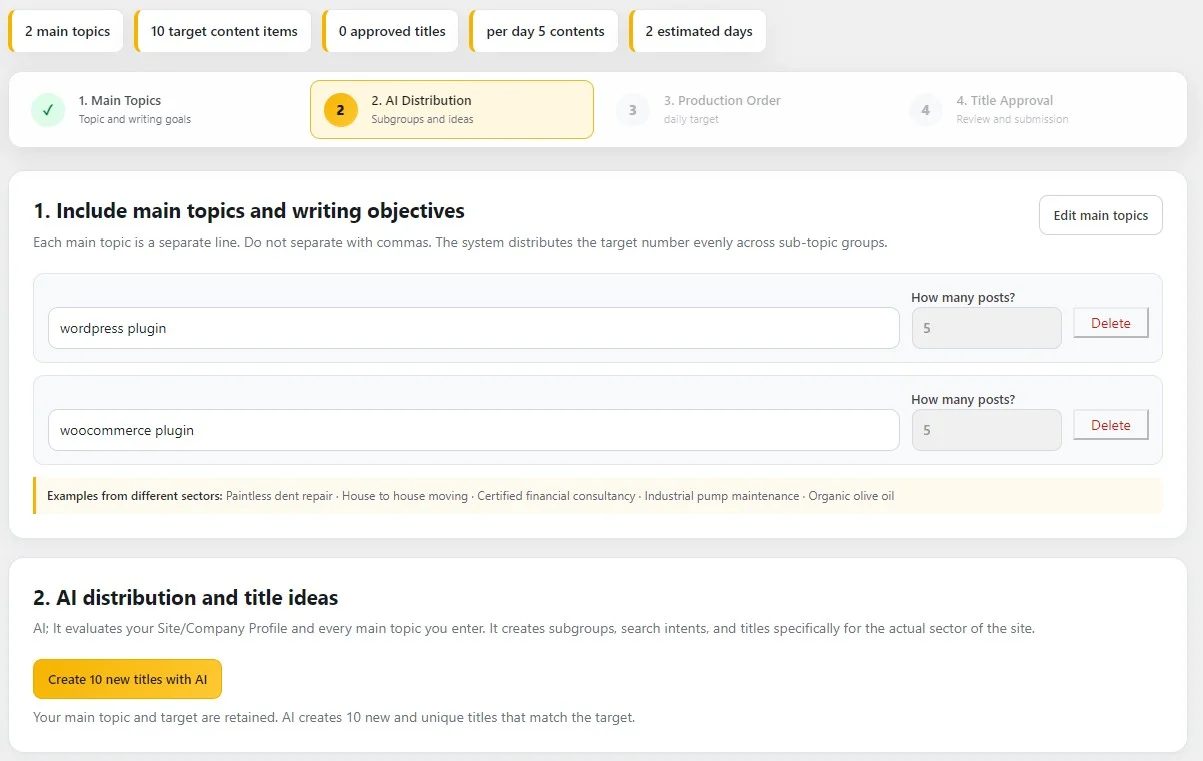
Before creating new articles, it is useful to understand what the website already contains.
A WordPress site may include dozens or hundreds of posts.
Some may still be useful.
Some may overlap.
Some may be outdated.
Some may receive no traffic.
Some may support important commercial pages.
Some may answer questions that remain relevant.
An intelligent content strategy should not ignore this existing library.
Before deciding what should be published next, the website can examine its current content categories and identify where new information would add value.
For example, a WordPress website focused on AI content automation may already have pages about AI writing and SEO.
Instead of producing more versions of the same articles, it may need content about GEO, content freshness, internal linking, automated publishing controls, metadata, content clusters, or AI search visibility.
This creates meaningful expansion.

AI can help maintain a continuous publishing rhythm
Regular publishing is difficult when every article requires manual planning from the beginning.
AI can reduce this planning burden.
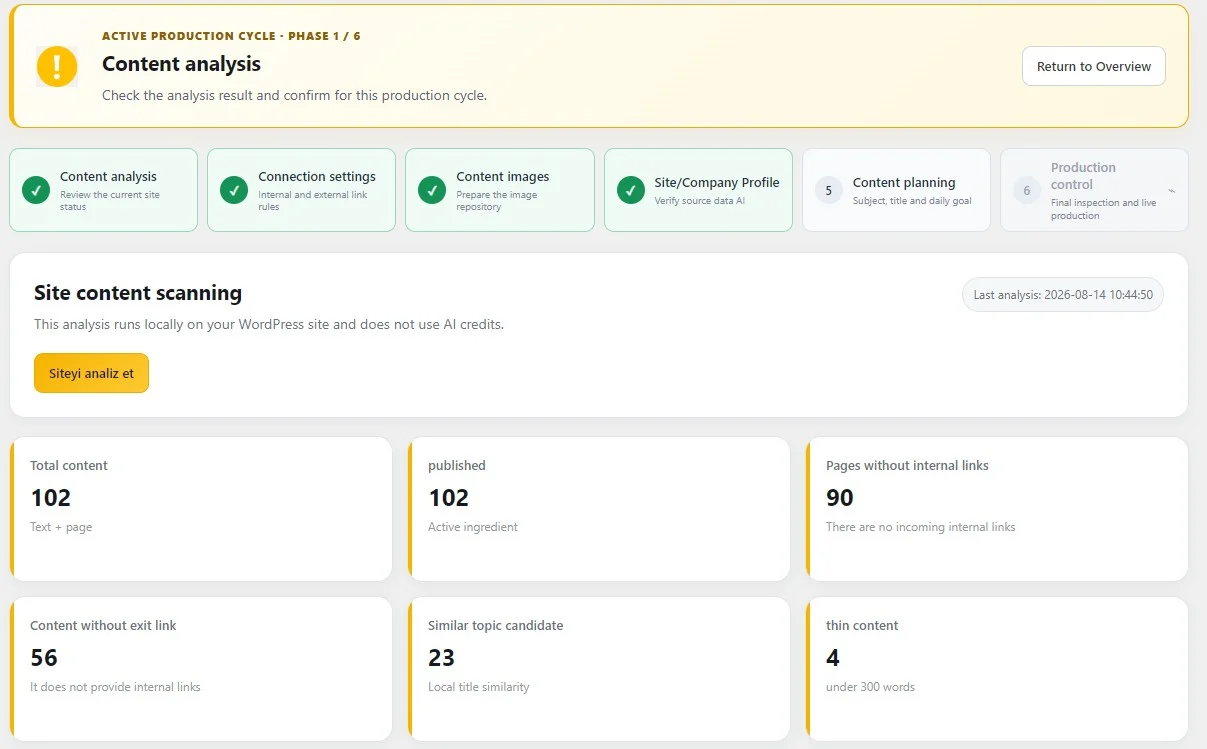
A content automation workflow can work from an approved collection of subjects.
Articles can then be produced according to a defined schedule or daily limit.
This does not mean that every WordPress website should publish every day.
Publishing frequency should match the site’s size, subject, and available content opportunities.
A small professional services website may benefit from a modest but consistent schedule.
A larger informational site may require more frequent publishing.
The important factor is continuity.
A website that publishes useful content steadily over time can build a much more coherent information library than one that publishes twenty articles in a week and then remains inactive for a year.
Fresh content should introduce new search opportunities
One of the main SEO benefits of continued publishing is the ability to address additional search queries.
A business cannot realistically target every relevant question on a few service pages.
Blog content provides room to answer more specific searches.
For example, a company offering WordPress-related solutions might have a main product page targeting a broad commercial keyword.
Supporting articles can then address specific informational searches.
How can WordPress content be automated?
How can AI help with SEO writing?
How should automatically generated content be reviewed?
How can WordPress content remain fresh?
How can content be optimized for generative search?

Each question represents a different search opportunity.
AI automation can help businesses cover these queries systematically.
This makes content freshness directly relevant to SEO expansion.
Freshness should not create duplicate content
Publishing regularly introduces an important risk.
As the content library grows, new articles can begin to resemble existing ones.
This problem is especially common with AI because content can be generated quickly.
Consider a site that already has an article about keeping WordPress content updated.
Creating another article called how to update your WordPress blog regularly may result in almost the same content.
The wording may be different, but the user intent could be identical.
A strong automation strategy should therefore consider existing topics before adding new ones.
Every article should answer a distinct question or approach a subject from a genuinely different perspective.
This protects the site from unnecessary internal competition and helps build wider topical coverage.
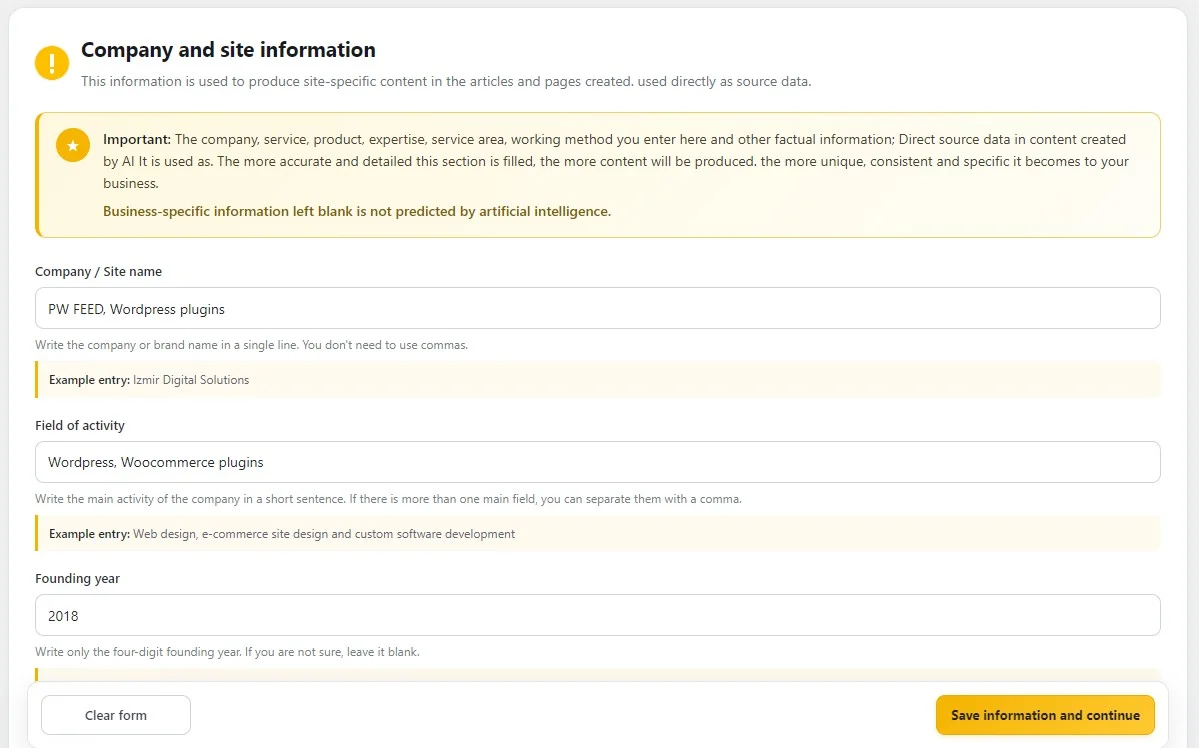
PW Feed can be used within this kind of structured WordPress content strategy where new pages are intended to expand the site rather than duplicate it.
Updating existing content can be as valuable as creating new content
Content freshness is not limited to new publication.
Sometimes the best action is improving an existing article.
An older page may contain useful information but need additional explanation.
A product mentioned in the article may have changed.
An example may no longer be relevant.
A section may need clarification.
New terminology may have become important.

SEO practices may have evolved.
Generative search may have introduced new GEO considerations.
AI can assist with identifying these situations and expanding older content.
This approach helps preserve the value of established URLs while improving the information available to users.
For some websites, a balanced strategy of new content creation and existing content improvement may be more effective than constantly creating additional pages.
Search behavior changes over time
People do not always search for the same concepts using the same language.
Technology changes quickly.
New terms appear.
Old terminology becomes less common.
New problems become important.
AI search itself is a good example.
Several years ago, most website content strategies focused almost entirely on traditional search engines.
Today, businesses also discuss AI search, answer engines, generative search, AI visibility, GEO, and conversational discovery.
A WordPress website that never updates its content strategy may miss these changes.
AI automation can make it easier to introduce new subjects as search behavior evolves.
The content system can incorporate new target topics while keeping them connected to the existing website structure.
GEO makes content freshness even more important
Generative Engine Optimization changes the way businesses think about content maintenance.
Traditional SEO often focuses heavily on rankings for specific queries.
GEO also considers how clearly a website communicates information that generative systems can interpret.
AI systems benefit from consistent and current information.
If a website contains several conflicting descriptions of a product, service, company, or process, interpretation can become more difficult.
Fresh content should therefore support consistency.
When a business changes how a service works, new content should reflect that change.
When terminology evolves, important pages may need revision.
When new functionality is introduced, related articles should explain it.
PW Feed content can maintain clear relationships between PW Feed, AI content automation, SEO, GEO, WordPress, and wordpress plugin functionality.
This helps create a recognizable informational environment around the product.
Freshness does not require changing pages without reason
Updating content simply to change a publication date provides little value.
An article should be updated when there is something meaningful to improve.
For example, a revision may add new information, remove outdated guidance, clarify a difficult section, add current examples, improve internal links, or incorporate new terminology.
Artificially editing sentences without improving the page does not necessarily make the content more useful.
The objective is informational freshness, not cosmetic freshness.
AI automation should therefore be used to identify and create meaningful improvements rather than meaningless changes.
Content gaps provide a natural source of fresh topics
A website often reveals its own future content opportunities.
Existing pages may introduce subjects that are never fully explained.
Customer support questions may reveal recurring problems.
Service pages may contain terms that users want to understand.
Product features may require educational content.
These are content gaps.
Instead of searching endlessly for random high-volume keywords, businesses can build new articles around these gaps.
This keeps the content closely connected to real website needs.
For PW Feed, relevant content gaps could include topics around AI publishing, automated WordPress workflows, SEO-friendly article generation, GEO optimization, content freshness, unique metadata, internal links, content planning, and AI-driven search visibility.
Each new subject strengthens the broader topical structure.
Automatic topic rotation can improve variety
A useful content automation strategy can divide topics into different groups.
One group may focus on AI.
Another may focus on WordPress workflows.
Another may cover SEO.
Another may focus on GEO.
Another may address content management.
Another may answer specific user questions.
Rotating between these topic groups helps prevent repetitive publishing.
It also creates a more balanced website.
For example, publishing ten consecutive articles about AI content generators may provide less value than publishing ten articles that cover different aspects of the overall content automation process.
Variety supports originality while maintaining topical relevance.
New content should strengthen older pages
Fresh content becomes more valuable when it connects with existing resources.
An article should not necessarily end its relationship with the website once it is published.
New posts can support older pages through internal links.
Older pages can also be updated to reference newer resources.
This creates a growing network of related information.
Suppose a website publishes a new article about keeping WordPress content fresh with AI automation.
An older page about AI-powered content workflows may be able to link to it naturally.
A future page about content planning may also reference the same subject.
Over time, these relationships create a richer site architecture.
Search engines can better understand related topics, while visitors can move between useful resources.
Content freshness can improve user trust
Users notice when a website appears abandoned.
An inactive blog is not always a problem, but in rapidly changing industries it can create uncertainty.
If the newest article discusses technology that is several years old, visitors may wonder whether the business remains active.
Current and useful content provides a different signal.
It shows that the website is being maintained.
It demonstrates that the business continues to discuss developments in its field.
For software, AI, WordPress, SEO, and digital services, this can be particularly valuable because these subjects evolve quickly.
Fresh content therefore supports not only search visibility but also user confidence.
AI can help small teams compete with larger publishers
Large organizations often have dedicated content departments.
Smaller businesses usually do not.
AI changes this balance.
A small team can use an AI-powered wordpress plugin to reduce time spent on repetitive content production.
This does not automatically give a small site the same authority as a major publisher.
However, it can make consistent publishing more achievable.
A small business can focus its expertise on a narrower subject and use automation to communicate that knowledge more regularly.
This can be especially effective when the content reflects genuine business knowledge rather than generic AI information.
Content should remain connected to commercial goals
Fresh content should support the website’s purpose.
A business blog is not an independent publishing project.
Its articles should ultimately help users understand the company’s field, products, services, or expertise.
This does not mean every article should be promotional.
Informational content should primarily provide value.
However, users who want to learn more should have a logical next step.
Readers who want additional information about PW Feed and its WordPress AI content solutions can use the PW Feed contact page.
Those who have already evaluated the solution and want to review purchasing options can continue to the PW Feed buy page.
These links provide a natural path from informational research to commercial action without turning the entire article into an advertisement.
Automatic publishing limits help protect quality
One of the advantages of AI is speed.
One of the risks of AI is also speed.
A system capable of producing many articles can quickly create a large amount of unnecessary content if there are no controls.
Publishing limits can help.
A website may define a daily maximum.
It may define a monthly content allowance.
Certain topic categories may require manual approval.
Some articles may be saved as drafts while others can be published automatically.
These controls make automation more sustainable.
They prevent the objective from becoming simply producing as much content as possible.
The real goal should remain publishing useful pages consistently.
Evergreen and timely content should be balanced
Not every article needs constant updates.
Some content is evergreen.
An explanation of a basic WordPress concept may remain relevant for years.
Other subjects change quickly.
Articles about AI search, software features, SEO developments, or new technologies may require more frequent revision.
A balanced content strategy recognizes these differences.
Evergreen articles provide a stable foundation.
More dynamic topics keep the website connected to current developments.
AI can help maintain both categories.
It can generate new evergreen resources while also helping identify subjects that may need updating because the surrounding environment has changed.
Content freshness supports topical expansion
A website develops authority by covering relevant subjects in meaningful depth.
Fresh publishing creates opportunities to expand from broad topics into narrower ones.
For example, a website may begin with a general article about AI content creation.
Later, it can publish separate resources about automatic WordPress drafts, SEO metadata, GEO, content clusters, publishing workflows, content freshness, and internal linking.
This gradual expansion is more natural than attempting to publish every possible topic immediately.
It also creates room for learning.
Website owners can observe which subjects matter most to users and expand those areas further.
AI should not remove editorial judgment
Automation is useful because it reduces repetitive work.
It should not remove strategic decisions.
The website owner should still decide which topics represent the business.
They should determine which information is important.
They should monitor whether the content remains accurate.
They should review how the overall content library develops.
AI can assist with execution.
Human judgment determines direction.
This balance is particularly important for maintaining freshness because relevance cannot be reduced to a simple publication date.
A technically new article can still be strategically outdated.
PW Feed and continuous WordPress content development
PW Feed supports a model where WordPress content is treated as an evolving system.
AI can assist with content creation, but the wider objective is maintaining a relevant and organized website over time.
SEO helps identify search opportunities.
GEO helps improve clarity for generative search environments.
Content planning prevents duplication.
Automation reduces repetitive work.
WordPress provides the publishing infrastructure.
Together, these elements create a practical foundation for ongoing content development.
Businesses can use this approach to maintain an active content presence without manually rebuilding the entire publishing process for every article.
Freshness should be measured by usefulness
The strongest definition of fresh content is simple.
The information should still help the person who finds it today.
A recent publication date cannot compensate for weak information.
An older article does not automatically become useless.
The focus should remain on usefulness.
Does the page answer the query?
Does it reflect current business information?
Is the terminology still relevant?
Are the links useful?
Does the article contribute something different from other pages?
Can search engines understand its purpose?
Can AI systems identify the important concepts?
If the answers remain positive, the content is still valuable.
Building a sustainable freshness strategy
A sustainable strategy combines several actions.
New articles should be published when genuine content opportunities exist.
Older pages should be reviewed when information changes.
Duplicate subjects should be avoided.
Topic groups should expand logically.
SEO and GEO should be considered together.
Internal links should evolve as the website grows.
Publishing volume should remain controlled.
Business information should remain consistent.
AI automation can make these activities easier to maintain.
The objective is not to create an endless content machine.
The objective is to build a WordPress site that continues to provide relevant information as both the business and search environment evolve.
Final thoughts on keeping WordPress content fresh with AI automation
Keeping WordPress content fresh requires more than adding a new blog post occasionally.
It involves maintaining relevance across the entire website.
AI automation can help businesses create new articles, identify content opportunities, maintain publishing consistency, expand topical coverage, and support ongoing content improvement.
SEO provides direction for traditional search visibility.
GEO prepares content for a world where generative systems increasingly influence how people discover information.
A wordpress plugin can make these processes easier to integrate with the existing WordPress environment.
PW Feed brings these elements together around a structured approach to AI-assisted content production.
The most successful strategy is not constant publishing for the sake of activity.
It is continuous improvement.
Every new article should add something useful.
Every important update should make existing information more accurate.
Every new topic should strengthen the website’s broader subject structure.
When AI automation is used with these principles, content freshness becomes a manageable long-term process rather than an endless manual task.