
How AI can reduce manual content work in WordPress
Managing content on a WordPress website involves far more manual work than many businesses initially expect. Writing an article may be the most visible part of the process, but it is only one task among many.
Website owners must decide what to write about, research topics, identify relevant keywords, create titles, structure articles, prepare SEO elements, review existing pages, add internal links, create drafts, publish content, and then repeat the process regularly.
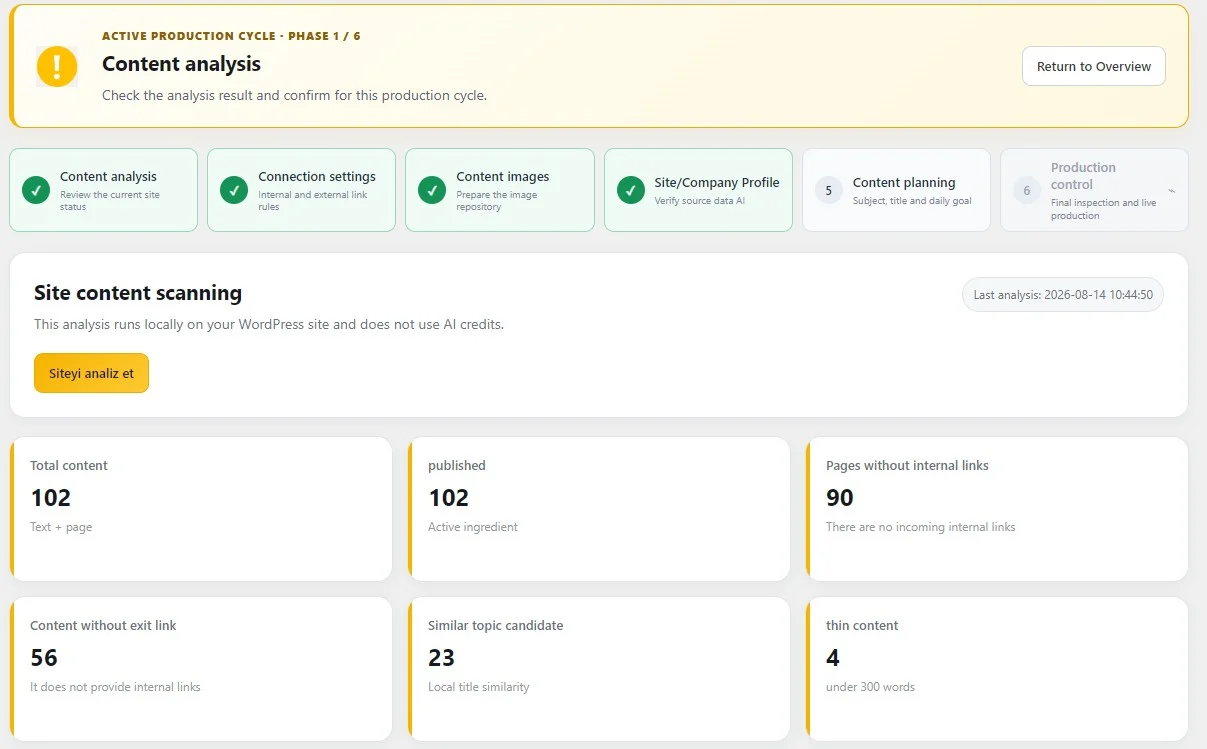
For a business owner or a small team, this workload can quickly become difficult to maintain.
Artificial intelligence offers a different approach.
Instead of using AI only as a writing assistant, WordPress users can build a more efficient content system where repetitive tasks are automated while important strategic decisions remain under human control.
PW Feed is designed around this idea. By combining AI content creation with WordPress workflows, SEO, GEO, and wordpress plugin functionality, businesses can reduce the amount of repetitive manual work required to maintain an active website.
The goal is not to remove people from the content process. It is to allow people to spend less time on repetitive production tasks and more time on decisions that require business knowledge, judgment, and experience.
Where does manual WordPress content work begin?
Content workload often starts before a single sentence is written.
Someone must first determine what the website needs.
Which topic should be covered next?
Has the subject already been discussed?
Which keyword should the page target?

What does the user expect to find?
Should the content be a blog post or a page?
Does it support an existing service?
Should it link to another resource?
Once these decisions are made, the writing process begins.
After writing, additional tasks appear.
The content needs to be checked.
A suitable title must be prepared.
An SEO title and meta description may be required.
Links need to be inserted.
The article may need to be saved as a draft, scheduled, or published.

Even a single article can therefore involve many separate actions.
When a website needs dozens of articles over time, the total workload becomes significant.
AI automation is valuable because it can reduce the repetition within this process.
AI can reduce the blank-page problem
Starting a new article from nothing is often one of the slowest stages of content production.
A writer may know the general subject but still need to decide how to introduce it, which questions to answer, how to divide the topic, and what information should appear first.
AI can generate a structured starting point based on defined instructions.
Instead of staring at an empty WordPress editor, the user can begin with a complete draft.
This changes the nature of the work.
The human role moves from initial production toward review and refinement.
For businesses that understand their field well but do not have time to write every article manually, this can create a major efficiency improvement.
The company can define the subject and important points while AI handles much of the repetitive writing process.
Topic discovery can also be automated
Writing is not the only time-consuming task.
Finding useful subjects can require considerable effort.
A website may already contain many pages, making it difficult to identify what should be published next.
AI can assist by examining the broader topic area and identifying potential content gaps.
For example, a WordPress website focused on AI content generation may already explain its primary product.
Additional useful subjects might include automated publishing, SEO-friendly content creation, content freshness, metadata generation, internal linking, content clusters, GEO, or AI search visibility.
The important principle is relevance.
AI should not simply produce a long list of random popular keywords.
Topics should relate directly to the website’s products, services, expertise, and target audience.

When topic selection is incorporated into the content workflow, website owners spend less time repeatedly asking what they should write next.
Keyword planning does not need to be entirely manual
Keyword selection can also become repetitive.
Each article needs a clear primary subject, but it can also benefit from related terminology.
Traditionally, someone may create a list of keyword variations manually and then try to distribute them throughout the article.
AI can help identify semantic variations that belong naturally to the topic.
For an article about reducing manual WordPress content work, relevant terms may include:
AI content automation
WordPress AI content
automatic content creation
WordPress content workflow

AI writing automation
SEO content generation
WordPress publishing automation
AI SEO content
GEO content optimization
wordpress plugin
These terms do not need to be inserted mechanically.
They help define the semantic environment of the article.
AI can use them naturally while maintaining readability.
This reduces the manual effort involved in trying to place every phrase individually.
AI can build an article structure automatically
Content structure is another stage that traditionally requires manual planning.
A detailed article may need to answer several related questions.
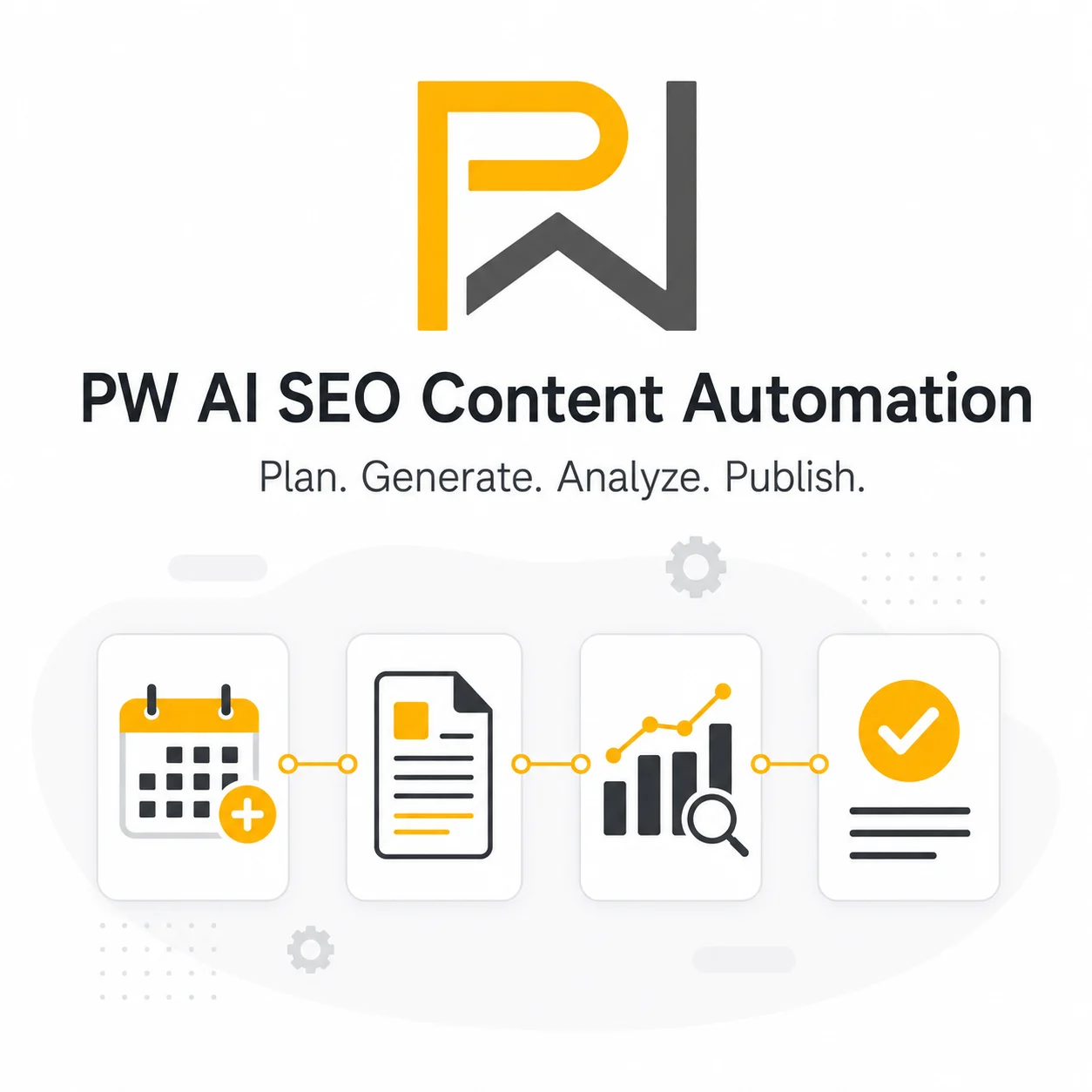
Without a structure, the writing can become repetitive or disorganized.
AI can create a logical progression before or during content generation.
For example, an article may begin by defining the problem, continue by explaining the repetitive tasks involved, examine specific areas that can be automated, discuss SEO and GEO implications, and finish with practical considerations.
This allows every section to have a distinct purpose.
A clear structure is valuable for readers because it makes long-form content easier to follow.
It also supports SEO by helping the page cover the topic comprehensively.
For GEO, structured explanations can make important concepts and relationships easier for generative systems to interpret.
Manual rewriting can be reduced
Businesses often produce content that contains the right information but needs improvement.
A paragraph may be too short.
An explanation may be unclear.
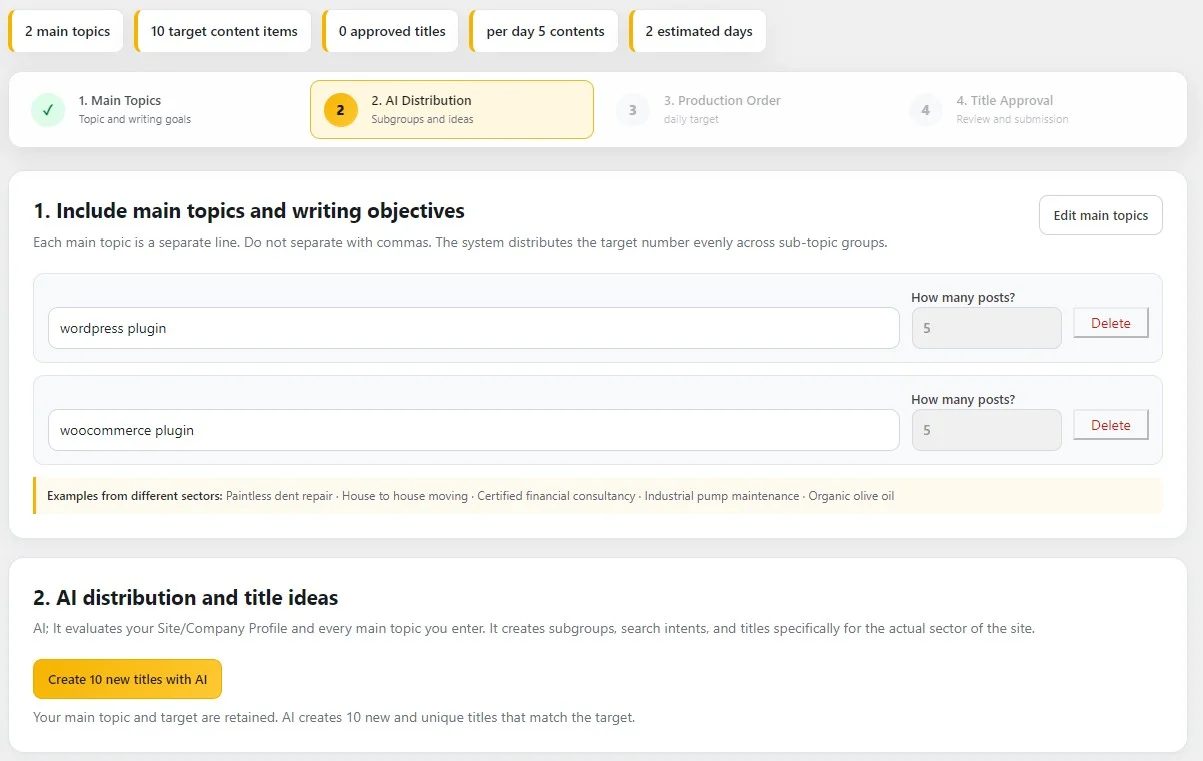
A section may repeat another part of the article.
The tone may not match the website.
Traditionally, these problems require manual rewriting.
AI can assist with refinement.
It can expand a section, simplify a difficult explanation, remove repetition, or adapt the content to a defined style.
This does not mean that every sentence should be changed automatically.
The advantage is that the human user can identify what needs improvement without rewriting everything manually.
This can be especially valuable for small teams where the person responsible for content also manages other parts of the business.
SEO title creation can be streamlined
Preparing SEO titles for many pages can become surprisingly repetitive.
Each title needs to represent the page accurately while remaining distinct from other pages.

A website with a growing content library must also avoid creating multiple titles that target the same intent.
AI can generate candidate titles based on the actual article topic.
A structured system can also use rules that encourage differentiation.
For example, an article about automatic publishing should not have almost the same title as an article about reducing manual content work.
The subjects are related, but the search intentions are different.
This distinction helps avoid keyword cannibalization.
Automating title generation can therefore save time while also supporting a more organized SEO structure.
Meta description creation can be automated
Meta descriptions are another repetitive task.
They are short, but writing a unique description for every article can require time, particularly when a website publishes regularly.
AI can create a meta description that reflects the specific page.
The important requirement is uniqueness.
If every automatically generated page receives nearly the same description, the benefit is limited.
The description should summarize what the user will find on that particular page.
For this article, the emphasis should be reducing manual content work with AI.
A different article about content freshness should emphasize maintaining updated and relevant WordPress content.
Automatic generation works best when the system understands these distinctions.
Draft creation can eliminate repetitive WordPress actions
A typical manual workflow may involve opening WordPress, creating a new post, adding a title, copying content from another application, formatting the text, and saving the page as a draft.
When repeated frequently, these small tasks add up.
A wordpress plugin can integrate AI content generation directly into the WordPress environment.
Instead of creating content externally and transferring it manually, the article can be generated where it will ultimately be managed.
This reduces unnecessary steps.
Draft mode can preserve human control.
The system prepares the content, and the website administrator reviews it before publishing.
For many businesses, this balance between automation and review is more practical than either fully manual writing or uncontrolled automatic publication.
Routine publishing decisions can be automated
Not every article requires a unique publishing process.
A website may have clear rules.
Certain categories may always be saved as drafts.
Other types of informational articles may be eligible for automatic publication.
Content may be limited to a specific number of posts per day or month.
Once these rules are defined, the system can apply them consistently.
This eliminates repetitive decisions.
Instead of deciding the publishing status of every individual article manually, the administrator defines the policy once.
Automation then follows that policy.
PW Feed can support this type of structured content process by connecting AI content production with controlled WordPress publishing.
AI can help reduce duplicate topic research
As a content library grows, checking whether a subject has already been covered becomes more difficult.
A website with ten articles may be easy to remember.
A website with hundreds of articles is different.
Before writing a new post, someone may need to search the existing site manually.
This becomes another repetitive task.
A structured content system can consider existing topics when determining what should be created next.
The objective is to identify whether the new article offers a distinct search intent.
This is more important than simply checking whether the exact same title exists.
Two titles can be different while the actual pages answer the same question.
Reducing duplicate topic research saves time and can also protect SEO quality.
Internal linking can require significant manual effort
Internal linking is valuable, but manually maintaining it becomes harder as a website expands.
A writer needs to remember which related pages exist, select appropriate anchor text, and determine where a link provides value.
AI can assist by identifying relevant relationships.
For example, an article about reducing manual WordPress content work may relate naturally to pages about AI-powered content workflows, automated publishing, SEO-friendly content creation, and content planning.
The system can suggest or create these relationships based on relevance.
This does not mean every keyword should automatically become a link.
Over-automation can create unnatural linking patterns.
The useful role of AI is to reduce the search effort required to find related pages while keeping the final structure logical.
AI can standardize recurring content requirements
Many businesses have rules that should apply to every article.
Certain terms must be included.
Some subjects should be avoided.
Content may need a minimum depth.
Specific commercial pages may need to be referenced.
Articles may need to incorporate SEO and GEO considerations.
When writers manage these requirements manually, something can easily be forgotten.
A structured AI workflow can make these requirements part of the generation process.
This improves consistency.
For PW Feed-related content, for example, important context can include PW Feed, WordPress, AI content creation, SEO, GEO, automation, and wordpress plugin functionality.
By defining these elements as part of the workflow, the user does not need to remember them independently for each article.
Reducing manual work does not mean reducing quality
Automation sometimes creates concern that faster production must mean weaker content.
This is not necessarily true.
The outcome depends on how AI is used.
If the objective is simply to publish the maximum number of articles, quality can decline quickly.
If the objective is to automate repetitive tasks while maintaining content rules, AI can improve efficiency without abandoning standards.
A useful workflow might automate initial drafting while requiring topic relevance.
It can automate metadata while checking for uniqueness.
It can automate publishing while enforcing volume limits.
It can automate keyword integration while avoiding excessive repetition.
The key is controlled automation.
Human expertise remains important
AI can reduce manual content work, but it does not replace genuine business knowledge.
A business knows its customers.
It understands which questions matter.
It knows how its services actually work.
It knows what differentiates its products.
It understands which claims are accurate.
This information should guide AI.
The strongest workflow combines business knowledge with automation.
Humans provide direction and context.
AI handles repetitive production.
This division of work can be much more efficient than asking a business owner to spend hours writing every article from scratch.
Small businesses can benefit significantly
Large companies may have content writers, editors, SEO specialists, and marketing teams.
Small businesses often have one person performing several of these roles.
For them, manual content production can be particularly demanding.
A business owner may understand that regular content is valuable but simply lack enough hours in the day.
AI provides an opportunity to reduce this gap.
The company can establish its content areas, target keywords, business information, and publishing preferences.
A wordpress plugin can then help turn these rules into repeatable content production.
This makes long-term publishing more realistic for businesses without large marketing departments.
Agencies can reduce repetitive client work
Digital agencies face a different version of the same problem.
They may manage content for many WordPress websites.
Every client has different services, keywords, brand information, and target audiences.
Repeating the same production steps manually across all sites is expensive and difficult to scale.
AI can assist by using different profiles and rules for each website.
The agency maintains the strategic differences while automating the repetitive stages.
One client may require local service content.
Another may need technology articles.
Another may focus on e-commerce.
The same general workflow can support different content environments when the website context is properly defined.
This can reduce production workload without forcing every client into identical content.
GEO can be incorporated automatically
Generative Engine Optimization introduces new considerations for content production.
Website information should be clear enough for AI-powered search and generative systems to interpret.
Manually checking every article for GEO-related clarity can add another task to the workflow.
AI can help incorporate these principles during generation.
Articles can define concepts clearly.
Important entities can be identified.
Relationships between products, platforms, services, and topics can be expressed directly.
Questions can be answered without unnecessary ambiguity.
This improves readability for people and can also create clearer information for generative systems.
For PW Feed, GEO is therefore not an extra task that needs to be added after writing.
It can be integrated into the content generation rules from the beginning.
SEO can also become part of the production process
The same principle applies to SEO.
Instead of writing an article and then performing a separate optimization stage, the content can be generated with search intent already defined.
The primary topic is known.
Related terminology is incorporated naturally.
The structure covers relevant questions.
The title reflects the search purpose.
The metadata can be prepared alongside the article.
This reduces the amount of manual optimization required afterward.
It also helps avoid the common problem of trying to force a finished article to target a keyword it was never designed around.
Automation can create more time for content strategy
Perhaps the most important benefit of AI is not the minutes saved on any single task.
It is what businesses can do with the time that is recovered.
Instead of spending hours formatting drafts or creating initial article structures, website owners can focus on higher-value questions.
Which services should receive more content support?
Which search areas are becoming more important?
Which customer questions remain unanswered?
Which existing pages should be improved?
Which content produces useful traffic?
Which topics should no longer be prioritized?
These decisions require judgment.
AI automation gives businesses more room to make them.
PW Feed can simplify WordPress AI content production
PW Feed is intended to help WordPress website owners make AI content production more systematic.
Rather than repeatedly moving between separate writing, optimization, and publishing processes, businesses can use a structured WordPress-based workflow.
AI can handle parts of topic development, writing, SEO preparation, GEO-oriented content creation, and routine publishing tasks.
Website owners who want additional information about how PW Feed can support their WordPress content workflow can visit the PW Feed contact page.
Those who want to review purchasing options can continue to the PW Feed buy page.
The purpose of these tools is not to remove human decision-making.
It is to reduce repetitive work around those decisions.
Automation should have clear boundaries
The most effective AI systems usually operate within defined limits.
A website can specify how many articles may be generated.
It can define approved subjects.
It can prevent publication when rules are not satisfied.
It can determine whether content is saved as a draft or published.
It can control which information AI receives.
These boundaries improve predictability.
Without them, automation may create more work instead of less.
Someone may then need to review large amounts of unnecessary content, remove duplicates, correct inconsistent terminology, and reorganize the site.
Good automation prevents those problems before they occur.
AI can turn repeated tasks into reusable rules
Manual work often means making the same decision repeatedly.
Should this article mention a specific product?
Should SEO and GEO be considered?
Which commercial pages should be available to readers?
What publication status should be used?
What subjects should be avoided?
When these decisions are predictable, they can become rules.
This is one of the most powerful ways AI reduces workload.
The website owner makes the decision once.
The system applies it consistently.
The result is not only faster production but also greater standardization.
Efficiency should be measured over the long term
Saving ten minutes on one article may not appear significant.
Saving that time across hundreds of content tasks is different.
AI content automation should therefore be evaluated as a long-term operational improvement.
The benefits accumulate.
Topic selection becomes faster.
Draft creation becomes faster.
Metadata preparation becomes faster.
Publishing becomes easier.
Routine formatting becomes more consistent.
SEO and GEO considerations can be integrated automatically.
For a website that intends to publish continuously, these improvements can transform content management from an occasional burden into a manageable process.
Final thoughts on reducing manual WordPress content work
AI can reduce manual content work in WordPress most effectively when it is used as part of a structured system.
The objective should not be to automate every decision.
The objective should be to automate work that does not need to be repeated manually.
Topic preparation can become more systematic.
Initial drafts can be generated automatically.
SEO-related terminology can be incorporated naturally.
Metadata can be prepared alongside content.
GEO principles can be included from the beginning.
Drafts can be created directly inside WordPress.
Publishing rules can be applied consistently.
Internal linking can become easier to manage.
Duplicate topic checks can reduce unnecessary production.
PW Feed combines these principles within a WordPress-focused AI content approach.
For businesses, the result can be more than faster writing.
It can mean a simpler content operation.
The website owner retains control over the business, strategy, and priorities while AI performs much of the repetitive production work.
That is where AI provides its greatest practical value for WordPress.
It does not remove the need for good content decisions.
It gives businesses more time to make those decisions well.