
How to build a consistent WordPress content strategy with AI
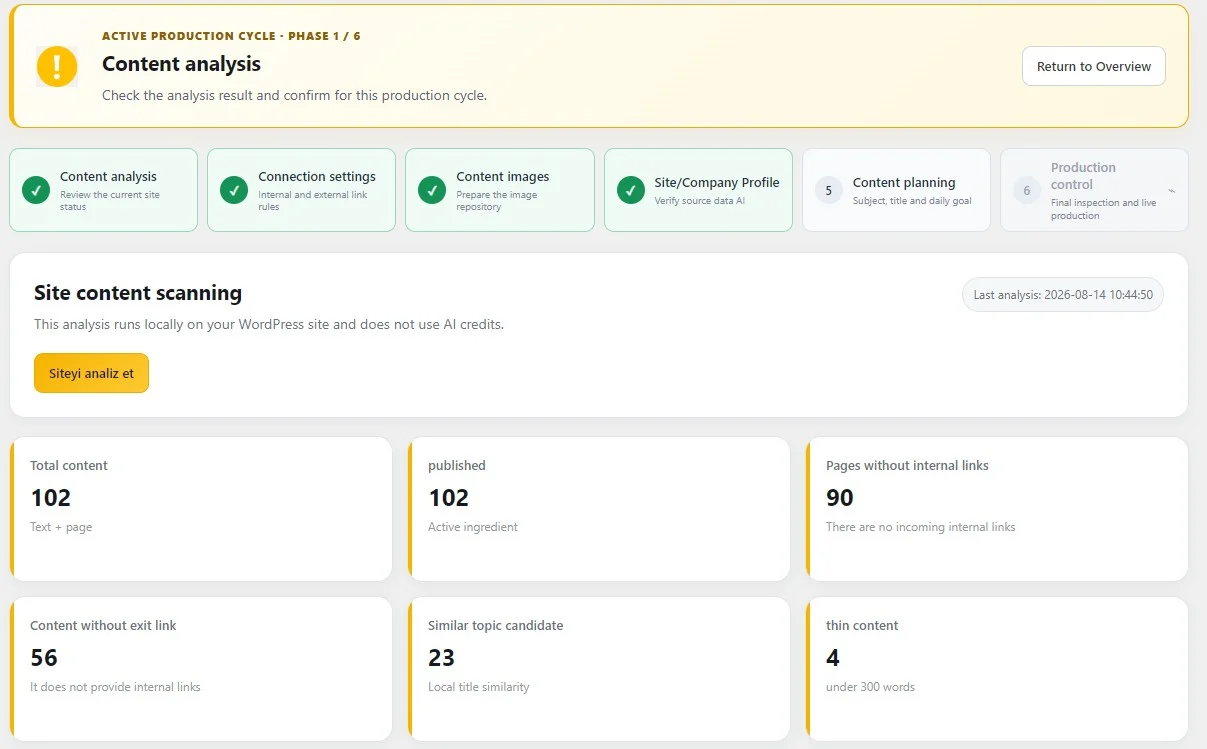
A consistent WordPress content strategy is not built by publishing random articles whenever there is time. It is built by creating a repeatable system that connects business goals, user questions, search intent, SEO, GEO, internal relevance, and publishing discipline.
This is where AI can become especially useful.

Artificial intelligence can help reduce the repetitive work involved in content production, but its real value appears when it is used within a clear strategy. A website that uses AI without planning may create large amounts of text but still fail to build meaningful topical depth. A website that uses AI within a structured content system can create articles that support each other, strengthen important subjects, and improve long-term search visibility.
PW Feed supports this type of approach by combining AI content creation with WordPress workflows, SEO, GEO, and wordpress plugin functionality.
The objective is not simply to publish more. It is to publish with greater consistency, relevance, and control.
What does a consistent content strategy mean?
Consistency in content does not mean every article should look the same.
It means the website should follow a stable direction.
The subjects should relate to the site’s real purpose.
The tone should remain appropriate.
The level of detail should remain reliable.
SEO principles should be applied consistently.
GEO considerations should remain part of the content process.
Publishing should follow an intentional rhythm.
New articles should connect logically with existing pages.
A consistent strategy therefore creates continuity.
Visitors should be able to understand what the website specializes in.
Search engines should be able to identify the main subject areas.
AI-powered discovery systems should encounter clear and repeated relationships between the brand, products, services, and relevant topics.
This creates a stronger overall content environment.
Consistency begins with defining the website’s core subjects
Before using AI to create content, a business should define the subjects it genuinely wants to own.
These are not simply keywords.
They are the main areas of expertise around which the website should build information.

For a WordPress AI content platform, core subjects may include:
AI content creation.
WordPress automation.
SEO content workflows.
GEO.
Automatic publishing.
Content planning.
Internal linking.
Metadata.
Content quality.
AI search visibility.

These subjects can then be divided into narrower topics.
This creates a content structure.
Instead of asking AI to generate something about WordPress, the system can work within approved topic families.
This makes the results much more consistent and useful.
PW Feed can operate within this kind of organized framework where content generation follows the site’s defined subject areas.
A content strategy should separate broad and specific topics
One common mistake is creating too many broad articles.
For example, several pages about AI and WordPress may all overlap heavily.
A stronger strategy separates broad overview pages from specific supporting articles.
A broad page may explain AI content creation for WordPress.
Supporting pages can then focus on:
Automatic publishing.
SEO-friendly post creation.
Content freshness.
Local business content.
Internal linking.
Unique meta descriptions.
Content clusters.
GEO.
AI search visibility.
This creates a hierarchy.
Broad pages establish the main subject.

Supporting articles answer narrower questions.
This structure helps reduce duplication and creates more useful topical depth.
Search intent should guide the content plan
A consistent strategy should not be based only on keyword lists.
It should also consider why people search.
Different users have different intentions.
Some want to learn.
Some want to compare.
Some want to solve a problem.
Some want to buy.
Some want to understand a technology.
A website should cover these intentions separately.
For example, someone searching for AI content automation may be looking for a general explanation.
Someone searching for how to automate WordPress publishing may want a practical workflow.
Someone searching for a WordPress AI SEO plugin may already be evaluating tools.
These searches are related but not identical.
A content strategy becomes stronger when each page is built around a distinct user objective.
AI can help scale this process, but the intentions should be defined first.
Consistency does not mean repeating the same keyword
Keyword repetition is not a content strategy.
A website can use the same phrase in dozens of articles and still provide weak coverage.
The stronger approach is semantic depth.

For example, a site focused on AI content can naturally use related terms such as:
WordPress AI content.
AI SEO content.
Automatic WordPress publishing.
AI article generation.
SEO automation.
GEO content optimization.
Content workflow.
WordPress content strategy.
AI search optimization.
wordpress plugin.
These terms help define the broader subject.
However, each article should use them according to its specific purpose.
An article about content planning should not be overloaded with publishing terminology if that is not the main subject.
Relevance should guide keyword use.
AI can help maintain publishing continuity
One of the biggest challenges in content strategy is consistency over time.
Businesses often publish actively for a short period and then stop.
This breaks continuity.
AI can reduce the production burden and make steady publishing easier.
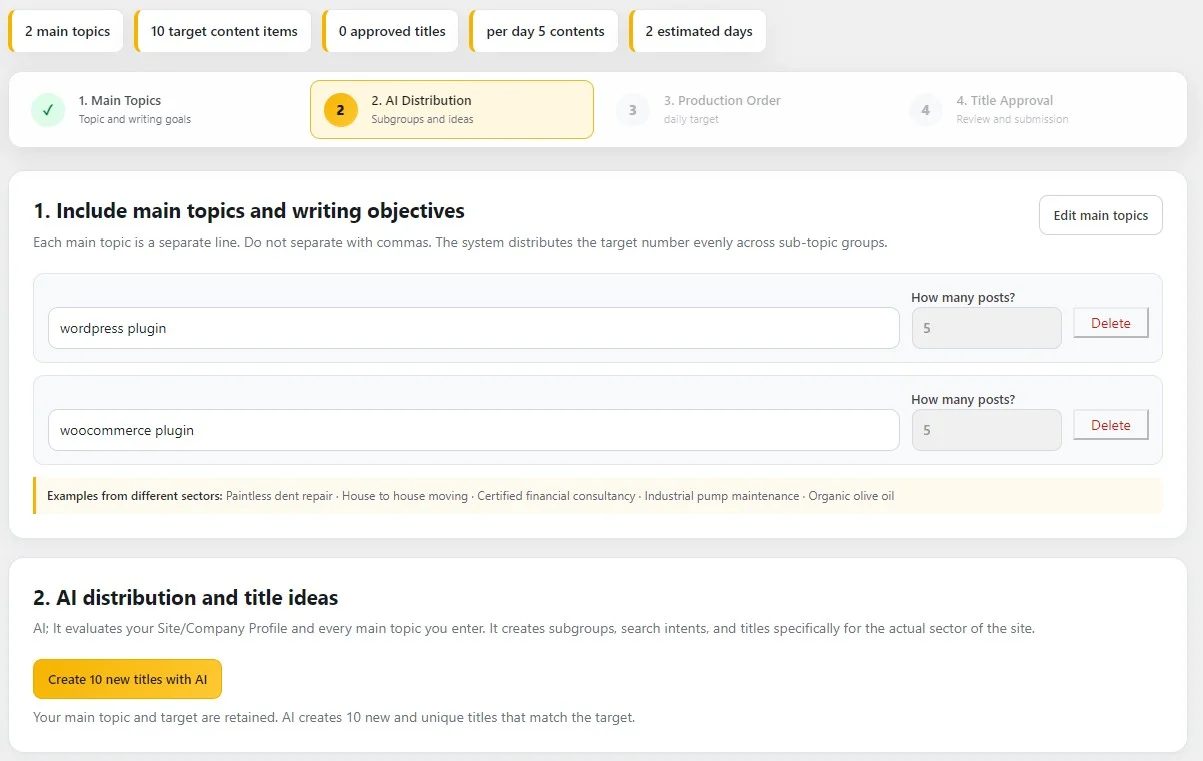
A predefined content list can be created.
Topics can be prioritized.
Articles can be generated according to a controlled schedule.
This allows the website to continue developing even when the business has limited writing time.
The important point is that the schedule should remain realistic.
A smaller website may only need a few strong articles each month.
A larger content platform may publish more frequently.
The ideal frequency depends on how many genuinely useful topics exist.
A publishing calendar can improve strategic control
A consistent WordPress content strategy benefits from a publishing calendar.
The calendar does not need to be complicated.
It can simply identify which topic will be published next and how it relates to the wider site.
For example:
Week one may focus on AI publishing.
Week two may focus on SEO content.
Week three may focus on GEO.
Week four may focus on content planning.
This rotation helps maintain topic balance.
It also prevents one subject from dominating the website unnecessarily.
AI can then generate content according to the planned sequence.
This creates a more intentional editorial process.
Topic clusters can improve consistency
Topic clusters are especially useful for building a structured content strategy.
A cluster contains one broader subject and several supporting pages.
For example, the main subject may be WordPress AI content automation.
Supporting articles may cover:
Automatic blog publishing.
SEO-friendly content generation.
Content freshness.
Reducing manual work.
Local business automation.
Content strategy.
Internal linking.
Metadata.
GEO.
This approach creates strong relationships between pages.
It also gives the website a clear expansion path.
Instead of inventing every new topic independently, future articles can be added to existing clusters.
This improves consistency and helps maintain topical organization.
Internal links should reflect the strategy
Internal linking should not be treated as a random SEO task.
Links can help express the content strategy itself.
A supporting article can link to a broader topic page.
Related articles can link to each other when there is a genuine connection.
Commercial pages can receive links from relevant informational content.
This creates a clearer path for both users and search engines.
For example, an article about content consistency may naturally connect with pages about automated publishing, content planning, or AI SEO workflows.
The anchor text should remain natural.
Links should exist because they provide additional value.
A structured internal linking approach reinforces the relationships that already exist within the content plan.
SEO should be integrated from the beginning
SEO should not be added at the end as a separate layer.
The content strategy itself should be SEO-informed.
Topic selection should reflect real search demand.
Search intent should shape page purpose.
Titles should be distinct.
Related terminology should appear naturally.
Internal links should support relevant relationships.
Metadata should be unique.
Each article should have a clear reason to exist.
When SEO is integrated from the beginning, AI-generated content becomes more focused.
The system is not simply writing an article and then trying to optimize it afterward.
It is creating the article around a search objective from the start.
GEO should also be part of the strategy
Generative Engine Optimization adds another important dimension.
AI-powered search systems need content that is clear and understandable.
A consistent GEO approach should help ensure that important concepts are described directly.
The business should be identified accurately.
Products and services should be connected clearly to what they do.
Important terminology should remain stable.
Definitions should be understandable.
Articles should answer questions directly.
This creates a more coherent information environment.
For PW Feed, consistent relationships between PW Feed, WordPress, AI content automation, SEO, GEO, and wordpress plugin functionality help build a recognizable subject framework.
This can support both human understanding and generative interpretation.
Brand terminology should remain stable
Content consistency also involves language.
If a product is described differently on every page, the website can become confusing.
A content strategy should define preferred terminology.
For example, the site may consistently describe a feature as AI content automation rather than alternating between several unrelated phrases.
This does not mean exact wording must be repeated everywhere.
It means the core meaning should remain stable.
Consistent terminology can strengthen brand understanding.
It can also support GEO because generative systems are more likely to encounter clear relationships between the brand and its functions.
AI can help enforce content rules
One of the advantages of AI automation is the ability to apply the same strategic rules repeatedly.
The website owner can define:
Approved topics.
Required terminology.
SEO principles.
GEO requirements.
Publishing limits.
Content depth.
Preferred tone.
Commercial link rules.
Draft or publish preferences.
AI can then use these rules during generation.
This reduces the risk that individual articles drift away from the strategy.
The goal is not mechanical uniformity.
The goal is strategic consistency.
A strategy should leave room for originality
Consistency and originality are not opposites.
A website can maintain the same strategic direction while producing very different articles.
Each article should have a unique purpose.
One may focus on efficiency.
Another may focus on local businesses.
Another may focus on search visibility.
Another may focus on content planning.
The tone, examples, structure, and entry point can vary.
The shared element is that all pages support the same broader website mission.
AI can help create this variety when instructions are specific enough.
Generic prompts often lead to generic articles.
Detailed topic definitions create more distinct content.
Existing content should influence future planning
A strong content strategy should not ignore what has already been published.
Every new topic should be considered in relation to existing pages.
Has this question already been answered?
Does the new article provide a different search intent?
Can it support an older page?
Should an existing article be improved instead?
These questions reduce unnecessary duplication.
They also help keep the site organized.
As a WordPress website grows, this becomes increasingly important.
A content list that was useful at the beginning may need adjustment later.
The strategy should evolve with the website.
Content gaps should drive expansion
Once the main topics are established, content gaps become easier to identify.
A gap is a relevant subject that the website has not yet covered sufficiently.
For example, a site may have strong content about AI writing but very little about GEO.
That may represent an opportunity.
Another website may explain automatic publishing but not internal linking.
That creates another gap.
Content gaps provide a logical roadmap for future publishing.
This is more strategic than selecting topics based only on general popularity.
AI can assist with producing articles for these gaps once they are identified.
Commercial pages and informational pages should support each other
A consistent content strategy should connect informational and commercial content.
Blog articles can educate users.
Commercial pages can explain products or services.
The two should not exist in isolation.
An informational article may introduce a problem.
A product page may offer the solution.
A guide may explain a process.
A contact page may provide a next step.
This creates a natural journey.
Readers interested in learning more about PW Feed and its AI content workflow can use the PW Feed contact page.
Users who want to review purchasing options can continue to the PW Feed buy page.
These links should support the user’s journey without turning every article into a sales page.
A content strategy should define what not to publish
Consistency also depends on limits.
A website should know which topics are outside its scope.
Publishing unrelated content can dilute topical focus.
For example, a WordPress AI content website does not need to cover every technology trend.
It should prioritize subjects connected to its actual product and expertise.
Defining exclusions helps AI remain focused.
This is especially important when automated systems can generate content quickly.
Without limits, topic drift can happen easily.
Controlled scope protects the site’s identity.
Publishing volume should be managed carefully
AI can create content much faster than human writers.
This creates both an opportunity and a risk.
A site may be tempted to publish excessively.
However, consistency should not be confused with volume.
A strong strategy may publish fewer articles while maintaining higher relevance.
A controlled monthly or daily limit can help protect quality.
It also encourages better topic selection.
Every article should justify its place on the website.
This is more valuable than maximizing page count.
Draft mode can support strategic review
A website may want AI to generate content automatically while keeping human review in the process.
Draft mode is useful for this.
The article can be prepared inside WordPress.
The administrator can then check:
Topic relevance.
Search intent.
Business facts.
Brand terminology.
SEO title.
Meta description.
Links.
Potential overlap.
This review helps ensure that the article fits the wider strategy.
Once the system becomes reliable, selected topic categories may be suitable for automatic publication.
Automatic publishing should still follow rules
If a business decides to use automatic publishing, the process should remain controlled.
Approved subjects can be defined.
Publishing frequency can be limited.
Certain content types can remain draft-only.
Commercial claims can require review.
This allows automation to improve efficiency without weakening strategic control.
PW Feed can fit into this type of structured WordPress content process where AI generation operates within defined limits.
Consistency can improve user experience
A well-organized content strategy helps users navigate the website.
Visitors can recognize related subjects.
They can move between articles naturally.
They can find detailed explanations without encountering repeated content.
The site feels more professional.
This matters because content strategy is not only about search engines.
It is also about helping real users understand the website.
A coherent content library can make a brand appear more knowledgeable and trustworthy.
Consistency can also support topical authority
Topical authority develops when a website covers a subject in meaningful depth.
One isolated article provides limited context.
A structured collection of related pages creates much more information around the subject.
For example, a WordPress AI content website that covers publishing, SEO, GEO, content planning, internal linking, metadata, and automation presents a broader field of expertise.
Search engines can identify these relationships.
AI systems may encounter the same entity connected consistently with related concepts.
This creates a stronger overall signal than disconnected publishing.
A strategy should be reviewed periodically
Even a good content strategy needs adjustment.
Search behavior changes.
New technologies appear.
Products evolve.
Business priorities shift.
Some topics become more important.
Others become less useful.
Periodic review helps keep the strategy relevant.
The business can identify:
Which subjects are well covered.
Where duplication exists.
Which pages need improvement.
What new content gaps have appeared.
Which articles support conversions.
Which topics should be deprioritized.
AI can then be used within the updated plan.
This creates a dynamic system rather than a static content calendar.
PW Feed and long-term WordPress content planning
PW Feed is designed to support businesses that want to make AI content production more systematic.
The platform can be used as part of a WordPress content strategy where topics, SEO, GEO, publishing, and business context are connected.
The key advantage is structure.
Instead of generating isolated articles whenever a new idea appears, the website can follow an organized roadmap.
This can reduce repetition.
It can improve content consistency.
It can make publishing easier to scale.
It can also help ensure that every new page contributes to a wider strategic objective.
A consistent strategy creates compounding value
One strong article can be useful.
A connected collection of strong articles can be much more powerful.
Each new page adds context to the others.
Internal links become more meaningful.
Topic clusters become deeper.
Commercial pages receive more informational support.
Search engines gain more information about the site’s subject.
Generative systems encounter a clearer knowledge structure.
This creates compounding value.
The benefit of the twentieth relevant article can be greater than the benefit of the first because it strengthens an existing content network.
That is one of the main reasons consistency matters.
Final thoughts on building a consistent WordPress content strategy with AI
A consistent WordPress content strategy is built through direction, not volume.
AI can make content production faster, but strategy determines whether that speed creates value.
The website should define its core subjects.
Search intent should guide page purpose.
Topic clusters should organize related content.
SEO should influence planning from the beginning.
GEO should help make information clear for generative discovery.
Brand terminology should remain stable.
Internal links should reflect genuine relationships.
Publishing frequency should be controlled.
Existing pages should influence future topics.
Content gaps should guide expansion.
PW Feed can support this process by combining AI content generation with WordPress, SEO, GEO, and wordpress plugin functionality.
For businesses, the most important benefit is not simply producing more articles.
It is building a content system that continues to make sense as the website grows.
When every new page supports a defined subject, answers a distinct question, and connects logically with existing content, AI becomes a strategic publishing tool rather than a simple text generator.
That is the foundation of a consistent WordPress content strategy.