
AI-generated content for service business websites
Service businesses sell expertise, experience, trust, and solutions rather than physical products. This creates a different content challenge from e-commerce websites or general publishing platforms.
A potential customer cannot always understand the quality of a service by looking at a photograph or reading a short description. Before making contact, people often want to understand what the service includes, whether it fits their problem, how the process works, what they should expect, and why they should choose one provider over another.

A WordPress website can answer these questions, but creating enough useful content manually can require significant time.
AI-generated content offers service businesses a practical way to turn their knowledge into detailed website information while maintaining a controlled publishing process.
PW Feed can support this approach by combining AI content generation, SEO, GEO, and wordpress plugin functionality. Instead of creating generic articles simply to increase page count, a service business can use AI to explain specific problems, processes, decisions, and customer concerns connected to its real expertise.
The result can be a stronger informational layer around the commercial pages of the website.
Why service businesses need more than a basic service page
Many service websites are built around a small number of pages.
There may be a homepage, an about page, a contact page, and several service pages.
This structure explains what the company offers, but it may not answer the detailed questions potential customers ask during the decision process.
A service page might say that a company provides WordPress development, accounting services, automotive repair, legal consulting, digital marketing, property maintenance, or another professional service.
That is useful, but customers often want more detail.
They may ask:
When is this service necessary?
How does the process work?
What should I prepare?
What are the differences between available options?
Which problems can be solved?
What factors affect the result?
How long can the process take?
What should I consider before choosing a provider?
These questions create opportunities for informational content.
AI can help transform them into dedicated articles without forcing the main commercial service page to become unnecessarily long.
Service content should begin with customer problems
The strongest content topics often begin with a problem rather than with the business itself.
Customers usually search because they need an answer.

A person may not initially search for a particular company.
They may search for the problem they are experiencing.
This distinction is important for SEO.
A service business can use informational articles to appear earlier in the customer journey.
For example, a company might have a commercial page describing a technical service.
Supporting articles can explain symptoms, causes, possible solutions, preparation, common mistakes, or decision criteria related to that service.
The customer discovers the information first.
The business becomes visible because it provided a useful answer.
AI-generated content can make it easier to cover these specific problems systematically.
The goal is not to mention the company in every paragraph.
The goal is to demonstrate knowledge around the problems the company actually solves.

Real expertise should guide AI-generated articles
AI should not determine what a service business knows.
The business should provide the direction.
This is one of the most important differences between useful AI content and generic AI writing.
A service provider has practical knowledge that comes from working with real customers.
It knows which situations are common.
It understands which mistakes people make.
It knows what information customers often misunderstand.
It can explain which solutions are suitable in different circumstances.
This expertise should form the foundation of the content strategy.
AI can then assist with organizing and expanding the information.
For example, the business may provide a short description of a recurring customer problem.
AI can turn that information into a detailed article that explains the subject, covers related questions, uses relevant search terminology, and presents the information in a logical structure.
This approach allows the business to scale its knowledge without asking employees to become full-time writers.
Every service deserves its own information ecosystem
A strong service page should not have to answer every possible question.
Instead, supporting content can create an information ecosystem around each important service.
Imagine a company provides three primary services.
Each service can become the center of its own topic group.
Around the first service, the website may publish articles about:
Common problems.
When the service is required.

How the process works.
Frequently asked questions.
Comparison with alternative solutions.
Preparation.
Maintenance.
Common misconceptions.
Expected outcomes.
Around the second service, an entirely different set of questions can be addressed.
This creates focused topical depth.
The commercial page explains what the business offers.
Supporting articles explain the wider subject.
Together, they create a stronger information structure.
AI can help create content for different stages of the customer journey
Not every visitor is ready to contact a service provider immediately.
Some users are only beginning their research.
Others understand the problem but are comparing solutions.
Some already know what service they need and are evaluating providers.
Content can address each stage.
Early-stage content may explain a problem or concept.
Middle-stage content may compare possible solutions.
Later-stage content may explain the service process, benefits, preparation, or provider selection.
This creates a more complete customer journey.
AI content generation can help service businesses build articles for each stage without manually producing every page.
SEO can then connect these pages with relevant searches.
GEO can help ensure that the information is clear enough for AI-powered discovery systems to interpret.
Service content should answer questions directly
Customers generally do not want unnecessarily complicated explanations.
They want clear answers.
This is particularly important for GEO.
Generative search systems and AI assistants often work with information that directly defines relationships and answers specific questions.
A service article should therefore explain key concepts clearly.
If there are conditions or limitations, they should be stated.
If different solutions are appropriate in different situations, the distinction should be explained.

If professional evaluation is required before a decision can be made, the content should say so.
This directness improves user experience.
It also creates clearer information for AI-based search environments.
GEO does not require stuffing an article with special phrases.
It benefits from useful, explicit, well-organized information.
AI can expand short service descriptions into deeper topics
Many WordPress service pages contain only a few paragraphs.
This may be enough for a quick overview but not enough to establish wider topical relevance.
Instead of making every service page extremely long, AI can help create supporting resources.
Suppose a service page briefly explains a process.
The blog can provide a separate detailed article about that process.
Another article can explain common customer questions.
Another can address mistakes.
Another can compare options.
This allows the service page to remain commercially focused while the supporting content provides depth.
Internal links can connect these resources naturally.
Search engines gain more context about the service.
Potential customers receive more information.
Generative systems encounter multiple consistent explanations around the same area of expertise.
SEO-friendly service content requires distinct search intent
Service websites can easily create overlapping articles.
This often happens when several pages target similar commercial keywords.
For example, a company may create separate pages around variations such as:
Professional WordPress service.
Best WordPress service.
WordPress service provider.
WordPress services for businesses.
If the pages contain almost the same information, they may compete with one another.
A stronger approach is to create different informational purposes.
One page can explain how a particular service works.
Another can discuss when it is needed.
Another can explain how to prepare.
Another can compare alternatives.
Another can address common problems.
Each page now answers a different search intent.
AI-generated content should be organized according to these distinctions.
This helps build wider search coverage while reducing unnecessary cannibalization.
Long-tail searches are especially valuable for service businesses
Many service-related searches are highly specific.
A potential customer may describe a problem in detail rather than searching for the official name of the service.
These long-tail searches can be valuable because they reveal strong intent.
The user is not browsing randomly.
They have a specific problem or question.
A service business can create content around these precise situations.
AI makes this more practical.
Instead of writing one broad article covering everything, the website can gradually publish detailed pages that each address a particular issue.
The combined search visibility of these pages can create meaningful organic traffic.
This is especially useful for specialized businesses where customer questions are detailed and technical.
The business profile should guide automatic content
Service businesses need accurate content.
AI should know what the company actually provides.
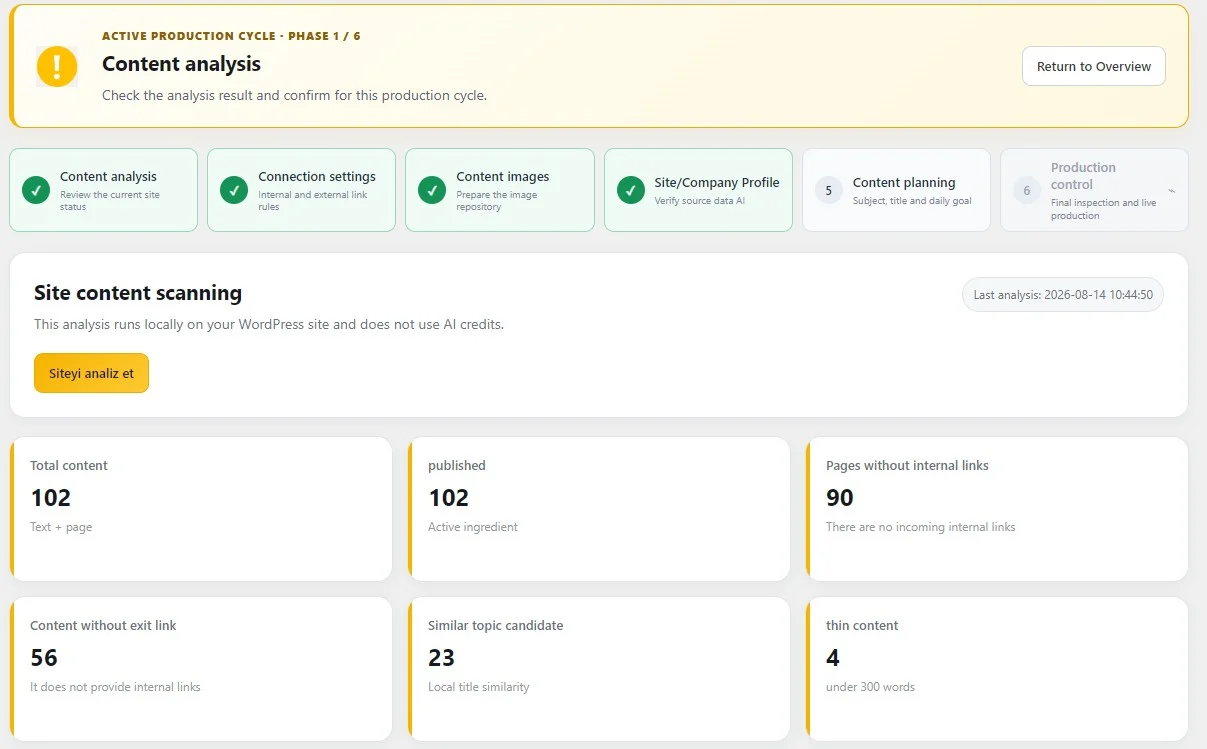
A useful business profile can include:
The company name.
Primary services.
Target customers.
Areas of specialization.
Preferred terminology.
Important limitations.
Service areas where relevant.
Brand style.
Important commercial pages.
Topics that should not be discussed.
This context helps reduce generic or inaccurate articles.
For example, AI should not claim that a business offers a service that is not actually available.
It should not invent guarantees, prices, certifications, or service areas.
The more accurately the content system understands the business, the more useful the generated articles can become.
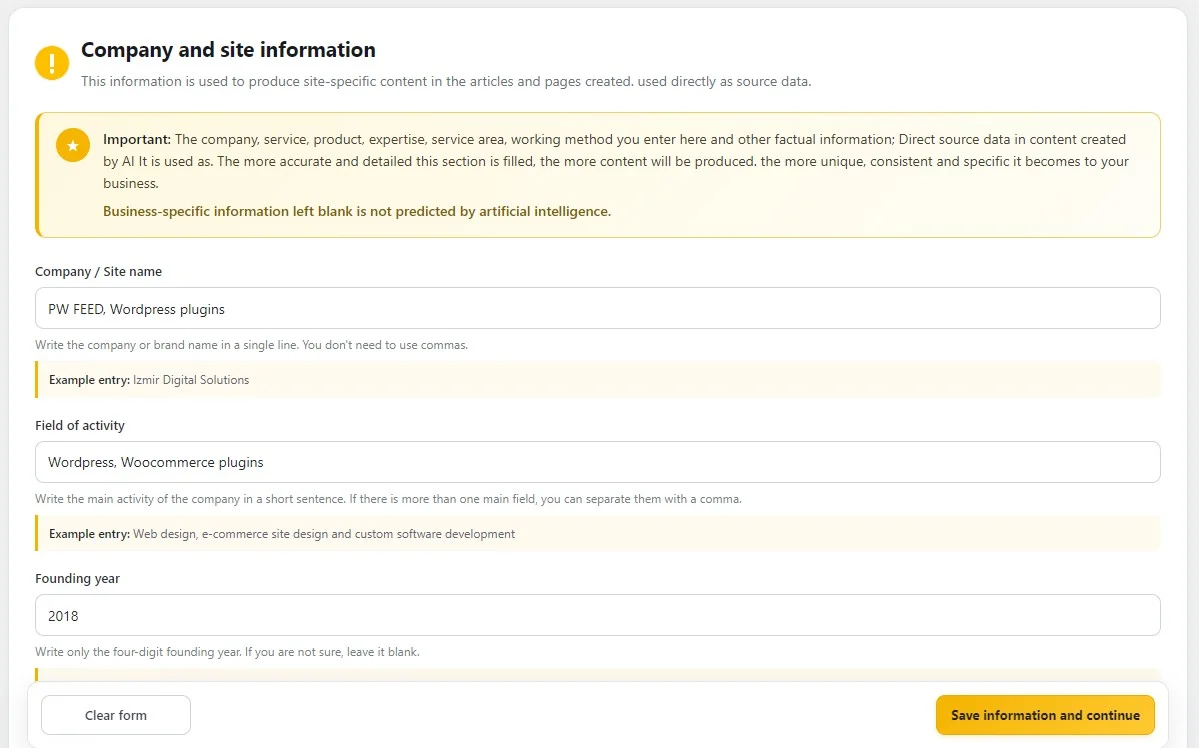
PW Feed can support structured content workflows where business context influences AI generation within WordPress.
GEO can help connect the business with its expertise
Generative Engine Optimization is particularly relevant for service companies because customers increasingly use AI systems to research solutions and providers.
A website should make important relationships clear.
PW Feed, for example, should be consistently associated with WordPress, AI content generation, SEO, GEO, publishing workflows, and wordpress plugin functionality.
A service business should apply the same principle to its own field.
Its content should clearly communicate:
What the company specializes in.
Which problems its services address.
Which subjects it has expertise in.
What type of customers it serves.
Where it operates when geography is relevant.
What users can do next.
Clear entity relationships can make the website easier to understand for both visitors and AI systems.
Service businesses should avoid exaggerated AI-generated claims
AI-generated marketing content can easily become overly promotional.
Statements such as best in the industry, guaranteed results, leading provider, or unmatched service may appear convincing but can create credibility problems when they are unsupported.
Service content should prioritize accuracy.
Explain what the business does.
Describe the process.
Demonstrate expertise through useful information.
Answer difficult questions.
Explain limitations honestly.
Trust is especially important for service businesses because the customer is often buying something that cannot be fully evaluated before delivery.
Useful content can build trust more effectively than exaggerated claims.
Case-style content can demonstrate practical knowledge
Service businesses often have real examples that can become valuable content.
These do not need to reveal private customer information.
A company can describe a common type of situation and explain how professionals approach it.
For example:
What problem was present?
Which factors were considered?
What possible solutions existed?
Why was one approach preferred?
What should customers learn from the example?
This type of content demonstrates practical reasoning.
AI can help organize anonymized business experience into educational articles.
The company supplies the real knowledge.
AI assists with presentation.
This can produce much stronger content than generic descriptions that could appear on any competitor’s website.
Frequently asked questions can become full articles
A frequently asked questions section is useful, but some customer questions deserve more than a two-sentence response.
These questions can become individual articles.
For example, if customers repeatedly ask whether one service is suitable for a particular situation, the website can create a detailed explanation.
The article can address conditions, alternatives, advantages, limitations, and next steps.
This creates a stronger search opportunity.
A short FAQ answer may not provide enough depth to rank for a detailed query.
A dedicated article can.
AI makes expanding these questions much easier.
Internal links should create a path toward the service
Informational content should not become disconnected from the business.
A reader who finds a useful article should be able to continue logically.
An article explaining a problem can link to the relevant service page.
A comparison article can connect to pages explaining each option.
A detailed guide can link to another resource answering a related question.
These relationships improve navigation.
They also help search engines understand which informational pages support which commercial services.
Internal linking should remain contextual.
The objective is not to force commercial links into every paragraph.
The link should appear where it genuinely helps the user.
Content can reduce repetitive customer explanations
Good website content can save time beyond marketing.
Service businesses often answer the same questions repeatedly by phone, email, or messaging applications.
Detailed website articles can reduce some of this repetition.
Staff can direct customers to a clear explanation.
Potential customers may find answers before making contact.
This can improve lead quality.
Someone who has already read about the process may have more realistic expectations when they contact the business.
AI content creation therefore has an operational benefit as well as an SEO benefit.
The business is converting recurring explanations into reusable information.
AI can make specialist knowledge easier to understand
Service businesses often use technical terminology.
Customers may not understand it.
Strong content should bridge this gap.
An article can introduce the technical term and then explain it using accessible language.
Related concepts can be compared.
Complex processes can be divided into understandable stages.
AI can assist with this translation from specialist knowledge to customer-friendly communication.
This supports SEO because users may search using both technical and everyday terms.
It also supports GEO because concepts and definitions become clearer.
Service content should remain useful before becoming promotional
The strongest informational articles provide value even if the reader never becomes a customer.
This may seem counterintuitive, but it helps build trust.
A page that exists only to repeat sales claims provides little reason for users to stay.
An article that genuinely explains a problem can establish credibility.
Commercial opportunities can appear naturally afterward.
Readers who want additional information about PW Feed and its WordPress AI content solutions can visit the PW Feed contact page.
Users who are ready to evaluate purchasing options can continue to the PW Feed buy page.
This creates a clear route from education to action without turning the article into an advertisement.
AI can help maintain consistency across different services
A company with many services may struggle to keep every area of the website equally developed.
One service may have numerous supporting articles while another has almost none.
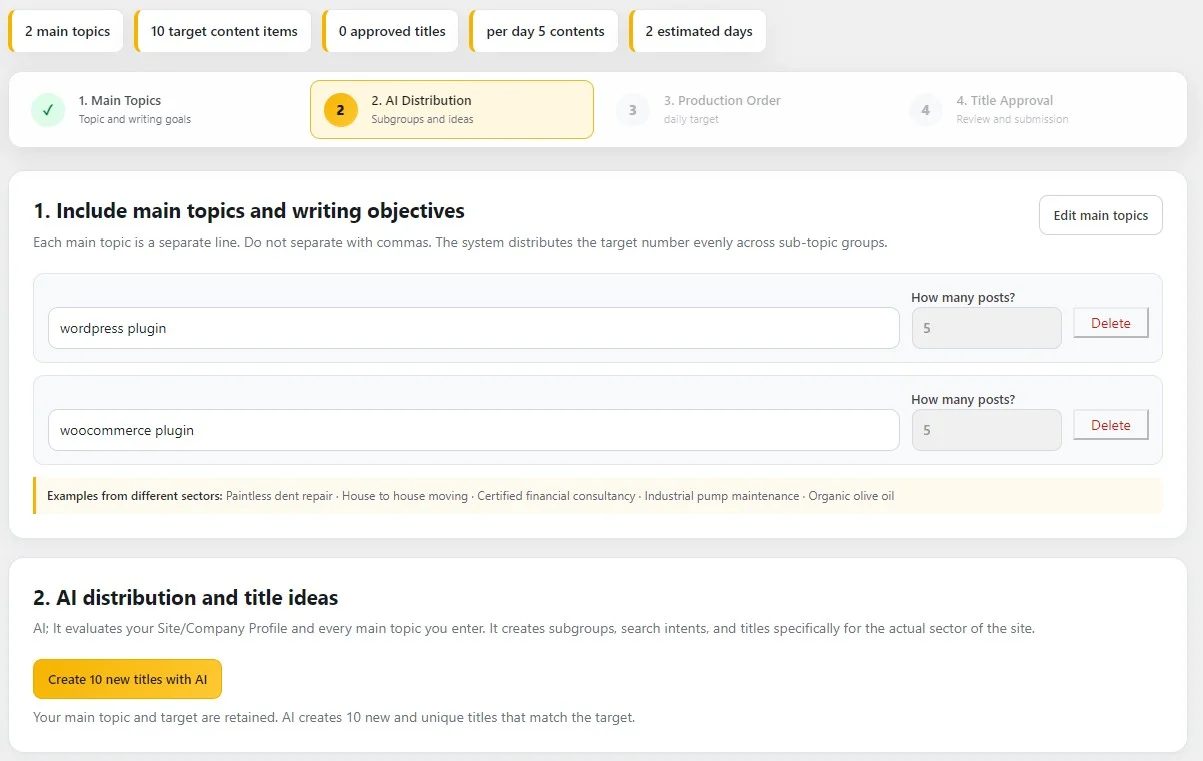
AI can help create a more balanced content plan.
Topics can be grouped by service.
The website can identify which areas already have strong coverage and which need additional information.
New content can then be prioritized accordingly.
This creates a more organized site.
Instead of publishing whatever topic happens to come to mind, the business can build depth across its most important service categories.
Automatic content should not remove professional review when needed
Some service industries involve complex, regulated, technical, financial, legal, medical, or safety-related information.
In these areas, AI-generated content may require professional review before publication.
Automation can still reduce workload.
AI can prepare the structure and draft.
A qualified person can verify the important statements.
This hybrid model is often more efficient than writing everything manually while still protecting accuracy.
A wordpress plugin can support draft-based workflows where content remains unpublished until reviewed.
Automation should adapt to the risk level of the subject.
Local service companies can combine expertise and geographic relevance
Many service businesses operate within specific regions.
For them, content can include geographic context when it is genuinely relevant.
The company may explain where customers are served or discuss conditions specific to its operating area.
However, AI should not create hundreds of artificial location pages by simply changing place names.
Geographic content needs meaningful differentiation.
Accurate location information strengthens both local SEO and GEO.
Artificial geographic expansion can create weak, repetitive pages.
Real service coverage should always guide content.
Service websites benefit from controlled publishing
Because AI can produce content quickly, publishing controls are important.
A company can define how many articles should be generated.
Certain service categories can be prioritized.
Some pages can remain drafts.
Other informational articles may be eligible for automatic publication.
This prevents the website from growing without direction.
A smaller, organized content library can be more useful than hundreds of repetitive pages.
The objective is strategic coverage.
PW Feed and service business content automation
PW Feed can help service companies transform their expertise into a more structured WordPress content system.
The workflow can combine target topics, AI content generation, SEO, GEO, controlled publishing, and wordpress plugin functionality.
The business defines its expertise and priorities.
AI helps perform the repetitive writing work.
WordPress manages the resulting content.
SEO helps align articles with relevant search intent.
GEO helps improve clarity for AI-driven discovery.
This creates a system where service knowledge can gradually become searchable information.
The strongest content often comes from real conversations
Businesses looking for new article ideas should examine their customer interactions.
Questions from sales calls can become articles.
Support enquiries can reveal confusion.
Objections can become comparison pages.
Common mistakes can become guides.
Technical explanations can become educational resources.
These topics often have more value than generic keyword lists because they are connected to real customer behavior.
AI can then help scale them.
This is one of the most practical ways for a service company to develop a distinctive content library.
A service content strategy should grow over time
There is no need to create every possible article immediately.
A website can develop gradually.
Begin with the most important customer questions.
Add articles around core services.
Identify gaps.
Create supporting content.
Connect pages through internal links.
Review which topics attract useful visitors.
Expand the strongest areas.
This gradual process creates a more natural information architecture.
AI makes it easier to sustain because the business does not have to manually write every new article.
SEO, GEO, and expertise should reinforce each other
A strong service business article can support several goals simultaneously.
SEO helps the page connect with relevant searches.
GEO improves clarity for generative systems.
Real expertise provides credibility.
Useful explanations help customers.
Internal links connect the article with the commercial structure of the site.
These goals do not need separate content.
One carefully planned article can support all of them.
The key is beginning with a real information need.
Technology should support the information, not replace it.
Final thoughts on AI-generated content for service business websites
AI-generated content gives service businesses an opportunity to make more of their expertise visible online.
Many companies already possess the knowledge customers are searching for.
The challenge is converting that knowledge into detailed, consistent, searchable content.
AI can reduce the writing burden.
A wordpress plugin can integrate the process with WordPress.
SEO can guide search relevance.
GEO can help prepare information for generative discovery.
Business profiles can preserve context.
Internal links can connect educational articles with commercial services.
Controlled publishing can protect quality.
PW Feed brings these elements together within a structured approach to AI-assisted WordPress content creation.
For service businesses, the strongest result does not come from publishing generic articles at maximum speed.
It comes from systematically answering real customer questions.
Every useful article can explain another problem, clarify another service, demonstrate another area of expertise, and provide another path for potential customers to discover the business.
Over time, these articles can transform a basic service website into a deeper information resource.
That creates value for users, traditional search engines, and the growing number of AI systems people use to discover and evaluate services online.