
How to generate WordPress drafts automatically with AI
Creating content automatically does not always mean publishing it immediately.
For many WordPress website owners, the most practical use of artificial intelligence is to generate complete articles automatically and save them as drafts for later review.

This approach combines two important advantages.
AI reduces the time required to create the first version of an article, while the website owner keeps control over what becomes public.
Automatic draft generation can be especially useful for businesses that want to increase content production without allowing an automated system to publish every article without human review.
PW Feed supports this type of workflow by combining AI content creation with WordPress, SEO, GEO, and wordpress plugin functionality.
Instead of starting every article from an empty editor, website owners can receive prepared drafts based on approved topics, target keywords, business information, and defined content rules.
The administrator can then review, edit, approve, schedule, or publish those drafts according to the needs of the website.
What is automatic WordPress draft generation?
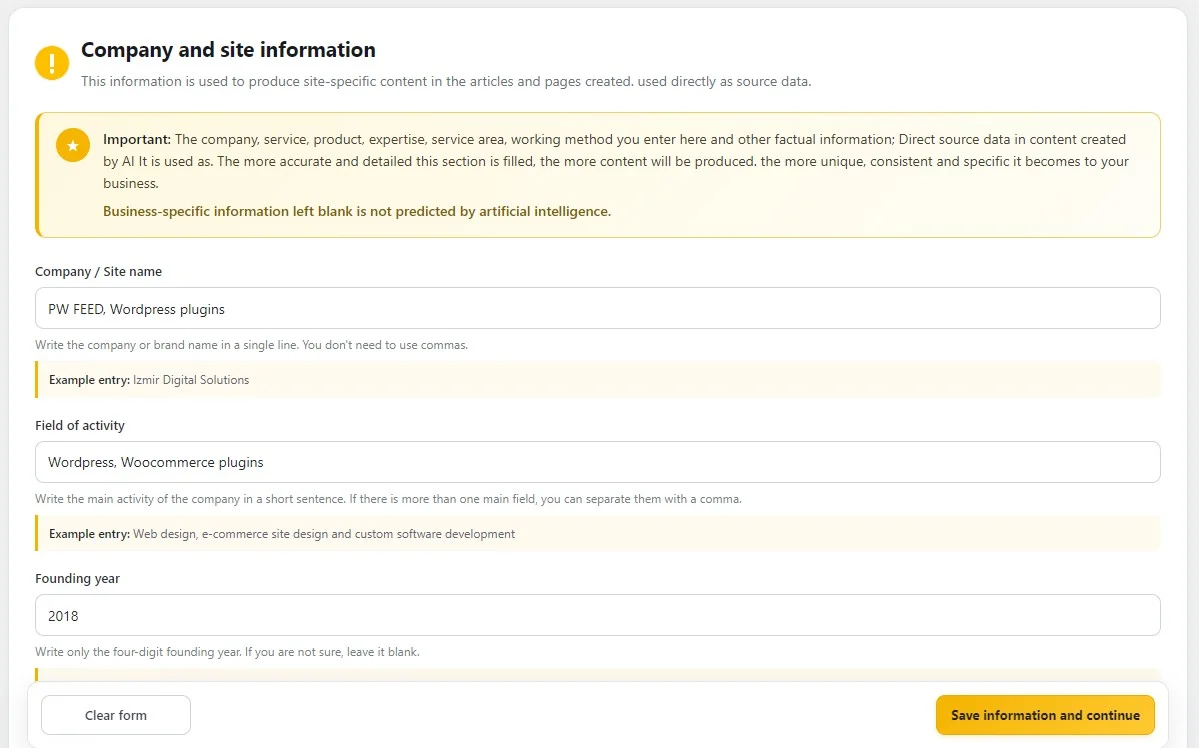
Automatic draft generation means using an AI-powered system to create a new WordPress post without immediately making it visible to the public.
The generated content is stored in WordPress with draft status.
This allows administrators or editors to access the article from the WordPress dashboard before publication.
The article may already contain a title, structured content, relevant terminology, SEO elements, and links depending on how the system is configured.
The important difference is publication control.
The AI creates the content.
The human decides when or whether the content should be published.
This can be an ideal starting point for businesses experimenting with AI content automation.
They receive the efficiency of automated creation without giving up editorial oversight.
Why drafts are useful in AI content workflows
AI can generate content quickly, but websites often contain information that requires context, verification, or human judgment.
A draft provides a safety layer between generation and publication.
For example, the AI may create an article about a company service.
The overall article may be strong, but one paragraph may need additional business-specific information.
A draft allows the administrator to make that change.

Another article may contain terminology that should be adjusted to match the company’s preferred language.
A draft provides the opportunity to correct it.
An automatically published article would require the website owner to discover the issue after it is already public.
Draft-based workflows reduce this risk.
They allow content automation to remain productive while keeping quality control in place.
Draft generation separates writing from publishing
In a traditional manual workflow, writing and publishing are often closely connected.
Someone decides to create an article, writes it, reviews it, and then publishes it during the same process.
AI allows these stages to be separated.
Content can be generated automatically even when the administrator is not ready to publish.
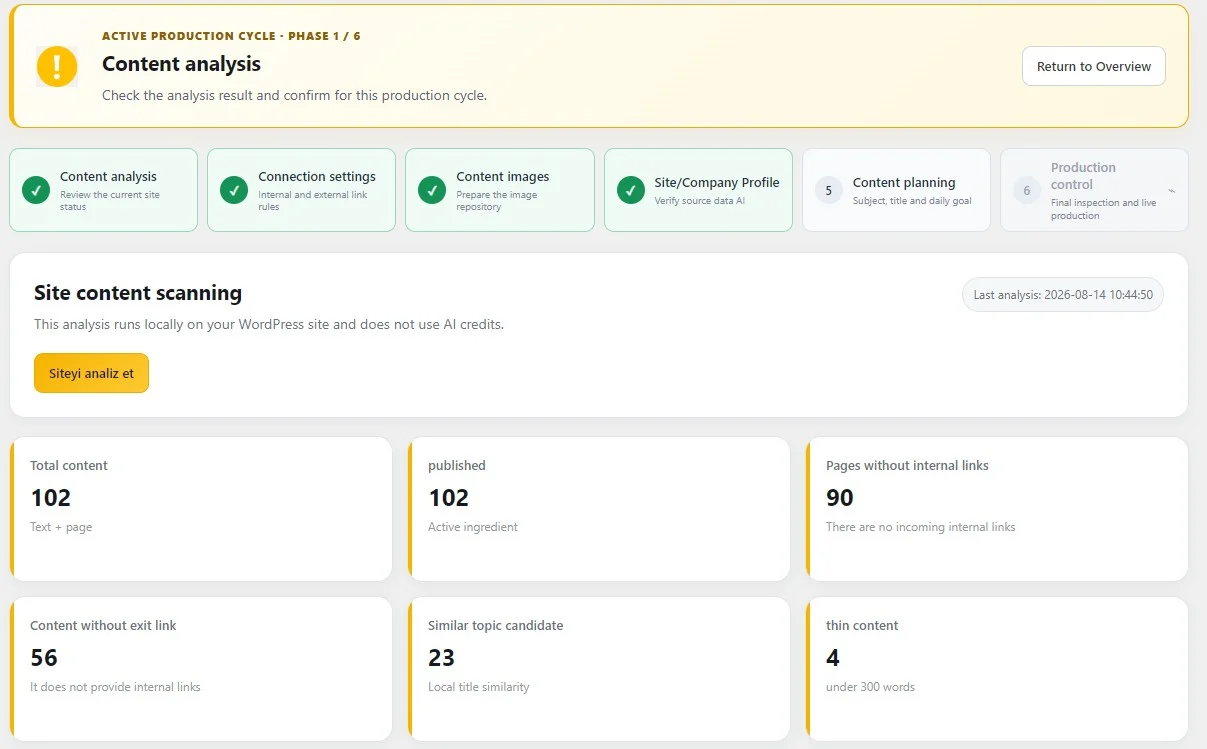
A queue of drafts can accumulate inside WordPress.

The website owner can review them at a convenient time.
This makes content management more flexible.
For example, ten articles might be generated across a month while only selected articles are published according to a planned schedule.
The business is no longer dependent on completing the entire content production process in one session.
Automatic drafts can reduce the pressure of constant writing
Many businesses know they need more content but struggle to find time to write consistently.
A draft-first AI system changes this problem.
Instead of asking an employee or business owner to write a complete article whenever a publishing deadline approaches, the AI system can prepare the content in advance.
The user begins with a completed draft rather than an empty page.
This significantly changes the amount of effort required.
Reviewing a prepared article is usually faster than creating one from the beginning.
The editor can focus on questions such as:
Is the information correct?
Does the article fit the business?
Does the tone feel appropriate?
Are the links useful?
Does the page target a distinct subject?
Is anything important missing?
This turns the human role into editorial review rather than full-scale production.
A draft-first workflow is useful during AI implementation
Businesses implementing AI content automation for the first time may not know exactly how the system will behave.
The initial instructions may need refinement.

Some terminology may require adjustment.
The AI may need more information about the website.
Draft mode provides a practical testing environment.
Generated articles can be reviewed before any public content is affected.
The business can observe patterns.
If introductions are too generic, the instructions can be improved.
If articles are too similar, originality requirements can be strengthened.
If important terms are missing, the business profile can be expanded.
If content is too promotional, the tone can be adjusted.
This iterative process makes the system more reliable.
Once the output consistently meets expectations, the business may decide whether certain types of content can move toward automatic publishing.
Draft generation can support an editorial calendar
A WordPress draft queue can become part of a wider editorial calendar.
Instead of generating an article only on the day it must be published, content can be prepared earlier.
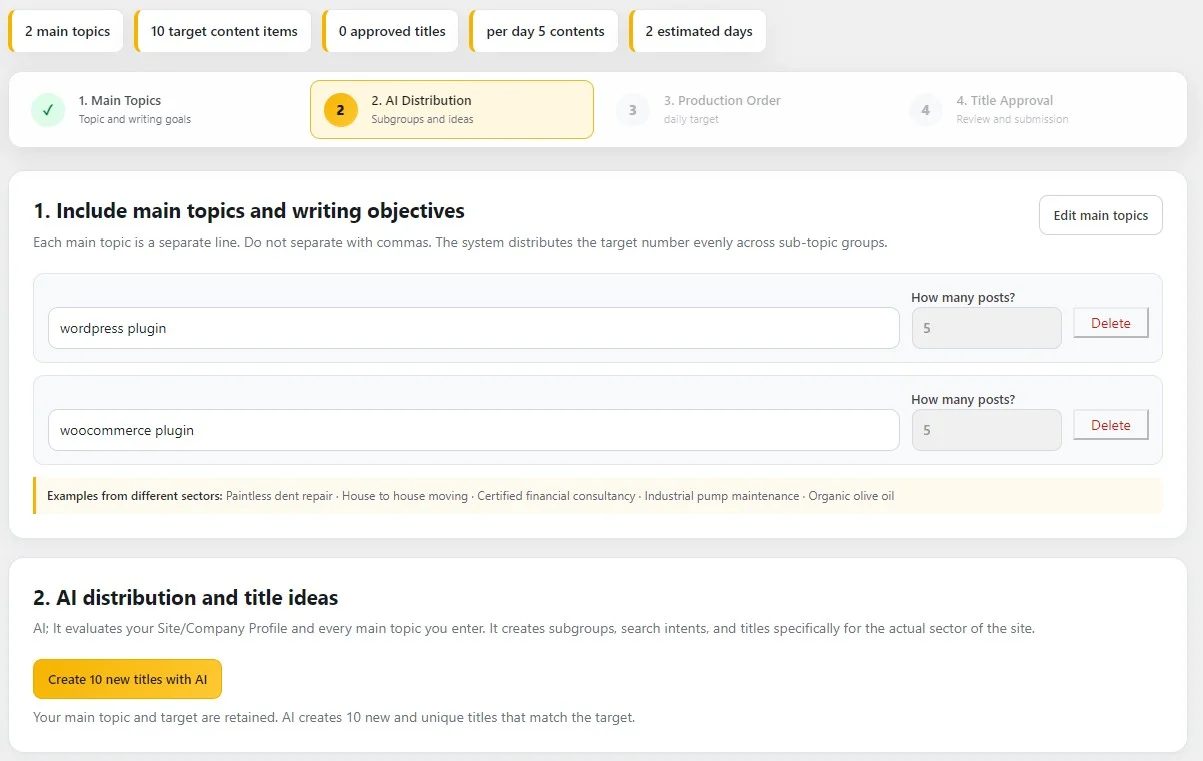
For example, a business may plan four articles for the next month.
AI can generate all four drafts.
The administrator reviews them.
Each article can then be scheduled for a different date.
This creates a predictable publishing rhythm.
The business avoids last-minute content production.
It also gains more time to identify whether topics overlap or whether the sequence should change.
A wordpress plugin that integrates AI directly with WordPress can make this workflow easier to manage.
Topic control should happen before draft creation
Automatic generation should not mean random topic selection.
The quality of the draft depends heavily on the quality of the topic.
A business should define which subjects the AI is allowed to cover.
These may come from:
Target keywords.
Customer questions.
Content gaps.
Service categories.
Product features.
Existing topic clusters.

SEO priorities.
GEO priorities.
The system can then create drafts within these approved areas.
This prevents the WordPress dashboard from filling with articles that have little strategic value.
PW Feed can support a structured approach where AI-generated drafts remain connected to the website’s broader content objectives.
Each draft should answer a distinct search intent
Automatic drafts become much more useful when every article has a clear search purpose.
A website may have a long list of keywords that appear different but represent the same user need.
If AI generates one draft for every keyword variation, the result may be several nearly identical articles.
For example:
How to generate WordPress drafts with AI.
Automatic AI draft creation in WordPress.
Create WordPress drafts automatically using AI.
These titles may represent essentially the same intent.
A better content strategy would create one strong article for that subject and use other drafts to address different questions.
One might focus on automatic publishing.
Another might focus on content review.
Another could explain SEO metadata.
Another may discuss draft approval workflows.
This creates broader topical coverage and reduces keyword cannibalization.
SEO should be included before the draft is generated
A common approach to content creation is to write first and optimize later.
AI workflows can improve this process by integrating SEO from the beginning.
Before generating a draft, the system can know:
The primary topic.
The target search intent.
Relevant semantic terms.
Important internal pages.
The desired article depth.
The specific business context.
The resulting draft is already shaped around the intended search purpose.
This reduces the amount of manual SEO editing required afterward.
The editor can still make improvements, but the first version starts from a stronger position.
AI drafts can include natural keyword variations
SEO-friendly content should not repeat the same keyword excessively.
An AI draft can use related terminology naturally.
For this subject, useful phrases may include:
WordPress AI drafts.
Automatic WordPress draft generation.
AI content creation.
WordPress content automation.
AI-generated WordPress posts.
AI SEO content.
WordPress publishing workflow.
Automatic article creation.
wordpress plugin.
These terms help provide semantic context.
They should appear because they belong to the subject, not because the system is trying to achieve an artificial keyword density.
The draft should remain readable first.
GEO can be incorporated into the draft stage
Generative Engine Optimization should not need to be added manually after the article is created.
GEO principles can be part of the initial generation rules.
The AI draft can define important concepts clearly.
Entities can be identified consistently.
Relationships between the business, product, service, platform, and topic can be expressed directly.
Questions can be answered without vague language.
For PW Feed, for example, content can clearly associate PW Feed with WordPress, AI content generation, SEO, GEO, automated workflows, and wordpress plugin functionality.
This type of clarity can benefit both users and AI-powered discovery systems.
By including GEO from the beginning, the editor does not need to reconstruct the article later to make its meaning clearer.
Drafts make business-specific verification easier
AI can work with business information, but some details deserve human verification.
A service may have specific limitations.
A product may include particular features.
A company may operate in defined geographic areas.
A price may have changed.
A process may depend on individual circumstances.
Draft status provides an opportunity to check these details.
The editor can correct any information that does not reflect the business accurately.
This is especially useful when content contains operational details rather than general educational information.
Accuracy should always be more important than publication speed.
Draft mode is useful for regulated or sensitive industries
Some subjects require particularly careful review.
Legal, financial, health, safety, compliance, and regulated professional content may involve information where errors can have serious consequences.
AI can still assist with drafting.
However, professional review may be necessary before publication.
A draft-first workflow supports this naturally.
AI reduces the initial writing workload.
A qualified person verifies the important statements.
The final article is published only after approval.
This hybrid model can provide efficiency without removing professional responsibility.
Drafts can improve collaboration between team members
WordPress often involves more than one user.
A writer may prepare content.
An SEO specialist may review keywords.
A manager may approve publication.
A technical expert may check factual accuracy.
AI-generated drafts can become the starting point for this collaborative process.
Instead of asking each team member to work from separate documents, the draft already exists inside WordPress.
Different reviewers can focus on their area.
One person checks business accuracy.
Another reviews SEO.
Another approves the final article.
This makes the workflow easier to organize.
For agencies managing multiple clients, this can be particularly valuable.
Agencies can use draft automation across multiple websites
Agencies frequently manage many WordPress websites at the same time.
Manual content creation across all clients can become expensive and difficult to scale.
Automatic draft generation can reduce repetitive work.
Each website can have its own profile.
The profile may contain:
Client name.
Services.
Target audience.
Keywords.
Preferred language.
Important links.
Geographic information.
Content restrictions.
AI can generate drafts according to these site-specific rules.
The agency can then review and approve them.
This creates scalability without publishing generic content across every client website.
The context should remain unique to each business.
Draft automation can support approval workflows
Some organizations require formal content approval.
The person who creates content may not have authority to publish it.
WordPress draft status fits naturally into this structure.
AI can create the article.
An editor can review it.
A manager can approve it.
The article can then be scheduled or published.
This separation of responsibilities can improve control.
It also reduces the risk that an automated system bypasses internal review procedures.
AI should adapt to the organization’s workflow rather than forcing the organization to adapt to unrestricted automation.
Generated drafts should not accumulate without review
Draft automation can create another problem if it is used without limits.
A website may generate dozens or hundreds of drafts that no one reviews.
This creates clutter.
The content may become outdated before publication.
Topics may overlap.
The editorial queue can become difficult to manage.
A better approach uses controlled generation.
The system should produce a manageable number of drafts.
The business can review them regularly.
New drafts can be generated according to actual publishing capacity.
This ensures that automation reduces workload rather than creating a different type of backlog.
Draft limits can protect content quality
A structured system can define how many articles may be generated within a certain period.
For example, a website may allow a specific daily or monthly amount.
This encourages more careful topic selection.
If the business knows only a limited number of drafts will be created, each topic should have a meaningful purpose.
This is more valuable than generating unlimited text.
PW Feed can be used within a controlled content process where AI generation follows defined limits instead of creating uncontrolled volume.
Draft review should check originality
One important review step is determining whether the article adds something new to the website.
The editor should ask:
Does another page already answer this question?
Is the search intent distinct?
Does the draft contain a different informational focus?
Could this topic be added to an existing article instead?
These questions help prevent duplicate content.
AI can produce original wording, but original wording alone is not enough.
The topic itself should also provide unique value.
Draft review should check the opening
AI-generated introductions can sometimes become repetitive.
A website publishing many articles may begin to use the same type of opening repeatedly.
Draft mode allows this to be corrected.
An editor can vary how articles begin.
One may start with a customer problem.
Another may introduce a practical scenario.
Another may explain a misconception.
Another may begin with a direct definition.
This variation makes the content library feel more natural and distinct.
It also helps separate articles that belong to the same broader topic cluster.
Draft review should check content depth
The draft should contain enough information to satisfy the search intent.
Some AI-generated content can appear complete while remaining superficial.
The editor should determine whether important questions are actually answered.
For example, a draft about automatic WordPress draft generation should explain more than the definition.
It should discuss why drafts are useful, how they fit into SEO and GEO workflows, how review works, who benefits, what should be checked, and when automatic publication may be more appropriate.
Depth comes from answering related questions, not from repeating the main keyword.
Draft review should check links
Automatically created links should also be reviewed.
Internal links should point to relevant pages.
Commercial links should appear naturally.
Broken or irrelevant links should not remain in the article.
Readers interested in learning more about PW Feed and its WordPress AI content workflows can use the PW Feed contact page.
Users who want to examine available purchase options can continue to the PW Feed buy page.
These links provide clear next steps while the article itself remains informational.
Drafts can be updated before scheduling
Another advantage of drafts is timing flexibility.
An article may be generated today but scheduled for publication several weeks later.
Before scheduling, the administrator can check whether anything has changed.
This is useful for topics involving software, technology, search, or product functionality.
AI and SEO environments can evolve quickly.
A draft that was accurate when generated may need a small update before publication.
Reviewing it shortly before scheduling helps maintain freshness.
Automatic drafts can reduce formatting work
Creating content outside WordPress often involves additional formatting steps.
The article is written in another application.
It is copied into WordPress.
Paragraph spacing is adjusted.
Links are checked.
Headings may need correction.
An integrated wordpress plugin can reduce this operational work.
The article can be created directly in the environment where it will be reviewed and published.
For websites producing content regularly, reducing these small repetitive actions can save considerable time over the long term.
Draft-first does not mean manual forever
Using drafts does not prevent a business from adopting more automation later.
It can be considered a progression.
The first stage may be fully manual content creation.
The second stage may use automatic draft generation.
The third stage may automate selected low-risk content while keeping important articles as drafts.
The fourth stage may use different rules for different content categories.
This gradual approach gives the business time to understand how AI performs.
Automation can increase as confidence grows.
There is no requirement for every website to move to fully automatic publishing.
For many businesses, draft-first may remain the preferred long-term model.
Draft mode can preserve brand control
Brand voice is important.
An AI-generated article may be factually useful but still need adjustments to sound like the business.
A draft allows this.
The editor can remove expressions that feel too generic.
Technical terminology can be adapted.
The tone can be made more formal or more accessible.
Business-specific language can be added.
This ensures that automation does not make every website sound identical.
The AI provides efficiency.
The business preserves identity.
Draft generation can support multilingual planning
Some WordPress websites operate in more than one language.
AI may help create or adapt content for different language versions.
Draft status becomes particularly valuable in these situations.
Language-specific editors can review terminology, cultural context, and business information before publication.
The website should not assume that direct translation alone produces high-quality localized content.
Search behavior may differ between languages.
Keywords may differ.
Examples may need adjustment.
Draft workflows provide room for these checks.
Draft content can be prioritized before publication
Not every generated article needs to be published in the order it was created.
The business may identify some topics as more important.
A draft about a newly launched service may receive priority.
Another article may be delayed because a related page needs to be created first.
A third may be merged with existing content.
Having a draft library allows these editorial decisions to be made without requiring the article to be written at the last moment.
This creates more strategic publishing.
SEO titles and meta descriptions can also be reviewed as drafts
If the AI system creates SEO titles and meta descriptions, these elements should also be available for review.
The editor can check whether the SEO title accurately represents the page.
It should be distinct from other content.
The meta description should summarize the article without simply repeating generic marketing language.
Automatic creation saves time.
Human review can protect uniqueness.
This combination is one of the strongest advantages of draft-based AI content workflows.
AI-generated drafts can strengthen topic clusters
A website may plan several related pages around a broader subject.
Draft generation allows all of them to be prepared before publication.
The editor can then compare them.
Do the articles overlap?
Does each one serve a different purpose?
Are internal links logical?
Is an important subject missing?
This is easier to evaluate when multiple drafts are visible together.
Topic clusters can therefore be planned as a group rather than one article at a time.
For SEO and GEO, this can create a clearer and more deliberate information structure.
PW Feed and automatic WordPress draft creation
PW Feed can help businesses use AI content generation without requiring immediate automatic publication.
This provides a useful balance between efficiency and control.
AI can prepare substantial WordPress content.
SEO can shape the search intent.
GEO can improve clarity for generative discovery.
Business information can provide context.
A wordpress plugin can place the resulting content within the WordPress workflow.
The administrator remains responsible for final approval.
For many businesses, this is one of the most practical applications of artificial intelligence in content management.
When automatic publishing may be preferable
Drafts are useful, but they are not always necessary for every article.
A mature workflow may identify low-risk informational content that can be published automatically.
The business may already have tested its generation rules.
Topics may be predefined.
Business claims may be restricted.
Publishing limits may be established.
In these cases, automatic publishing can reduce work further.
The important point is that draft mode and automatic publication should be choices.
Different content types have different risk levels.
A flexible WordPress AI system should support both.
When draft mode is usually the better choice
Draft mode may be preferable when:
The content includes important business claims.
The topic is technically complex.
The industry is regulated.
The article contains changing information.
The website is new to AI content automation.
The business wants strict brand control.
Multiple people must approve publication.
The content targets strategically important keywords.
These conditions make human review more valuable.
AI can still perform most of the initial production work.
Automatic drafts turn AI into an editorial assistant
Thinking of AI as an automatic publisher can make some businesses uncomfortable.
Thinking of it as an editorial assistant provides another perspective.
The system prepares the article.
It organizes information.
It integrates relevant terminology.
It follows content rules.
It creates a complete draft.
The human editor makes the final decision.
This model uses AI for what it does well while preserving judgment where judgment matters.
It can also be easier to adopt gradually.
Final thoughts on generating WordPress drafts automatically with AI
Generating WordPress drafts automatically with AI provides a practical middle ground between manual content creation and fully automated publishing.
The website owner no longer needs to begin every article from an empty page.
AI can create a structured first version based on defined topics, SEO goals, GEO principles, business information, and publishing rules.
The article can remain safely inside WordPress until it is reviewed.
A wordpress plugin can reduce the manual work involved in transferring and preparing content.
PW Feed brings these elements together in a workflow where AI content generation can support rather than replace editorial control.
For businesses, this can significantly improve productivity.
Writers can focus on refinement.
Experts can focus on accuracy.
SEO teams can focus on search intent.
Managers can control publication.
AI handles much of the repetitive first-draft work.
The strongest benefit is not simply faster writing.
It is the ability to build a reliable pipeline of content without forcing every generated page directly onto the live website.
When automatic drafts are combined with clear topic selection, originality checks, SEO, GEO, business context, and controlled review, WordPress content production can become faster without becoming uncontrolled.