
How to generate topic-focused WordPress articles with AI
A WordPress website becomes more useful when every article has a clear subject, a defined audience, and a specific reason to exist. Publishing content simply because a keyword appears attractive can lead to overlapping pages, weak topical structure, and articles that offer little additional value.
Topic-focused content takes a different approach.

Instead of asking artificial intelligence to write broadly about a large subject, the website defines a precise topic and builds the article around the questions, terminology, search intent, and supporting information that genuinely belong to that topic.
This approach can be particularly valuable for WordPress websites using AI content automation.
AI can generate long-form content quickly, but speed alone does not create quality. If the topic is unclear, the article may drift between different ideas, repeat information already published elsewhere, or target several unrelated search intentions at the same time.
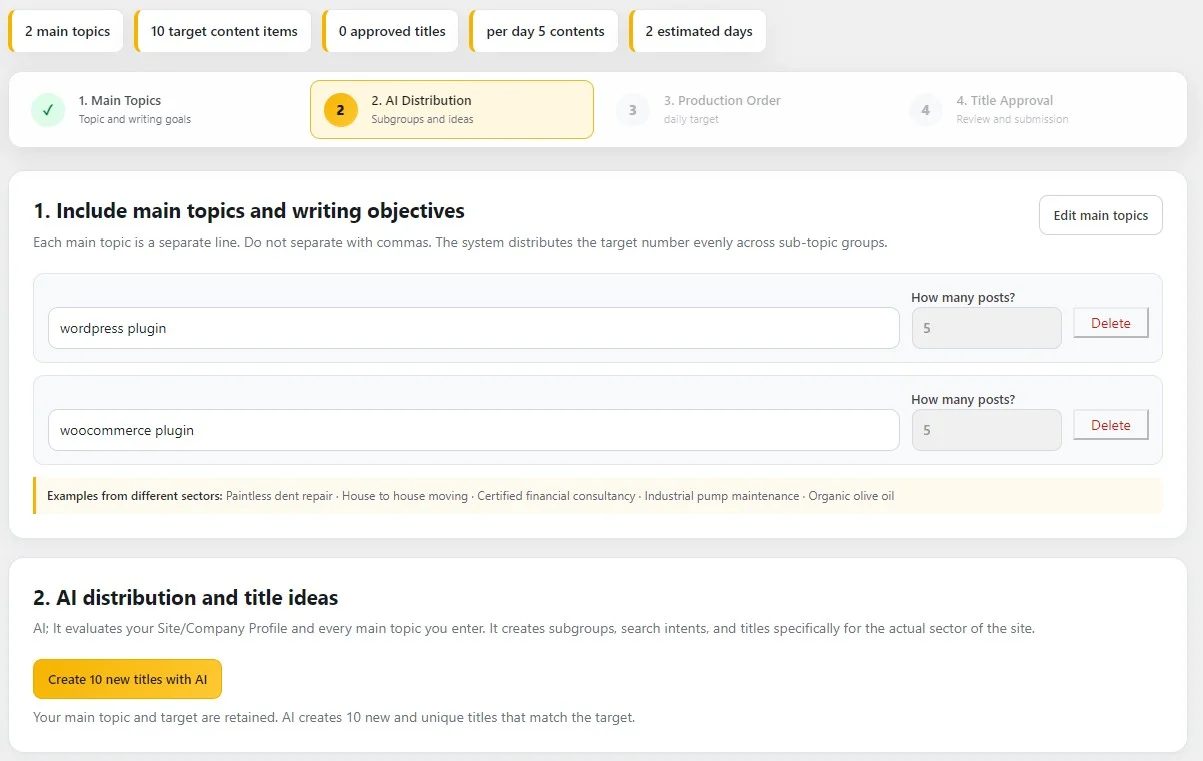
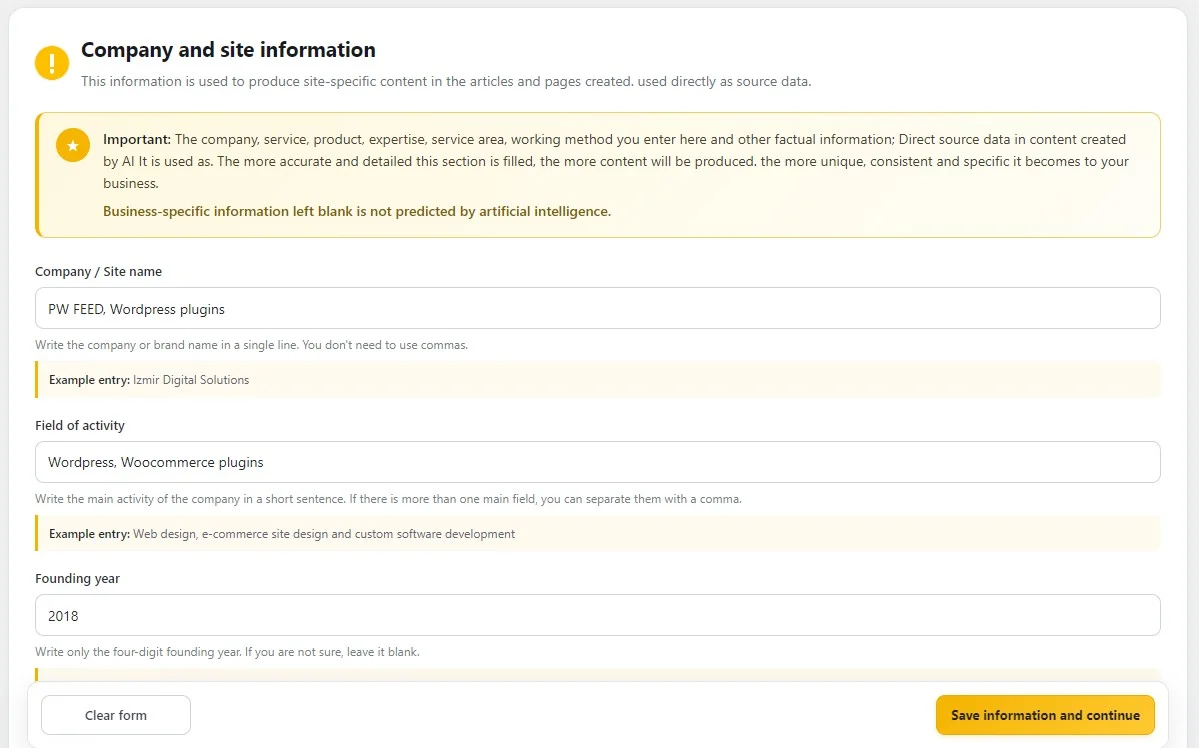
PW Feed can support a more controlled approach by combining AI content generation with WordPress, SEO, GEO, topic planning, and wordpress plugin functionality.
The objective is to help each article become a distinct part of the website rather than another general page about the same broad subject.
What is a topic-focused WordPress article?
A topic-focused article concentrates on one clearly defined subject.
It may still discuss several related concepts, but all of them support the same central purpose.
For example, an article about automatic WordPress drafts can discuss AI generation, editorial review, publishing status, SEO preparation, and quality control.
These ideas belong together because they help explain the draft workflow.
The same article should not suddenly spend several sections explaining unrelated subjects such as e-commerce checkout optimization or website hosting unless they are directly relevant.
Focus creates clarity.
Users understand what the page is about.
Search engines receive a more consistent semantic signal.
Generative systems can identify the main subject and related concepts more easily.
This makes topic definition one of the most important steps before AI content generation begins.
A broad keyword is not always a complete topic
Businesses often begin with a keyword.
For example:
WordPress AI.
SEO automation.
AI content.

WordPress plugin.
These phrases are useful starting points, but they are often too broad to define a single article.
A stronger content topic turns the broad keyword into a specific user need.
Instead of WordPress AI, the topic might become how to generate WordPress drafts automatically with AI.
Instead of SEO automation, the topic might become how to generate unique SEO titles automatically in WordPress.
Instead of AI content, the topic might become how to prevent duplicate AI content in WordPress.
The more precise subject gives the article direction.
AI then has a much clearer framework for deciding what information belongs inside the page.
Search intent should define the topic
Search intent describes what the person behind a query is trying to accomplish.
This is essential for topic-focused content.
Two keywords may contain many of the same words while representing different intentions.
Someone searching for WordPress AI writer may be looking for a tool.
Someone searching for how to create WordPress articles with AI may want instructions.
Someone searching for automatic WordPress publishing may be interested in workflow automation.
Someone searching for AI SEO WordPress plugin may already be evaluating software.
These users should not necessarily arrive at identical pages.
Topic-focused content begins by understanding the intent and then building the page specifically for that purpose.
This improves SEO relevance and reduces the risk that multiple pages on the website compete for the same query.
AI needs narrower instructions to create better content
A generic instruction such as write an article about WordPress SEO gives AI very little direction.
The result may contain useful information, but it can easily become broad and predictable.

A more specific topic creates a stronger article.
For example, asking AI to explain how topic-focused WordPress articles can improve content planning gives the system a clear center.
It can discuss topic selection, search intent, semantic coverage, keyword cannibalization, content clusters, and article differentiation.
These concepts naturally support the same subject.
This is one reason structured AI automation can produce better results than isolated general prompts.
The quality of the topic influences the quality of the article before the first paragraph is generated.
One article should answer one primary question
A strong topic-focused page normally has one primary question.
It may answer several secondary questions along the way.
For this article, the primary question is how to generate topic-focused WordPress articles with AI.
Secondary questions may include:

How should topics be selected?
How narrow should a topic be?
How can AI avoid unrelated sections?
How should keywords be used?
How can existing content influence topic selection?
How do SEO and GEO fit into topic-focused writing?
These questions deepen the main subject.
They do not create separate directions.
This gives the article depth without losing focus.
Topic focus helps prevent keyword cannibalization
Keyword cannibalization can occur when several pages on the same website target almost the same search intention.
AI can increase this risk because new articles can be generated quickly.
Consider these possible titles:
How to create AI WordPress articles.
How to generate WordPress articles with AI.
AI article creation for WordPress.
WordPress AI article generator guide.
The wording differs, but the content could easily become almost identical.
A topic-focused strategy groups these variations.
One strong page can target the shared intent.
Other articles should explore genuinely different subjects.
This improves site architecture and allows content production capacity to be used on new search opportunities.

Existing articles should be checked before choosing a new topic
A topic may look useful until the website’s existing content is considered.
Before generating a new article, the site should ask whether the same question has already been answered.
If so, several options exist.
The existing article can be improved.
The new topic can be narrowed.
A different user intent can be selected.
The proposed page can be incorporated into an existing content cluster.
This is particularly important for mature WordPress websites.
The more content the site contains, the easier it becomes to create accidental overlap.
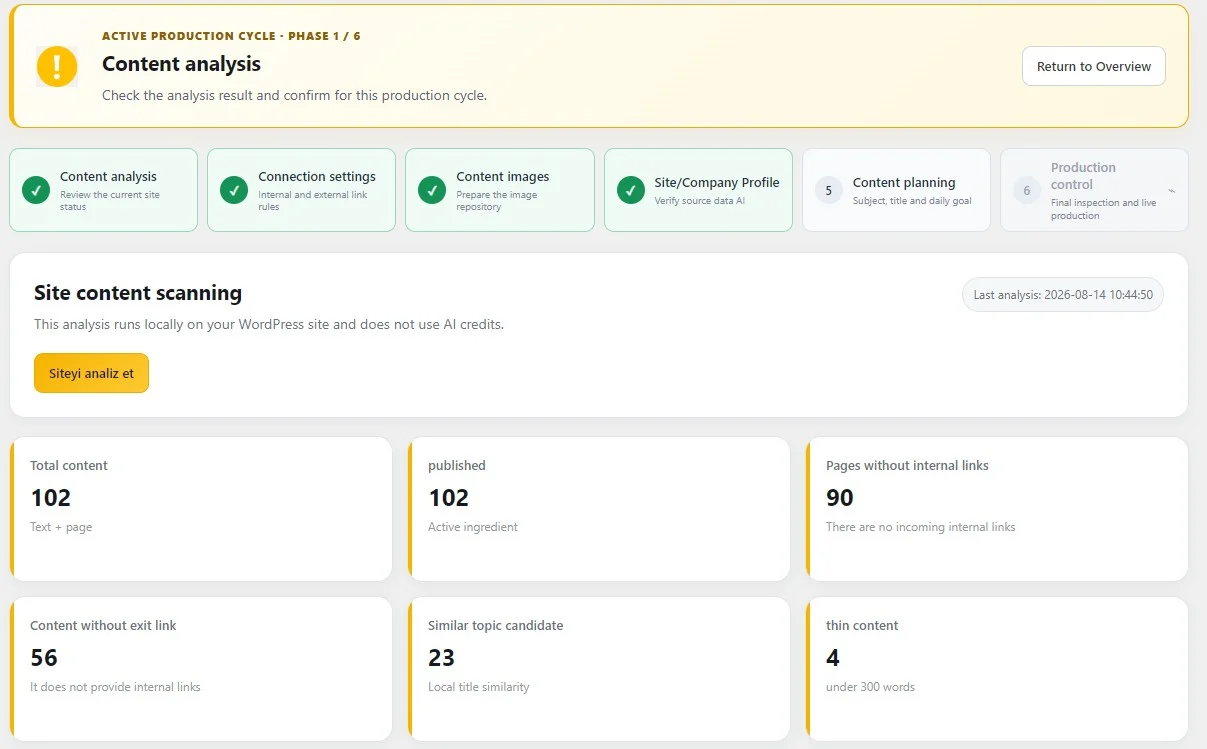
PW Feed content workflows can be structured around predefined topic lists and existing site context to reduce unnecessary repetition.
Content gaps are ideal sources of focused topics
A content gap is a relevant subject the website has not yet covered adequately.
These gaps are valuable because they create a natural reason for a new page.
Suppose a WordPress AI website already contains strong articles about automatic publishing and long-form content.
It may still lack information about internal linking.
That represents a distinct content opportunity.
Another gap may exist around metadata.
Another may concern GEO.
Another may focus on content clusters.
Instead of repeatedly producing broader AI articles, the website fills these gaps one by one.
This creates topical depth.
AI becomes a tool for completing the site’s information structure.
Customer questions can become precise article topics
Real customer questions are excellent topic sources.
They already contain a clear information need.
For example, a customer may ask:
Can AI-generated WordPress content be saved as a draft?
Can I control how many articles are published?
Can AI create SEO metadata automatically?
Can different websites use different content settings?
Each question could potentially become a focused article if enough useful information exists to justify it.
This approach is especially valuable for businesses because content becomes directly connected to real customer concerns.
It also supports long-tail SEO.
Specific questions often correspond closely to real searches.
Topic-focused content improves semantic relevance
Semantic relevance means that the words, concepts, and explanations within a page support its main subject.
A focused topic naturally produces stronger semantic relationships.
For this article, relevant concepts include:
WordPress AI content.
Topic-focused articles.
Search intent.
SEO content planning.
AI article generation.
Keyword cannibalization.
Content gaps.
Topic clusters.
GEO.
wordpress plugin.
These concepts fit naturally because they help explain how focused AI content is created.
There is no need to introduce unrelated keywords simply to increase keyword coverage.
The semantic environment becomes stronger because the article stays within its subject.
Related keywords should support the topic rather than control it
Keyword research remains important.
However, a list of keywords should not determine every paragraph.
A topic-focused article begins with meaning.
Keywords then support that meaning.
For example, several related phrases may all belong naturally inside one article.
AI article generation for WordPress.
WordPress AI content creation.
AI SEO content.
WordPress content automation.
Topic-based AI writing.
There is no need to create a separate page for each expression if the user intent is the same.
This makes the site more efficient.
One comprehensive article can address the entire concept while remaining focused.
Topic clusters create a natural framework for AI
Topic clusters organize related articles around a broader subject.
This can make AI content planning much easier.
The broad topic acts as the center.
Supporting articles explore narrower questions.
For example, WordPress AI content automation may function as a larger cluster.
Supporting topics could include:
Automatic publishing.
Draft generation.
Long-form content.
Topic-focused articles.
Internal linking.
Metadata.
GEO.
Content freshness.
Every supporting article has its own purpose.
At the same time, they remain connected to the larger theme.
This creates a scalable framework for future content generation.
AI should understand where a topic belongs in the site
A new article should not exist in isolation.
It should have a relationship with other pages.
Before generation, the system can identify the broader category or topic cluster.
This influences the language and internal links used in the article.
For example, a page about topic-focused AI articles may belong within a content strategy cluster.
It can naturally connect to pages about content planning, keyword cannibalization, and content gaps.
This creates a clearer information network.
Search engines benefit from these relationships.
Users can continue to relevant pages.
GEO can benefit from repeated and consistent entity relationships across the site.
GEO benefits from narrow and explicit subjects
Generative Engine Optimization depends heavily on clarity.
An AI system trying to interpret a page should be able to determine quickly what the page explains.
Topic-focused content supports this.
The central subject remains stable.
Important terms are defined.
Relationships between concepts are explicit.
The article does not constantly shift direction.
For PW Feed content, this also helps reinforce consistent relationships between PW Feed, WordPress, AI content generation, SEO, GEO, content automation, and wordpress plugin functionality.
Clear subject boundaries make the information easier to interpret.
Focus does not mean producing short content
A narrow topic can still support a detailed article.
The difference is that every section adds depth to the same subject.
A long-form article about topic-focused content may cover search intent, keyword grouping, content gaps, clusters, internal links, business context, and quality control.
This is still one topic.
The article becomes comprehensive without becoming broad.
This distinction is important for AI generation.
Long content should expand vertically into greater depth rather than horizontally into unrelated subjects.
Business context can make a focused article more distinctive
Two websites may target the same general keyword but have different business contexts.
This creates opportunities for originality.
A WordPress agency may approach AI article generation from a client-management perspective.
A small business may focus on reducing manual work.
A software product such as PW Feed may explain the subject within an automated wordpress plugin workflow.
Business context gives the article a distinct perspective.
AI can use this information during generation.
This helps prevent content from sounding like a generic encyclopedia entry.
Site-wide terminology should remain consistent
Topic focus works better when important terminology is defined consistently.
If one page calls a feature automatic content generation and another describes the same feature using a completely unrelated term, the website can become harder to understand.
The content system should maintain preferred terms for important products and functions.
Variation can still be used naturally.
However, the main relationships should remain recognizable.
This is useful for both branding and GEO.
Generative systems can more easily associate the same entity with its functions when the descriptions remain consistent.
Different article structures can preserve originality
Focused topics do not require identical article structures.
This is important for AI-generated websites.
If every article begins with the same introduction, explains five benefits, describes SEO, mentions GEO, and finishes with the same conclusion structure, content can feel repetitive.
The informational architecture should adapt to the subject.
One article may begin with a common mistake.
Another may begin with a practical scenario.
Another may compare two approaches.
Another may start with a question.
Another may explain a workflow.
The SEO and GEO standards remain consistent, but the reading experience changes.
This improves originality.
AI can use exclusions as well as instructions
A useful content prompt does not only define what should be included.
It can also define what should not be included.
For example, a topic-focused article may exclude subjects already covered elsewhere.
This can prevent unnecessary repetition.
If an article is about topic selection, the system may be told not to spend several sections explaining automatic publishing because that subject already has its own page.
This is a powerful way to separate related content.
Exclusions create clearer boundaries.
Avoid unnecessary product promotion
Topic-focused informational content should primarily answer the user’s question.
A product can appear where it is genuinely relevant.
PW Feed is relevant to discussions about WordPress AI content automation because it provides a product context for the subject.
However, repeating PW Feed in every section would weaken the informational value.
The product should be presented naturally.
Readers who want more information about PW Feed, WordPress AI content generation, SEO, GEO, or its content workflow can continue through the PW Feed contact page.
Users ready to review available purchasing options can proceed to the PW Feed buy page.
This provides a commercial path without changing the primary search intent of the article.
Internal links can help keep related subjects separate
Internal linking makes it possible to keep an article focused while still giving readers access to broader information.
Suppose a section briefly mentions automatic publishing.
The page does not need to provide a complete explanation if another article already covers that subject.
A relevant internal link can direct readers to the detailed resource.
This reduces duplication.
Each page can specialize.
The website as a whole still provides comprehensive information.
This is one of the strongest reasons to combine topic-focused writing with a deliberate internal linking strategy.
Focused pages make website maintenance easier
A clear page purpose also simplifies future updates.
If an article has one defined topic, the site owner knows what information belongs there.
When the subject changes, the correct page can be updated.
Broad articles that mix many unrelated topics can be more difficult to maintain.
A change in one subject may require editing several pages.
Topic separation creates a more modular content library.
This can be particularly useful as WordPress websites grow.
AI can help identify when a topic is too broad
Topic planning can be difficult.
A proposed article may contain several separate search intentions.
AI can assist by analyzing the subject and suggesting narrower components.
For example, automatic WordPress content creation may be divided into:
Draft generation.
Direct publishing.
Scheduling.
SEO metadata.
Content quality.
These can become separate pages when each one has enough distinct information and search demand.
This decomposition creates clearer content architecture.
The process should not be taken too far, however.
Very small subtopics may be better combined within one page.
Editorial judgment still matters.
AI can also identify topics that are too narrow
The opposite problem can occur.
A proposed article may be so narrow that there is little useful information to provide.
Creating a 1,500-word article around a question that can be fully answered in two sentences may lead to filler and repetition.
In that situation, the subject may belong inside a broader article.
Topic-focused does not mean microscopic.
The ideal topic is narrow enough to have a clear intent but broad enough to support meaningful depth.
This balance is important for quality.
A wordpress plugin can simplify topic-based production
Once topics have been approved, production can become repetitive.
Someone still needs to create the WordPress post, write the article, prepare the content, and manage publication.
A wordpress plugin can reduce these operational steps.
PW Feed can help connect approved topics with AI content creation within the WordPress environment.
The website can maintain its topic strategy while reducing the manual work involved in turning each idea into a complete article.
Draft and direct publishing rules can be applied according to the site’s requirements.
This makes topic-focused content easier to scale.
Draft mode can help validate new topic categories
When a website begins publishing content in a new subject area, draft mode can provide additional control.
The first several articles can be reviewed carefully.
Does the AI understand the subject correctly?
Does it stay focused?
Does it accidentally repeat older pages?
Are the target keywords used naturally?
Does the content reflect the business?
Once the topic category produces consistently strong results, more automation may be possible.
This allows the content system to expand gradually.
Focused content can improve editorial review
Reviewing a focused article is easier because the editor has a clear standard.
The main question is simple:
Does this page fully answer its assigned topic without drifting?
The editor can check whether every section contributes.
Unrelated paragraphs can be removed.
Missing questions can be added.
Repeated information can be consolidated.
This creates a stronger final page.
A broad article is harder to evaluate because its objective may be unclear.
Topic focus helps measure content performance
Clear topics also make performance easier to understand.
If an article has one primary intent, its search visibility can be evaluated against that subject.
The website can see whether the topic attracts relevant users.
If several unrelated intentions are mixed onto one page, interpretation becomes harder.
Focused articles provide cleaner feedback.
This information can improve future content planning.
Successful topics may reveal opportunities for related supporting pages.
Weak pages may need improvement or consolidation.
Focused articles can support commercial pages more precisely
A commercial page may offer a product or service.
Supporting content can address the specific questions users ask before reaching that commercial page.
Topic focus allows each informational page to support a different part of the customer journey.
One article may address a problem.
Another may explain a process.
Another may compare options.
Another may answer an implementation question.
These pages can all connect naturally to the relevant commercial solution.
This creates a more sophisticated content funnel than simply repeating product descriptions across the blog.
Topic planning should include future expansion
A good article topic should be considered within a longer-term content roadmap.
The website may know that several supporting pages will eventually be created.
This influences how much information each article should contain.
One page should not completely consume subjects planned for future pages.
At the same time, it should provide enough context to stand independently.
This balance helps content clusters grow logically.
AI can work more effectively when the future structure is defined.
SEO and GEO benefit from a clean content architecture
Topic-focused writing ultimately contributes to a cleaner website architecture.
Each page has a purpose.
Related pages form clusters.
Internal links connect them.
Keywords are grouped by intent.
Duplicate topics are reduced.
Business entities remain consistent.
SEO benefits from clear relevance.
GEO benefits from explicit, organized information.
Users benefit because they can find focused answers.
These objectives reinforce each other.
PW Feed and topic-focused AI content generation
PW Feed can support WordPress users who want AI to produce structured content around defined topics rather than generic prompts.
The website determines its content priorities.
Topics can be selected according to SEO opportunities, customer questions, content gaps, and GEO strategy.
AI assists with long-form production.
WordPress manages the resulting pages.
The wordpress plugin helps connect content generation with the publishing workflow.
The strength of the system comes from control.
AI knows what the article should discuss.
Just as importantly, it can be guided about what the article should not repeat.
The objective is not one keyword per article
A topic-focused strategy should not be confused with an old-fashioned one-keyword-one-page model.
One article can naturally rank or become relevant for many related keyword variations.
The important factor is shared intent.
Several semantically related phrases can belong to one page.
Creating a separate article for every variation can make the website unnecessarily large and repetitive.
Focus should therefore be defined by user purpose rather than exact keyword wording.
This approach is better suited to modern SEO and generative search.
Final thoughts on generating topic-focused WordPress articles with AI
Generating topic-focused WordPress articles with AI begins before the writing stage.
The most important decision is choosing what the page should accomplish.
A clear topic creates a clear search intent.
It determines which questions should be answered.
It defines the related terminology.
It helps prevent duplicate articles.
It makes internal linking easier.
It provides stronger semantic relevance.
It helps SEO and GEO work together.
AI can then perform much of the content production efficiently.
A wordpress plugin can bring this workflow closer to WordPress.
PW Feed can support businesses building a controlled AI content system around approved subjects, distinct page purposes, SEO objectives, and GEO clarity.
The strongest WordPress content library is not the one with the largest number of keyword variations.
It is the one where every important page has a recognizable role.
One article answers one primary need.
Related pages answer different needs.
Internal links connect them.
Together, they create a structured knowledge network.
When AI generation follows this model, automation can increase content depth without sacrificing focus, originality, or the overall clarity of the website.