
Automated content planning and publishing for WordPress
WordPress content automation is most effective when planning and publishing work together. Generating an article with artificial intelligence can save time, but content creation alone does not solve the larger challenge of deciding what should be written, why the page should exist, when it should be published, and how it should connect with the rest of the website.
A strong automated content system therefore begins before the writing stage.
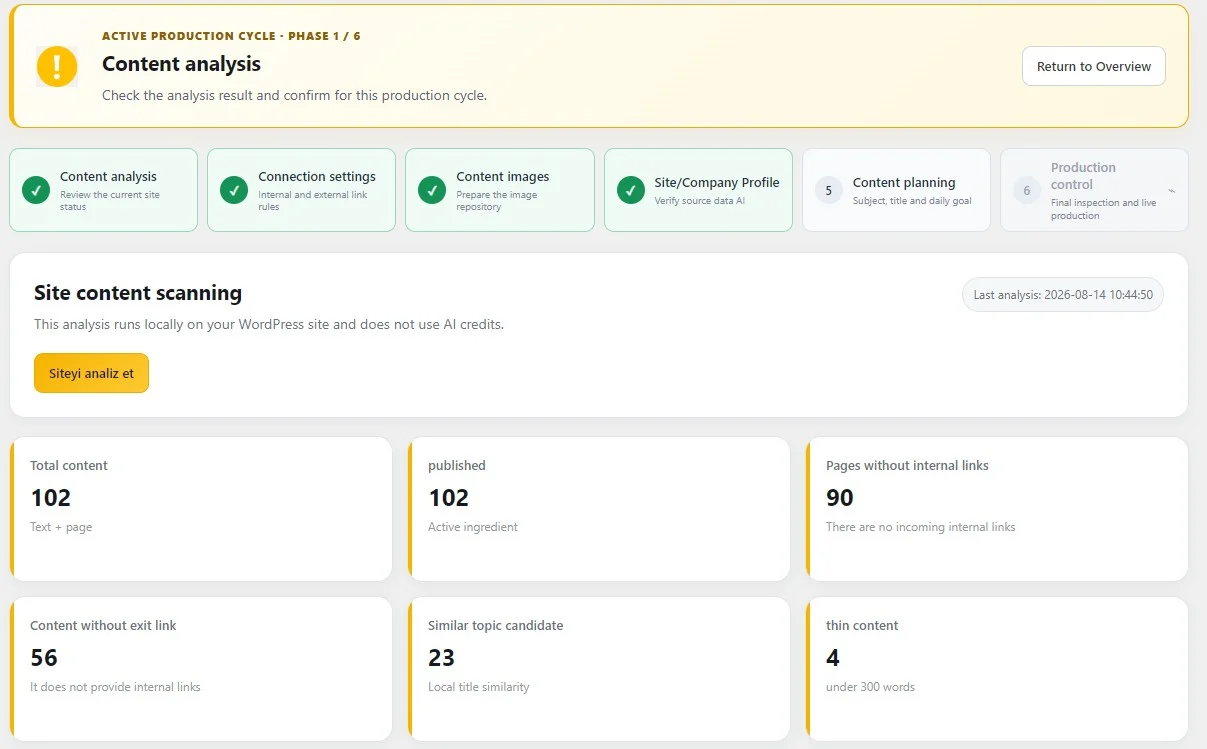
Topics need to be selected. Search intent needs to be understood. Existing pages should be considered. SEO opportunities need to be prioritized. GEO requirements should influence how information is presented. Publishing frequency must remain controlled. New articles should support the wider structure of the WordPress site rather than appearing as isolated pages.
PW Feed can support this broader approach by combining AI content generation, automated planning, SEO, GEO, and wordpress plugin functionality within a structured WordPress workflow.
The purpose is not simply to automate writing.
The purpose is to create a repeatable process that moves from content opportunity to publication while maintaining strategic control.
Why content planning matters before AI generation
Artificial intelligence can create content very quickly.
This makes planning more important, not less important.
When manual writing is slow, production naturally limits how many pages can be created. AI removes much of that limitation.
A poorly planned website can therefore produce large amounts of unnecessary content much faster than before.
Planning provides direction.
The website should know which subjects matter.

It should understand which pages already exist.
It should know where content gaps remain.
It should identify which commercial pages need informational support.
It should decide which user questions deserve dedicated articles.
Only then should AI begin generating content.
This sequence helps ensure that automation expands the website intelligently rather than simply increasing its page count.
A content plan should begin with the website’s real purpose
Different WordPress websites require different content strategies.
An online store has different needs from a professional services company.
A local business has different priorities from an international software company.
An agency has different requirements from a niche publisher.
The content plan should reflect the actual business.
For example, a service company may need articles answering customer questions.
An e-commerce website may need educational resources around product categories.
A software provider may need content explaining features, workflows, use cases, and problems its technology solves.
PW Feed content naturally belongs within topics connected to WordPress, AI content creation, SEO, GEO, publishing automation, content management, and wordpress plugin workflows.
This subject boundary helps determine what should and should not be published.
Automated planning should work from approved topic areas
An AI system should not be given unlimited freedom to choose every future article.
A more controlled approach begins with approved topic areas.
These can function as content pillars.
For example:

WordPress AI content creation.
SEO automation.
GEO and generative search.
Publishing workflows.
Content strategy.
Metadata.
Internal linking.
Business use cases.
Each pillar can contain many narrower topics.
The system can then select or generate articles only within those approved areas.
This keeps the website focused.

It also reduces the chance that content drifts into unrelated subjects simply because they appear popular.
Content gaps can guide automated planning
One of the strongest ways to select new topics is to identify missing information.
A content gap exists when a relevant question or subject has not yet been covered adequately.
Suppose a WordPress website already contains detailed articles about AI publishing, drafts, and long-form content.
It may still lack articles about internal linking, duplicate content prevention, or AI search visibility.
Those gaps provide logical next steps.
Automated content planning can use this principle.
Instead of repeatedly asking what should we publish next, the system can compare planned subject areas with existing coverage.
Future articles then fill missing parts of the content structure.
This creates gradual topical expansion.
Existing content should influence every new publishing decision
A common weakness in automated systems is treating each new article as if the website were empty.
A mature WordPress site already has history.
Before creating another page, the content workflow should consider what already exists.
Has the same topic been published?
Is another page targeting the same search intent?
Could an existing article be expanded instead?
Would the proposed topic support a current content cluster?
Does the website need a new article at all?
These questions protect the site from unnecessary duplication.
AI generation becomes more valuable when it understands that not every keyword deserves a new URL.

Search intent should determine page creation
Keyword research is useful, but keywords alone should not decide what gets published.
Several phrases can represent the same user intention.
For example:
Automatic WordPress content publishing.
WordPress automatic AI publishing.
AI publishing automation for WordPress.
Automatically publish AI articles in WordPress.
These phrases may all belong to one page.
Creating a separate long-form article for every variation could create keyword cannibalization.
Automated planning should group keywords by intent.
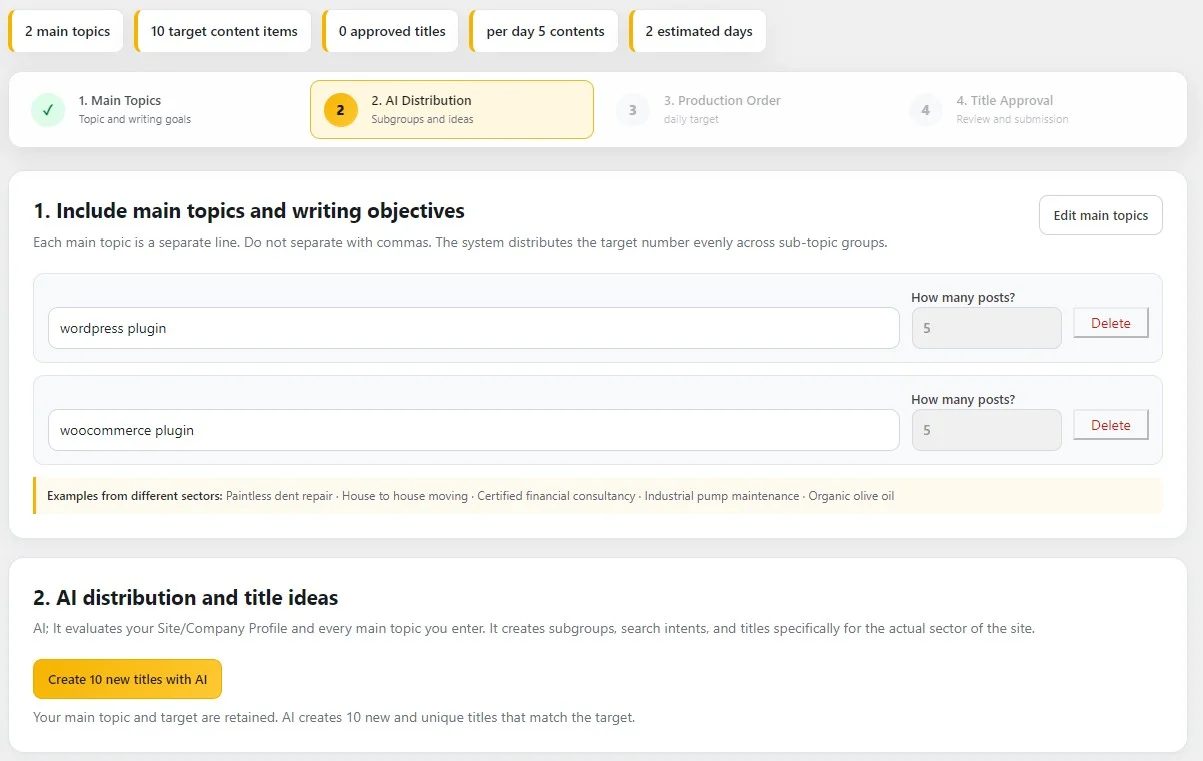
One strong article can target the shared need.
Production capacity can then be used for other distinct topics.
This results in broader and cleaner search coverage.
A publishing queue creates structure
Once topics have been approved, they can be placed into a publishing queue.
This queue creates an organized sequence of future content.
Each entry may contain:
The article topic.
Primary search intent.
Target keyword.
Related terminology.

Content category.
Relevant internal pages.
Publication priority.
Draft or direct publishing status.
This transforms content production into a manageable pipeline.
AI does not need to rediscover the strategy every time.
It works from a prepared set of priorities.
For WordPress users who want regular publishing, this can significantly reduce daily decision-making.
Priority should not be based only on search volume
High search volume can be attractive, but it is not always the best reason to publish a page.
A lower-volume topic may be much more relevant to the business.
It may support an important product.
It may answer a question frequently asked by customers.
It may attract users with stronger purchase intent.
It may fill a critical content gap.
A useful automated planning system should therefore consider several forms of value.
Search demand matters.
Business relevance matters.
Topical importance matters.
Search intent matters.
Commercial relevance matters.
The strongest content plan balances these factors rather than sorting every subject only by estimated traffic.
Planning can separate informational and commercial content
Not every article should try to sell immediately.
WordPress websites often need both informational and commercial pages.
Commercial pages describe a product or service.
Informational content helps users understand problems, processes, choices, terminology, or broader concepts.
Automated planning should understand the difference.
For example, an article about how AI-generated WordPress drafts work is informational.
A PW Feed purchase page serves a commercial purpose.
Both are important, but they should not use the same content style.
This separation creates a more natural user journey.
Publishing frequency should be defined deliberately
AI can generate content faster than most websites need to publish it.
A sustainable content plan therefore requires limits.
A site may choose to publish several articles per month.
Another may require several per week.
A larger publisher may operate at higher volume.
There is no universal number.
The appropriate frequency depends on available topics, business needs, website size, and content quality.
Publishing should remain purposeful.
The fact that AI can produce fifty articles does not mean all fifty should be published immediately.
Controlled frequency makes the content strategy easier to manage.
A content calendar can balance different topics
Automated publishing should not produce several nearly identical articles in sequence.
A content calendar can distribute topics more intelligently.
One publication may focus on AI content generation.
The next may address SEO.
Another may explain GEO.
Another may focus on WordPress workflows.
This rotation can help create a more balanced website.
It also reduces the risk that the blog appears repetitive.
Automated planning can assign topics to future publication slots according to category or priority.
The website gains consistency without becoming monotonous.
AI can generate content after the planning stage
Once a topic is approved, AI can perform much of the production work.
The system already knows:
What the article should cover.
Why the page exists.
Which search intent is important.
Which target terminology belongs to the topic.
Which business context is relevant.
Which pages may deserve internal links.
Whether the content should be saved as a draft or published.
This creates better conditions for generation.
AI is no longer being asked to invent the entire strategy and article simultaneously.
It is executing a defined content assignment.
SEO should be part of planning, not an afterthought
Automated SEO works best when it begins before the article is written.
The topic should have a defined search purpose.
The title should reflect that intent.
Related semantic terminology can be identified.
Potential overlap with existing pages should be checked.
Metadata can be planned alongside the article.
Internal linking opportunities can be considered.
This is far stronger than generating generic content and then attempting to optimize it later.
For PW Feed, SEO can become part of the entire AI content workflow rather than a separate task performed after generation.
GEO should also influence content planning
Generative Engine Optimization adds another dimension.
A topic may be useful not only because people search for it in traditional search engines, but because it helps explain the business clearly to AI-driven discovery systems.
A WordPress content strategy can therefore include subjects that strengthen important entity relationships.
For example, multiple distinct articles may explain different aspects of PW Feed while maintaining clear relationships between PW Feed, WordPress, AI content automation, SEO, GEO, and wordpress plugin functionality.
This creates a richer information environment.
GEO planning encourages businesses to think about whether their important products, services, concepts, and expertise are explained clearly across the site.
Topic clusters can guide automated publishing
Topic clusters are particularly suitable for automation.
A broad subject becomes the center of the cluster.
Supporting articles answer narrower questions.
For example, a WordPress content automation cluster may contain pages about:
Automatic publishing.
Draft generation.
Content planning.
Long-form generation.
Content consistency.
Internal linking.
SEO metadata.
GEO.
Each supporting article has a distinct purpose.
Automated planning can identify which cluster needs additional depth and prioritize new articles accordingly.
This prevents random expansion.
Internal linking can be planned before publication
Internal links are easier to manage when relationships are considered during planning.
If a new article belongs to a particular content cluster, the workflow already knows which pages may be related.
A page about automated content planning may connect naturally to articles about publishing schedules, AI workflows, topic clusters, or SEO automation.
These links can then be incorporated during content generation or review.
This is more reliable than publishing pages first and trying to reconstruct the internal architecture later.
A connected site is easier for users to navigate and easier for search engines to understand.
Automatic publishing should follow content readiness
A topic appearing in the queue does not necessarily mean it should publish regardless of output quality.
A mature system can apply quality gates.
The article should satisfy defined requirements before publication.
For example:
The topic must match the approved assignment.
Content depth should be sufficient.
Required business terminology should be accurate.
The article should not duplicate an existing page.
SEO elements should be present.
Links should be valid.
Publishing limits should not be exceeded.
If important conditions are not satisfied, the content can remain a draft.
Automation should control publication rather than blindly execute it.
Draft mode fits naturally into automated planning
A planned content system can still use human review.
AI may generate articles according to the publishing calendar but save them as drafts.
The editor can review several pieces in advance.
This provides time to:
Correct business information.
Improve examples.
Adjust terminology.
Check internal links.
Confirm SEO targeting.
Detect overlap.
Schedule the final publication date.
Draft mode separates production from approval while preserving the benefits of an automated plan.
Direct publishing can work for approved categories
Some websites may eventually identify categories that require little human review.
For these areas, direct publishing can reduce administration further.
For example, stable evergreen informational content around predefined subjects may be suitable for greater automation.
Other categories can remain draft-only.
This hybrid approach creates flexibility.
The content plan determines not only what should be written but also how much control each type of content requires.
Automation can prevent publishing gaps
One practical advantage of automated planning is continuity.
Manual blogs often become inactive because the next topic has not been selected or nobody has time to prepare the article.
A predefined queue reduces this problem.
The next subject is already known.
AI can generate it according to the established workflow.
The publication schedule remains more stable.
This helps businesses avoid the cycle of publishing several articles quickly and then disappearing for months.
Consistency becomes easier to maintain operationally.
Automation should also allow planned pauses
Consistency does not mean that content must always be published.
Sometimes the correct decision is to pause.
The approved topic queue may be exhausted.
The business may need to review strategy.
A major product change may require updated information before new articles are generated.
Several existing pages may need improvement instead of new content.
A good automation system should make stopping as easy as starting.
Publishing should always remain subordinate to strategy.
Old content should be included in the planning process
A content calendar should not contain only new articles.
Updating older content can also be scheduled.
For example, the website may plan:
Three new articles.
One older article update.
One internal linking review.
One metadata improvement.
This creates a more balanced maintenance strategy.
AI can assist with identifying older articles that need expansion or revised terminology.
A WordPress website becomes stronger when automation supports both growth and maintenance.
Content planning can reduce unnecessary production costs
Even when AI content is inexpensive compared with manual writing, generating unnecessary articles still consumes resources.
There may be AI usage costs.
Review takes time.
WordPress pages require maintenance.
Internal links become more complex.
Sitemaps become larger.
Every page creates future responsibility.
Planning prevents waste.
The best page to avoid publishing is one that never had a strong reason to exist.
Automation should therefore increase efficiency at the strategic level, not just the writing level.
Business profiles make automated planning more relevant
A generic content planner may suggest topics that have little connection with the actual website.
Providing business context improves relevance.
A profile can include:
Primary products.
Services.
Customer types.
Business goals.
Geographic information.
Important terminology.
Commercial priorities.
Topics to avoid.
This information can influence topic selection.
A local service company receives a different content plan from a WordPress software business.
An e-commerce website receives different suggestions from an accounting firm.
The automation becomes site-aware rather than generic.
A wordpress plugin can connect planning with execution
Planning is useful, but it becomes more powerful when connected to production.
A wordpress plugin can bring approved topics, AI generation, draft creation, and publishing closer together.
PW Feed can support this type of workflow.
Instead of maintaining one plan outside WordPress and manually transferring each article into the site, more of the process can happen within a structured system.
This reduces repetitive administrative work.
It also makes content automation easier for smaller businesses that do not use complex enterprise publishing platforms.
Calls to action can also be planned
Commercial actions should be intentional.
Not every article needs the same aggressive sales message.
An informational page may provide a subtle route toward further information.
Readers interested in PW Feed, WordPress AI content automation, SEO, GEO, or publishing workflows can continue through the PW Feed contact page.
Users who have already evaluated the product and want to review purchasing options can proceed to the PW Feed buy page.
These destinations can be incorporated naturally because they serve different stages of the user’s journey.
Planning helps prevent calls to action from becoming random or repetitive.
Agencies can use automated plans for multiple sites
Agencies managing several WordPress websites can benefit significantly from planning automation.
Each client can maintain a separate topic queue.
A local client can have local service content.
A software client can have technical and product-related topics.
A professional services client can prioritize customer questions.
Publishing frequency can differ by client.
Approval rules can differ.
SEO and GEO requirements can remain standardized at the agency level while actual subjects stay client-specific.
This creates scalability without making all sites follow the same editorial plan.
Content planning can support seasonal priorities
Some businesses have seasonal demand.
Their content plans can reflect this.
Certain topics may become more important before specific times of year.
Articles can be generated and prepared in advance.
This prevents the business from creating seasonal content after the relevant search period has already begun.
Automated planning can therefore support timing as well as topic selection.
The content calendar becomes connected to real business cycles.
Publishing order can influence the usefulness of a content cluster
When several related articles are planned, publishing sequence can matter.
A broad foundational article may be useful before highly specific supporting content.
A product explanation may need to exist before multiple guides link toward it.
An internal linking article may make more sense once several related pages already exist.
Planning allows these relationships to be considered before publication.
AI generation can then follow a deliberate sequence rather than simply selecting topics randomly.
Analytics can improve future planning
Automated planning should not remain static forever.
Published content creates data.
Some articles may attract strong relevant traffic.
Others may receive little attention.
Certain topics may lead users toward important commercial pages.
Some content clusters may develop more successfully than others.
This information can influence future priorities.
The content process becomes cyclical.
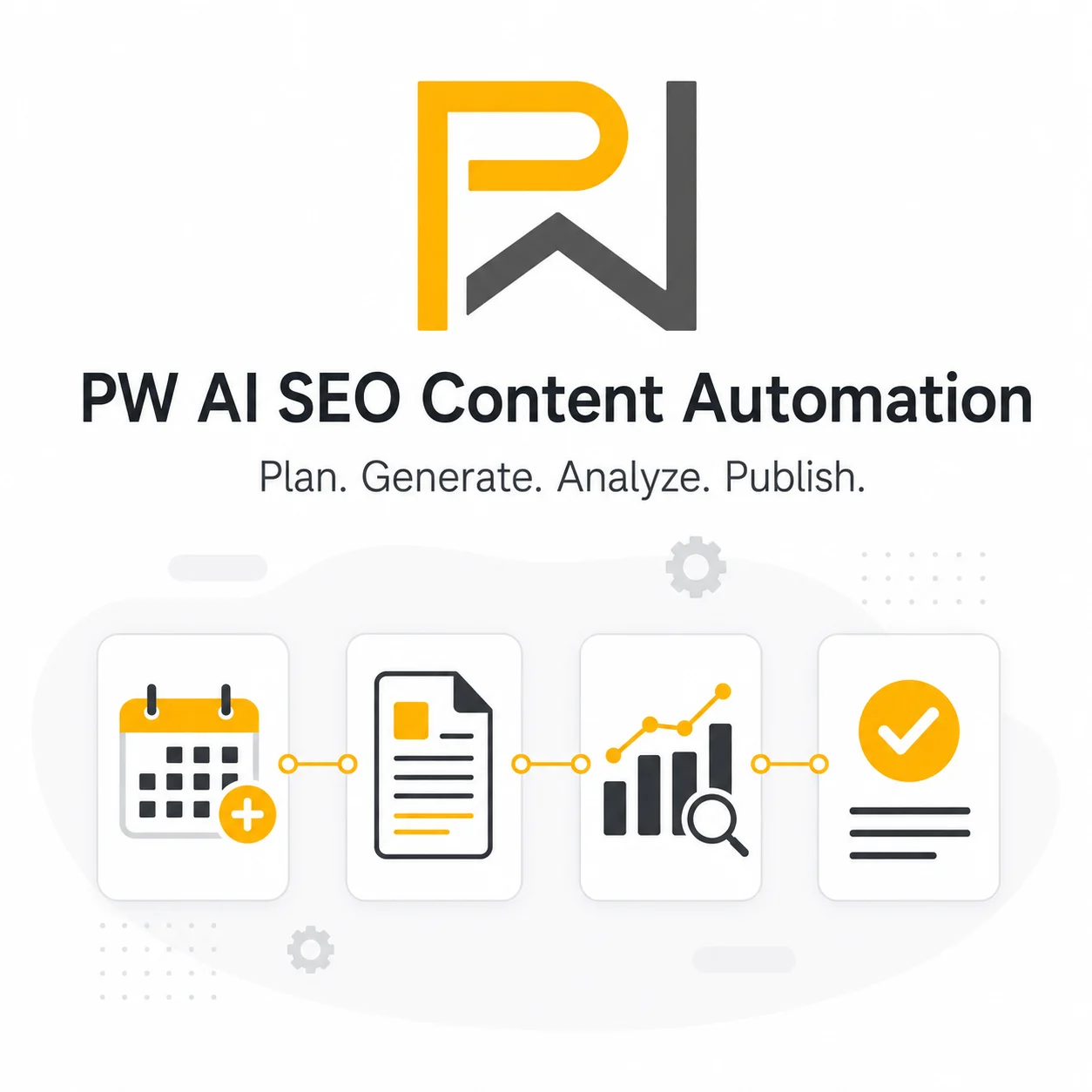
Plan.
Generate.
Publish.
Observe.
Improve.
AI can assist with production, but strategy should continue evolving based on real website behavior.
Publishing performance should not be measured only by page count
An automated system can easily make page count look impressive.
This is not necessarily meaningful.
A stronger evaluation asks:
Are new search intents being covered?
Are users finding helpful information?
Are important commercial pages receiving relevant support?
Is topical depth increasing?
Are duplicate subjects being avoided?
Is GEO clarity improving?
Is the website becoming easier to understand?
These are more useful indicators than the number of articles generated.
Content planning should optimize for contribution, not volume.
Planning protects originality
Originality begins before writing.
When every page has a distinct purpose, AI has a much better chance of producing genuinely different content.
If several assigned topics are almost identical, no amount of wording variation will make the pages strategically unique.
A good planning stage removes overlap first.
Each article then develops from a different question, use case, problem, or search intent.
This creates real differentiation.
For a growing WordPress AI content library, this is one of the most important safeguards against repetitive pages.
SEO and GEO can work together in the publishing roadmap
Traditional SEO may identify search opportunities.
GEO may identify important concepts that deserve clearer explanation for AI-powered discovery.
A strong roadmap can consider both.
Some articles may target established search queries.
Others may strengthen understanding of the product, service, technology, or entity relationships around the business.
Often the same article can achieve both goals.
Useful search-focused content can also be clear generative-search content.
The distinction is not necessarily between two separate sets of pages.
It is between different aspects of the same strategic planning process.
PW Feed and automated WordPress content planning
PW Feed can help WordPress users move from isolated AI writing toward a more organized content workflow.
Topics can be planned.
Publishing rules can be established.
SEO and GEO can inform generation.
Business information can provide context.
Articles can become drafts or be published according to controlled settings.
The wordpress plugin environment connects the content process with the platform where the final pages actually live.
This makes automation more practical for businesses that want regular content without creating a large editorial infrastructure.
The best automation removes repeated decisions
Many WordPress content tasks involve making the same decisions again and again.
What topics are allowed?
How long should articles be?
Should SEO be considered?
Should GEO be considered?
Should this type of article become a draft?
Which commercial pages should be available?
How often should content publish?
Once the answers are known, they can become rules.
The system applies them repeatedly.
The website owner can focus on higher-level strategy.
This is where automated planning provides greater value than simple automatic writing.
Final thoughts on automated content planning and publishing for WordPress
Automated content planning and publishing can transform the way a WordPress website manages long-term content production.
The process begins before AI writes anything.
The website defines its core subjects.
Content gaps are identified.
Existing pages are considered.
Keywords are grouped by search intent.
Topics are prioritized according to business relevance and search opportunity.
A publishing queue organizes future work.
SEO and GEO become part of the content assignment.
AI generates the article.
Quality rules determine whether it becomes a draft or is ready for publication.
A wordpress plugin can help connect these stages directly with WordPress.
PW Feed brings this structured approach to AI-assisted content creation by combining planning, generation, SEO, GEO, and publishing control.
The most valuable form of automation is not one that produces the greatest number of articles.
It is one that reduces repeated work while preserving good decisions.
Every new page should have a reason to exist.
Every article should answer a distinct need.
Every publication should strengthen the broader website.
When AI content generation is guided by an organized plan, controlled publishing, SEO, GEO, business context, and originality, WordPress automation can become a sustainable content system rather than an endless stream of automatically generated posts.