
How to create unique meta descriptions with AI in WordPress
Meta descriptions are small pieces of text, but they play an important role in how WordPress pages are presented in search results. They help users understand what a page offers before they click, and they give website owners another opportunity to communicate the specific purpose of each article.
As a WordPress website grows, however, creating individual meta descriptions for every page becomes repetitive.

The problem becomes even more noticeable when AI is used to produce content at scale.
A website may contain dozens or hundreds of AI-generated articles, each targeting a different question. If the meta descriptions are created from the same template, they can quickly become repetitive. Some may differ by only one keyword. Others may describe the website generally instead of explaining the individual page.
Artificial intelligence can automate meta description creation, but automation needs rules.
A useful AI system should understand the page, identify its primary search intent, summarize its unique value, avoid duplication with existing descriptions, and produce natural language that accurately represents what the user will find after clicking.
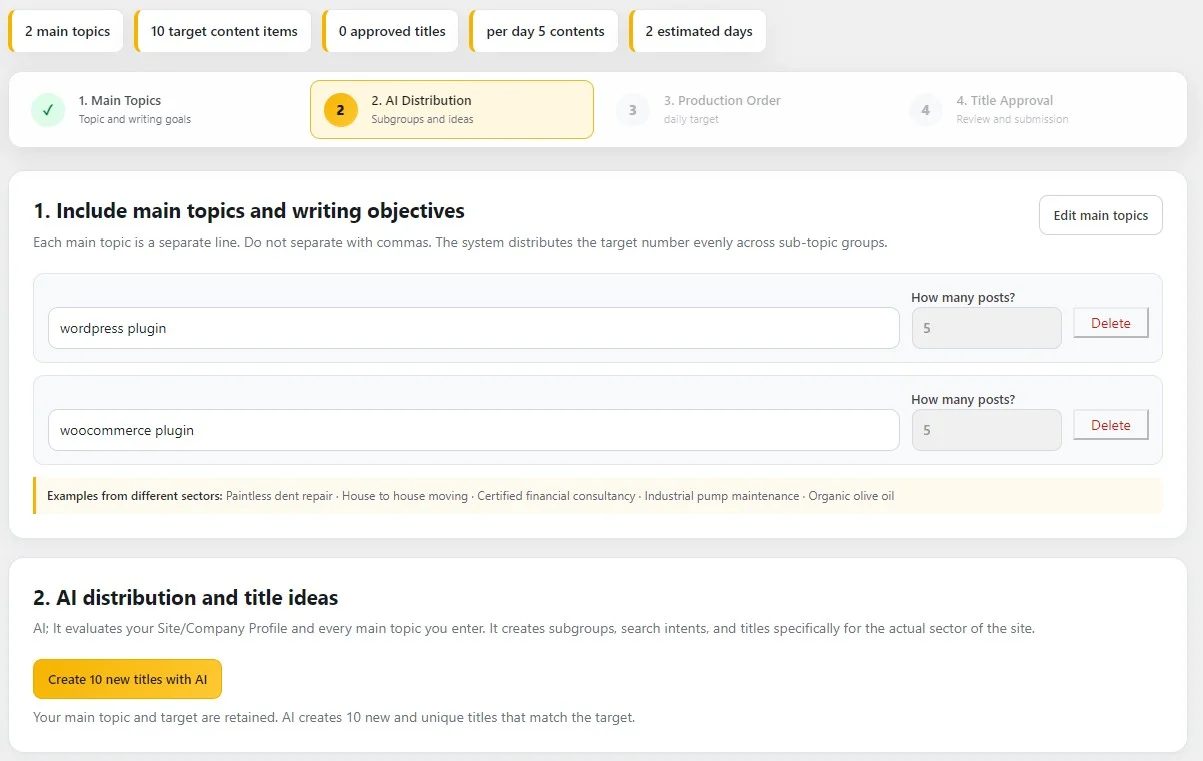
PW Feed can support this approach by combining WordPress AI content generation, SEO, GEO, publishing automation, and wordpress plugin functionality within a controlled workflow.
The objective is not simply to generate a meta description for every article.
The objective is to ensure that each description helps distinguish the page it belongs to.
What is a meta description?
A meta description is a short summary associated with a web page.
It can help explain the page in search results.
For a WordPress article, the description should communicate the specific subject of that article rather than provide a generic description of the entire website.
For example, an article about automatic WordPress drafts should have a description focused on AI-generated drafts, review workflows, or publishing control.
An article about duplicate AI content should instead explain that it covers topic overlap, search intent, originality, or duplicate prevention.
Both pages may belong to the same WordPress AI content website.
Their descriptions should still be clearly different.
This distinction becomes important as the site’s content library expands.
Why unique meta descriptions matter
Every page should have a reason to exist.
The meta description can help communicate that reason.
If twenty articles use nearly identical descriptions, users may have difficulty distinguishing them in search results.
Consider several descriptions that all begin with language such as:
Learn how AI can improve your WordPress SEO and automatically generate high-quality content.
The sentence may be reasonable on one page.
When repeated across many pages, it stops explaining what makes each result different.
A page about automatic SEO titles should mention titles.
A page about internal links should mention linking.
A page about GEO should mention generative search or AI visibility.
A page about content planning should mention planning and publishing.
Unique descriptions support a cleaner search presence.
Exact duplication is only one type of problem
A website may avoid exact duplicate meta descriptions and still have a similarity problem.
For example:
Learn how AI can automatically generate SEO-friendly WordPress articles and improve your content workflow.

Discover how artificial intelligence can create optimized WordPress content automatically and make publishing more efficient.
These descriptions are not identical.
However, they communicate nearly the same message.
If they belong to two pages with different search purposes, they are not doing enough to distinguish those pages.
AI meta description generation should therefore focus on semantic uniqueness.
The system needs to understand what makes each page different rather than simply generating new wording.
The article should come before the meta description
A common automation mistake is generating the metadata from a keyword before the full article exists.
This provides limited context.
A stronger approach creates or defines the article first.
The AI can then examine:

The central question.
The primary search intent.
The most important concepts.
The page’s distinctive value.
The target audience.
The actual information provided.
This makes it easier to produce an accurate description.
The meta description becomes a real summary of the page rather than an imagined description based only on a target keyword.
Search intent should guide the description
Search intent should influence both the article and its metadata.
Someone searching for how to generate WordPress drafts automatically has a specific goal.
A useful description might communicate that the article explains how AI can create WordPress drafts while preserving editorial review and publishing control.
Someone searching for how to prevent duplicate AI content has another goal.
That description should emphasize duplication, topic overlap, originality, or search intent.
The page title identifies the subject.
The meta description adds useful detail.
Together, they should make the search result understandable before the user clicks.
A meta description should not describe the entire business
Businesses sometimes use the same company description across every page.
For example, a software website may insert a sentence explaining that it provides WordPress AI tools into all metadata.
This misses an opportunity.
The company may still be mentioned when relevant, but the description should primarily represent the page itself.

An informational article about unique SEO titles should describe unique SEO titles.
A page explaining PW Feed specifically can describe PW Feed.
The search intent should determine the emphasis.
This creates greater differentiation across the site.
Automatic generation should start with the page’s unique angle
Many WordPress articles are related.
This means the AI needs to identify the unique angle before generating metadata.
Suppose a content cluster includes:
Automatic WordPress publishing.
Automatic WordPress drafts.
Long-form AI content.

SEO title generation.
Meta description generation.
Duplicate content prevention.
All of these pages concern WordPress AI content automation.
A generic description mentioning WordPress AI automation would not distinguish them.
The system should instead focus on the specific contribution of each page.
For the current article, that contribution is automatic creation of unique meta descriptions.
This should remain visible in the final metadata.
Meta descriptions should complement SEO titles
The title and description should work together rather than repeat each other word for word.
Consider this title:
How to create unique meta descriptions with AI in WordPress
The description does not need simply to repeat:
Learn how to create unique meta descriptions with AI in WordPress.
That adds little information.
A stronger description could communicate additional value, such as avoiding repetitive metadata, aligning descriptions with search intent, and automating the process within WordPress.
The title establishes the topic.
The description expands the promise.
This makes better use of the available search-result space.
Avoid keyword stuffing
Meta descriptions should use important terminology naturally.
They are not containers for every keyword associated with the website.
For example, a description containing:
WordPress AI SEO content plugin, WordPress SEO AI, AI WordPress content, GEO AI SEO plugin, automatic WordPress AI content
is difficult to read.
A human user should immediately understand the meaning.
One primary concept and a few supporting terms are usually enough.
For PW Feed content, terms such as WordPress, AI content, SEO, GEO, and wordpress plugin can appear naturally when relevant.
They do not all need to be forced into every meta description.
Different keyword variations can belong to the same description
A page can naturally be relevant to more than one search phrase.
For example, this article may relate to:
AI meta description generator for WordPress.
Automatic WordPress meta descriptions.
AI SEO meta descriptions.
WordPress AI metadata.
These phrases share a similar intent.
There is no need to create separate pages or separate descriptions for every variation.
One clear description can communicate the concept naturally.
This supports a more efficient SEO architecture and avoids unnecessary duplication.
AI should understand the difference between titles and descriptions
SEO titles and meta descriptions perform related but different functions.
The title needs to identify the page quickly.
The description has more space to explain why the result may be useful.
AI should not treat the description as simply a longer version of the title.
It can mention an important benefit, process, problem, or distinction that the title does not contain.
This produces a stronger combination.
Automated metadata works best when each element has its own role.
Description templates can become repetitive
Templates can make automation easier.
For example:
Learn how to X in WordPress with AI and improve your SEO strategy.
If this format is applied to every article, the website eventually develops a large collection of nearly identical descriptions.
AI allows more variation than fixed templates.
One description can emphasize a problem.
Another can explain a workflow.
Another can communicate a comparison.
Another can highlight a specific benefit.
Another can mention a common mistake the page helps prevent.
The description should adapt to the subject.
Variation should still preserve clarity
Creativity can become excessive.
A description does not need to sound mysterious.
The user should know what the page contains.
Phrases such as unlock the future of digital visibility may sound promotional but provide little information.
Direct language is often stronger.
For a page about AI-generated meta descriptions, phrases such as create unique descriptions, avoid repetitive metadata, improve page differentiation, and automate WordPress SEO are much clearer.
Clarity supports both users and search systems.
Meta descriptions should be accurate
An automatically generated description should never promise content that the page does not provide.
For example, if the article does not compare ten plugins, the description should not say it compares the ten best WordPress AI plugins.
If the article does not include a step-by-step configuration guide, the metadata should not claim that it does.
Accuracy matters because the description creates an expectation.
When users click and find something different, the result becomes less useful.
AI should summarize the actual page rather than optimize for attention at any cost.
Unique metadata begins with unique page intent
Meta descriptions cannot solve duplicate content architecture.
If two pages serve the same search intent, creating two different descriptions does not make the pages strategically unique.
The deeper problem remains.
This is why metadata generation should be connected to topic planning.
Before creating the description, the system should know that the page itself has a distinct purpose.
For example:
One page owns automatic SEO title generation.
Another owns automatic meta description creation.
Their metadata can then naturally emphasize different subjects.
Clear topic ownership makes unique metadata easier.
Existing descriptions should be checked
As a WordPress website grows, new meta descriptions should be compared with existing ones.
Exact duplicates can be detected easily.
Near duplicates require greater attention.
A similarity check can identify descriptions that repeatedly use the same wording or communicate nearly identical messages.
This does not always mean there is a problem.
Some shared terminology is unavoidable on a focused website.
However, strong similarity can reveal:
Template overuse.
Topic overlap.
Weak page differentiation.
Repeated calls to action.
Generic metadata generation.
These findings can be used to improve both metadata and content planning.
AI can compare meaning rather than only text
A basic database check may detect exact duplicates.
AI can go further.
It can compare the meaning of two descriptions.
For example:
Automatically create SEO descriptions for your WordPress posts using AI.
Use artificial intelligence to generate optimized metadata for WordPress articles automatically.
A text-based check may consider these different.
A semantic analysis would recognize that they are very similar.
This capability can help protect growing AI-generated content libraries.
Semantic originality is often more important than superficial wording differences.
Meta descriptions can expose duplicate topics
Just as SEO titles can reveal topic overlap, metadata can reveal it too.
If two pages are difficult to summarize differently, they may be targeting the same purpose.
Imagine two articles that both need a description explaining how AI creates SEO-friendly WordPress content automatically.
Perhaps the pages should not be separate.
One may need a narrower angle.
Another may need to be merged.
Automatic metadata generation can therefore provide useful feedback about the site’s information architecture.
Content clusters make metadata easier to differentiate
A well-organized content cluster creates natural metadata distinctions.
Consider a WordPress SEO automation cluster.
One page covers SEO-friendly article creation.
Another covers titles.
Another covers meta descriptions.
Another covers internal linking.
Another covers duplicate prevention.
The descriptions can each emphasize the specific component.
The relationship between the pages remains clear.
The individual purpose also remains clear.
This is a healthier structure than creating multiple broad WordPress SEO automation pages.
GEO also benefits from clear page summaries
Generative Engine Optimization emphasizes information clarity.
While meta descriptions are traditionally discussed in SEO, the same content discipline supports GEO more broadly.
Every page should have a clearly defined subject.
Important entities should be described consistently.
Relationships between products, platforms, and functions should remain understandable.
For PW Feed, the website can consistently establish relationships between PW Feed, WordPress, AI content automation, SEO, GEO, and wordpress plugin functionality.
At the same time, the individual page description should reflect its own topic.
Consistency exists at the entity level.
Uniqueness exists at the page level.
GEO does not require stuffing AI terminology into metadata
A page does not become GEO-friendly simply because the meta description contains phrases such as generative AI, AI search, or GEO.
The page needs to provide useful and understandable information.
Metadata should describe that information accurately.
If an article is specifically about GEO, generative search terminology is relevant.
If the article is about WordPress meta descriptions, forcing unrelated GEO language into the metadata may weaken focus.
The subject should remain primary.
A business profile can improve automatic metadata
AI generates better descriptions when it understands the website.
Useful context can include:
Business name.
Product names.
Primary services.
Preferred terminology.
Target audience.
Industry.
Geographic information.
Important features.
Terms that should not be used.
This prevents descriptions from making incorrect assumptions.
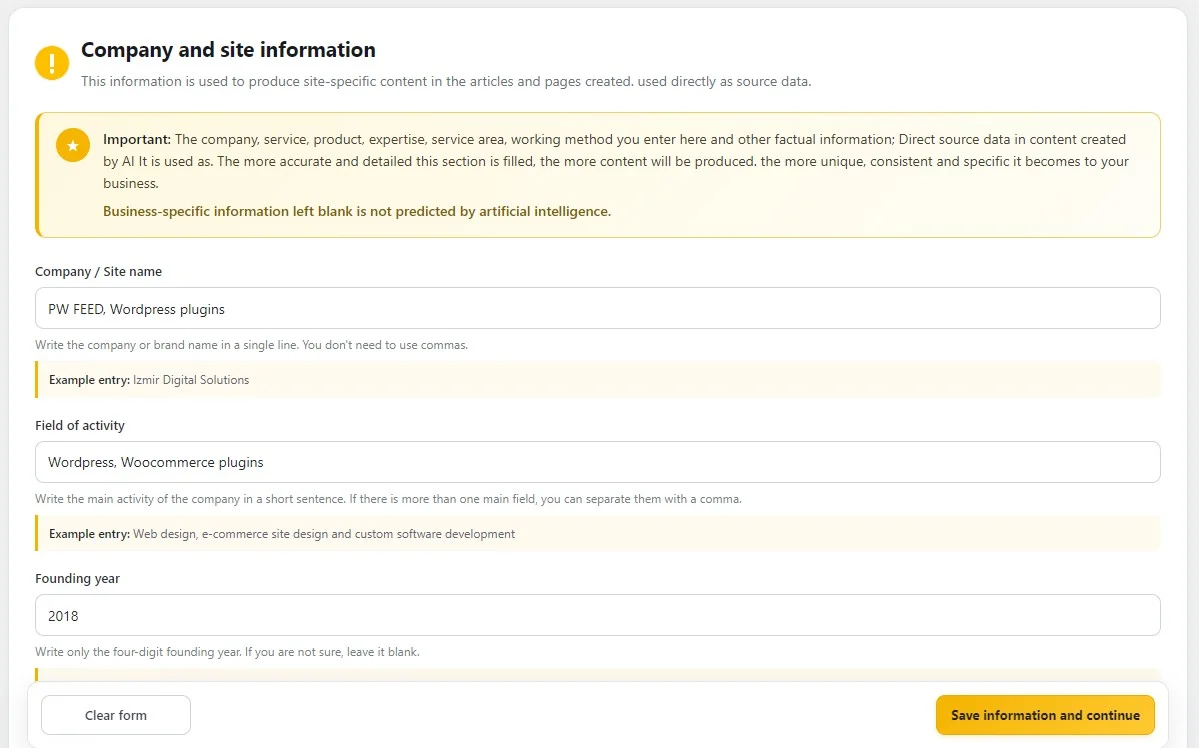
For PW Feed, the system can understand that the product operates within the WordPress AI content ecosystem.
Another WordPress site may have a completely different business context.
The same metadata formula should not be applied to both.
Brand names should be used selectively
Including a brand name in every meta description may consume valuable space and make descriptions repetitive.
Branded pages should naturally mention the brand.
Informational pages may not need it.
For example, an article targeting a general search about WordPress meta descriptions can focus on the topic first.
PW Feed can be introduced within the page and through appropriate commercial paths.
This helps the website develop broader informational visibility rather than limiting every search result to branded language.
Calls to action should not dominate meta descriptions
Meta descriptions do not always need commands such as Buy now, Contact us today, or Start immediately.
These may be appropriate for commercial pages.
Informational content usually benefits from a description that explains what the user will learn.
The commercial journey can continue inside the article.
Readers who want more information about PW Feed and its WordPress AI content capabilities can continue through the PW Feed contact page.
Users ready to evaluate purchasing options can proceed to the PW Feed buy page.
This allows informational metadata to remain aligned with informational search intent.
Automatic descriptions should respect page type
Different WordPress content types require different metadata approaches.
A blog article may describe what the reader will learn.
A service page may emphasize the service and intended customer.
A product page may communicate an important product function.
A local page may include genuine geographic relevance.
A comparison page may identify the options being compared.
An AI system should understand the content type before creating the description.
A universal template will rarely work equally well for every page.
Local content needs accurate geographic metadata
Location-based WordPress pages require additional control.
A meta description should not introduce a city or service area that the business does not genuinely serve.
AI should work from approved location data.
For a real local service page, geographic terminology may help communicate relevance.
For a general article, there may be no reason to insert a city at all.
Location metadata should describe reality rather than attempt to capture unrelated searches.
This benefits SEO, GEO, and user trust.
A wordpress plugin can automate the workflow
Creating metadata manually often involves several small steps.
The article is written.
The topic is reviewed.
A meta description is drafted separately.
The editor finds the correct SEO field.
The description is pasted.
The process repeats for every page.
A wordpress plugin can reduce these operations.
PW Feed can support a workflow where AI content generation and related SEO tasks are connected directly with WordPress publishing.
The description can be generated using the same article context.
This reduces manual transfer and improves consistency between content and metadata.
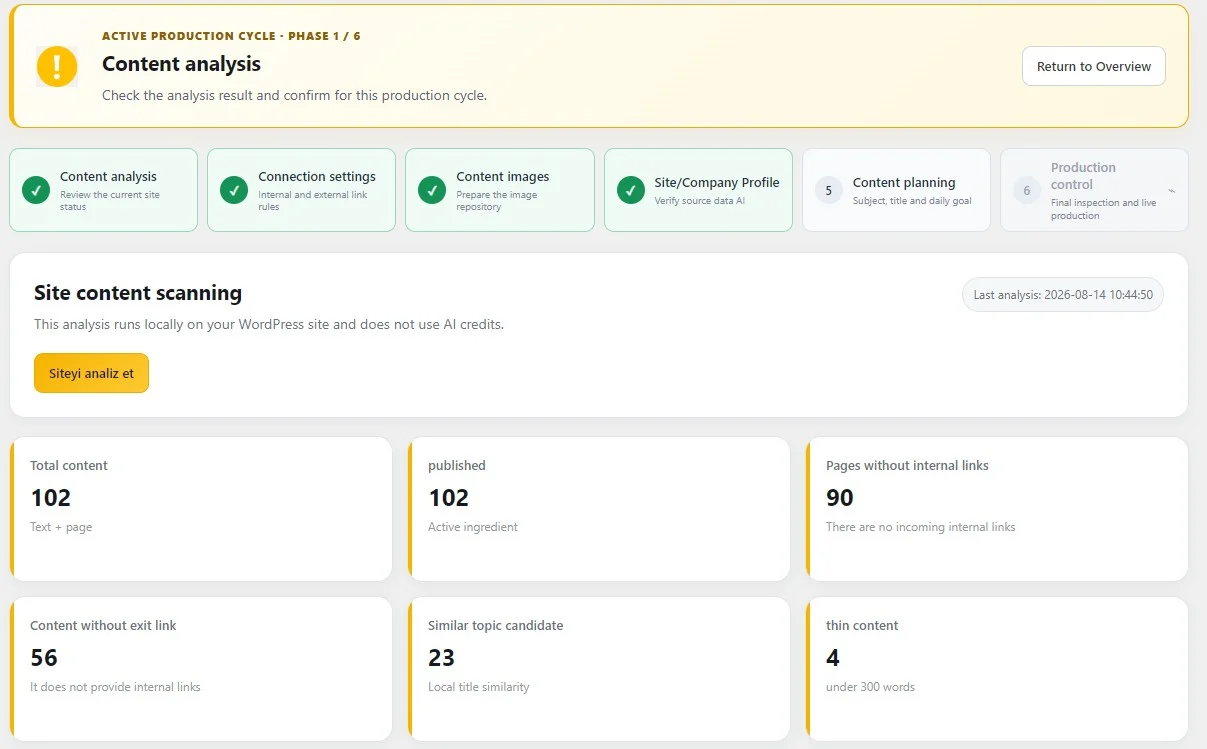
Meta description generation can happen after content generation
A logical automated sequence may be:
Choose the topic.
Generate the article.
Analyze its primary purpose.
Generate the SEO title.
Generate the meta description.
Check uniqueness.
Save as draft or publish according to the site’s rules.
This sequence gives the AI maximum context.
The metadata represents the finished content rather than an early assumption about what the article might contain.
For long-form AI content, this can improve accuracy considerably.
Draft mode allows metadata review
If an article is saved as a draft, the metadata can be reviewed at the same time.
An editor can check:
Does the description summarize the page?
Is it too similar to another description?
Does it use the correct terminology?
Is it overly promotional?
Does it promise information that the article does not provide?
Can the page be distinguished from related search results?
These checks can take little time while preventing low-quality metadata from becoming part of the live site.
Direct publishing requires automatic validation
A WordPress site using direct publishing should apply stronger automated controls.
Before a description is accepted, the system can verify that:
A description exists.
It is not an exact duplicate.
Its topic matches the article.
Business terminology is valid.
Unsupported claims are avoided.
The page is permitted to publish.
The description is associated with the correct article.
If important validation fails, the content can remain unpublished or become a draft.
Automation should create a controlled process rather than remove quality gates.
Description length should serve clarity rather than a rigid formula
Meta descriptions are often discussed in terms of character limits.
Practical display can vary.
The stronger principle is to communicate the page’s value concisely and place the most important information early.
Artificially expanding a complete description just to reach a particular number adds no value.
Likewise, an extremely short and vague description may fail to explain the page.
AI can be instructed to create concise summaries rather than rigidly filling a template.
The meaning should come first.
Front-load the important subject
Since search presentation can vary, important information should not be hidden at the end of the description.
A page about automatic meta descriptions should communicate that subject early.
For example, starting with Create unique WordPress meta descriptions with AI immediately establishes relevance.
A long introduction about digital marketing trends would waste valuable attention.
This principle also improves readability.
Users scanning search results can identify relevant pages faster.
Avoid generic opening phrases
Automated descriptions often begin with expressions such as:
Discover everything you need to know about…
Learn all about…
In today’s digital world…
Explore the power of…
These phrases consume space without providing much information.
Topic-specific openings are usually stronger.
For example:
Generate unique WordPress meta descriptions with AI while reducing repetitive metadata across your site.
The user knows immediately what the page addresses.
This type of direct language works particularly well for technical and instructional content.
Do not reuse the article introduction
A meta description should not simply copy the first sentence of the article.
The introduction serves a different purpose.
It can establish context and lead the user into the discussion.
The meta description needs to summarize the page quickly.
AI can create a dedicated description based on the overall article rather than extracting text mechanically.
This improves both relevance and originality.
Product terminology should remain consistent
Although descriptions should be unique, important product names should not change randomly.
If the product is PW Feed, AI should not invent alternative product names.
If a feature has an official name, that terminology should remain stable.
This is where consistency and originality must work together.
The description of the individual page changes.
The underlying business facts remain accurate.
This also supports GEO by reinforcing consistent entity relationships.
Descriptions can support content management as well as SEO
WordPress administrators sometimes use metadata during content audits and editorial reviews.
Clear descriptions can make pages easier to distinguish.
This is particularly useful on websites with large archives.
An editor can quickly understand what each article is intended to cover.
Agencies managing multiple sites can benefit similarly.
Good metadata therefore has an organizational benefit in addition to its search role.
Agencies need client-specific metadata rules
An agency may manage many WordPress websites.
Automatic metadata generation should not apply the same tone and terminology to every client.
Each site should have its own profile.
One client may use formal language.
Another may emphasize local service.
A software business may use technical terms.
An e-commerce business may use product-focused language.
AI can automate production while maintaining these differences.
This is essential for agencies that want efficiency without making client websites sound identical.
Multilingual websites require localized descriptions
A translated meta description is not always an optimized meta description.
Search behavior differs between languages.
Terminology can change.
Sentence structures vary.
The same expression may sound natural in English but artificial in another language.
AI can help localize descriptions based on meaning and search intent rather than translating mechanically.
Each language version should represent the page naturally for its intended audience.
This creates stronger multilingual SEO.
AI can improve old meta descriptions too
Automatic metadata generation is not limited to new articles.
An established WordPress website may contain older pages with:
Missing descriptions.
Duplicate descriptions.
Generic descriptions.
Outdated terminology.
Descriptions that no longer match expanded content.
AI can analyze these pages and generate improved alternatives.
This creates an optimization queue.
The website can gradually improve existing metadata rather than focusing exclusively on new publishing.
For mature sites, this may create substantial value.
A content audit can prioritize metadata problems
Not every description needs to be rewritten immediately.
A site can prioritize the most important problems.
For example:
Exact duplicates.
Missing descriptions.
Descriptions on high-value pages.
Outdated product names.
Highly similar metadata across content clusters.
Descriptions that clearly do not match the page.
AI can assist with remediation.
This turns metadata optimization into a manageable process rather than a complete manual rewrite of the website.
Metadata should evolve when page intent changes
An article may begin as a simple introduction and later be expanded into a comprehensive guide.
Its original description may no longer represent it accurately.
When the content changes substantially, metadata can be reviewed.
AI can generate a new description based on the updated version.
However, automation should not rewrite descriptions continuously without reason.
Changes should reflect meaningful content improvements.
Stable pages do not need constant metadata variation.
Unique descriptions help clarify content clusters
When several related pages appear in search results, strong descriptions can communicate the difference between them.
For example:
One result explains automatic titles.
Another explains automatic descriptions.
Another explains duplicate-content prevention.
Another explains internal linking.
Even if the titles contain similar WordPress AI terminology, descriptions can provide additional differentiation.
This creates a clearer search presence for the entire cluster.
It can also help users select the page that best matches their immediate need.
The strongest description focuses on value, not adjectives
AI-generated marketing language often relies on words such as powerful, revolutionary, ultimate, advanced, or incredible.
These adjectives do not necessarily communicate value.
Specific information is stronger.
Instead of saying:
Discover a powerful way to revolutionize WordPress SEO.
A description could say:
Create unique WordPress meta descriptions with AI, reduce repetitive metadata, and align each page with its search intent.
The second version explains what the user will actually learn.
This is a better foundation for informational SEO content.
PW Feed and automatic meta description generation
PW Feed can support WordPress users who want AI content generation and SEO-related tasks to work within a connected workflow.
The article provides the context.
AI identifies the page intent.
A suitable SEO title can be created.
A unique meta description can be generated.
GEO-oriented clarity can remain part of the wider content standard.
Publishing can follow controlled draft or direct-publication rules.
A wordpress plugin connects these functions with WordPress itself.
This removes repetitive steps while keeping metadata closely aligned with the page it represents.
Meta descriptions should support a larger content system
Metadata should not be treated as an isolated SEO checklist item.
It belongs to the wider information architecture.
Every page has a topic.
The title identifies that topic.
The meta description summarizes its value.
The article provides depth.
Internal links connect related information.
SEO connects the page with relevant searches.
GEO helps create clear relationships for generative discovery.
When these elements agree, the page becomes easier to understand.
AI automation can help maintain this alignment across large WordPress websites.
Final thoughts on creating unique meta descriptions with AI in WordPress
AI can make WordPress meta description creation significantly faster, especially for websites publishing content regularly.
However, useful automation should do more than generate a different sentence for every page.
The description should represent the actual article.
It should align with search intent.
It should complement the SEO title.
It should distinguish the page from related content.
Exact duplicates should be prevented.
Semantic similarity should be considered.
Keyword use should remain natural.
Business terminology should stay accurate.
GEO-related entity relationships should remain consistent.
A wordpress plugin can bring these processes closer to the WordPress publishing environment.
PW Feed can support a structured workflow in which AI content generation, SEO metadata, GEO clarity, originality checks, and publishing control work together.
The most important principle is simple:
Unique metadata begins with unique content purpose.
If every page answers a genuinely different question, AI can summarize those differences naturally.
If several pages exist only because keyword wording changed, no amount of meta description rewriting can solve the deeper content overlap.
When the website begins with clear page intent and uses AI to generate accurate, distinct descriptions around that intent, automated metadata can become a practical part of a scalable WordPress SEO and GEO content strategy.