
AI content automation for local business WordPress sites
Local businesses face a different content challenge from national publishers, large e-commerce platforms, and international companies. Their customers are usually searching for a specific service, solution, or business within a real geographic area. A potential customer may want a repair service nearby, a professional consultant in a particular city, a local contractor, a specialist clinic, a workshop, an agency, or another business that can actually serve their location.
This means content for a local business must do more than attract general traffic.

It should explain what the company does, demonstrate relevant expertise, answer real customer questions, connect services with genuine geographic areas, and provide enough context for search engines and AI-powered discovery systems to understand the business accurately.
Producing this content manually can require significant time.
AI content automation offers local businesses a practical way to expand their WordPress websites without manually writing every article from the beginning.
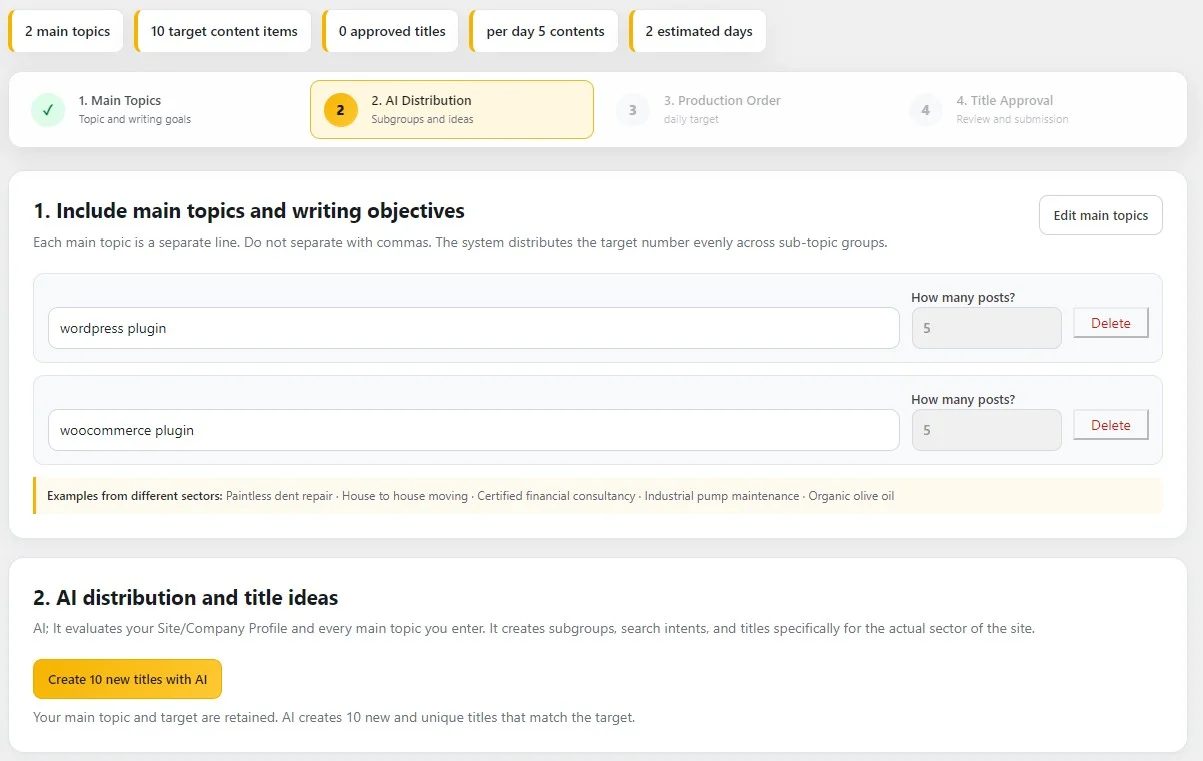
PW Feed can support this process by bringing AI content generation, SEO, GEO, WordPress publishing, and structured content rules together through a wordpress plugin workflow.
The objective is not to generate hundreds of artificial location pages. It is to create useful content that reflects the real services, expertise, and operating area of the business.
Why local business content requires a different strategy
A local company normally competes within a defined market.
Its customers may be located in one city, several districts, a metropolitan area, or a specific region.
This geographic connection changes search intent.
Someone searching for general information about a service may still become a customer, but users making location-oriented searches often have stronger commercial intent.
For example, a person searching for how a particular repair process works may only be researching.
A person searching for the same repair service in their city may be actively looking for a provider.
A strong local content strategy should address both stages.
Informational articles can answer questions and demonstrate expertise.
Service pages can explain what the business provides.
Location information can clarify where those services are available.
Together, these elements create a more complete website.
AI can help local businesses produce the informational layer more consistently without requiring every page to be written manually.
Local SEO is more than repeating a city name
One of the biggest mistakes in local content creation is excessive geographic keyword repetition.
Adding a city name to every sentence does not automatically make an article locally relevant.
It can make the content difficult to read and may create pages that feel artificial.
Real local relevance comes from accurate context.
A business may mention the city in which it operates.
It may explain which districts or areas it genuinely serves.
It can discuss local customer needs when geography actually affects the service.
It may provide accurate business information and connect articles with relevant service pages.
This is very different from creating dozens of nearly identical pages where only the place name changes.
AI automation should therefore be controlled carefully.
A good WordPress content workflow should use geographic information when it adds meaning rather than inserting location keywords mechanically.
Real service areas should guide geographic content
A local business should only target areas it genuinely serves.
This principle is important for users, SEO, and GEO.

If a business operates in one city but generates articles for dozens of unrelated locations, the site can create conflicting signals.
Potential customers may also receive misleading information.
A better strategy starts with the actual service area.
The business can define its primary location and surrounding areas where customers realistically receive service.
AI-generated content can then use this information when appropriate.
For example, an article may discuss the company’s service from the perspective of customers within its operating area.
Another article may answer a common question that occurs frequently among local clients.
A location-specific page may be appropriate when the business genuinely has meaningful information to provide about that area.
Accuracy should remain more important than geographic volume.
Local customer questions are powerful content opportunities
Local businesses interact directly with customers every day.
This gives them a valuable source of content ideas.
Customers often ask recurring questions before making a purchase or requesting a service.
How long does the service take?
Is an appointment required?
Which solution is suitable for a particular problem?
What should the customer do before arriving?
Can the service be completed on the same day?
Which areas are served?
What factors affect the process?
What is the difference between two service options?
These questions can become useful WordPress articles.

AI can help transform a simple question into a detailed explanation.
The business provides the relevant facts and context.
The AI content system can assist with structure, related terminology, SEO coverage, and readability.
This creates content based on real customer demand rather than random publishing.
AI automation can turn everyday expertise into website content
Many local businesses possess years of practical knowledge.
A specialist may solve the same type of problem repeatedly and know exactly what customers should consider.
However, that information may exist only in conversations.
It is never added to the website.
This creates a gap between the company’s real expertise and its online presence.
AI can help close that gap.

The business can identify an important subject and provide essential information.
AI can then assist with converting that knowledge into structured content.
This is particularly useful for businesses whose employees are experts in their field but are not professional writers.
The objective should be to preserve genuine expertise while reducing the writing workload.
A strong AI content workflow does not invent expertise.
It helps communicate expertise that already exists.
Local content can support important service pages
A local WordPress website often has a limited number of commercial pages.
These may include the homepage, service pages, contact information, and perhaps several category pages.
Blog content can support these pages.
Suppose a business has a primary service page.
Instead of forcing every possible customer question onto that one page, the company can create supporting articles.
One article can explain the process.
Another can describe common problems.
Another can discuss how to choose between different solutions.
Another can address maintenance or preparation.
Another can answer a frequently asked question.
These articles can naturally connect back to the relevant service.
This creates a network around the commercial page.
The service page remains focused on the business offering, while informational articles provide greater depth.
Content automation can expand long-tail search visibility
Local businesses often benefit from specific searches rather than only broad keywords.

A highly competitive broad keyword may be difficult to rank for and may include users with very different intentions.
Long-tail queries are more specific.
They often describe a precise question or problem.
For example, users may search for:
How does a particular service work?
Can a specific problem be repaired?
What should I do before booking a service?
How long does a particular process take?
Which option is better for a certain situation?
These searches may have lower individual volume, but together they can represent substantial opportunity.
They can also attract visitors who are highly relevant to the business.
AI content automation can make it easier to address many of these distinct questions over time.
The important requirement is that every article answers a genuine topic instead of creating slight variations of an existing page.
Local businesses should avoid doorway-style location content
Automation makes it technically easy to create large numbers of geographic pages.
This capability should be used cautiously.
A business could theoretically create separate pages for every district, neighborhood, or nearby city.
If those pages contain essentially identical content, they provide little value.
Changing only the geographic name does not make a page unique.
A useful location page should contain information that genuinely relates to that area.
If no meaningful difference exists, a broader service-area page may be better.
AI should therefore not be used as a location-page multiplication tool.
PW Feed can be incorporated into a more controlled WordPress content process where geographic targeting remains accurate and purposeful.
SEO benefits from relevance.
GEO benefits from clear and consistent entities.
Users benefit from honest information.
All three goals support avoiding artificial geographic expansion.
GEO is particularly relevant to local business information
Generative Engine Optimization is important for local businesses because AI-driven search systems increasingly help users research companies, services, and solutions.
For an AI system to understand a local business correctly, the website should communicate important relationships clearly.
What is the business name?
What services does it provide?
What subjects does it specialize in?
Where does it operate?
What problems does it solve?
How can customers continue to the next step?
Consistent information can make these relationships easier to interpret.
Blog articles contribute to this context.
If multiple useful pages consistently connect the business with its real expertise and service categories, the website creates a clearer information environment.
GEO therefore extends beyond adding particular keywords.
It involves making the meaning of the business understandable.
SEO and GEO should use accurate geographic signals
Local SEO often involves geographic terminology.
GEO also benefits from geographic clarity.
However, both depend on accuracy.
A business should not claim to operate from locations where it has no genuine presence.
It should not mention unrelated cities simply to gain visibility.
If the company serves surrounding areas from one physical location, this can be explained accurately.
Clear language is better than artificial expansion.
For example, a business can state that it is based in one location and serves customers from nearby districts when that is true.
This provides useful context without creating misleading information.
AI-generated articles should respect these geographic rules.
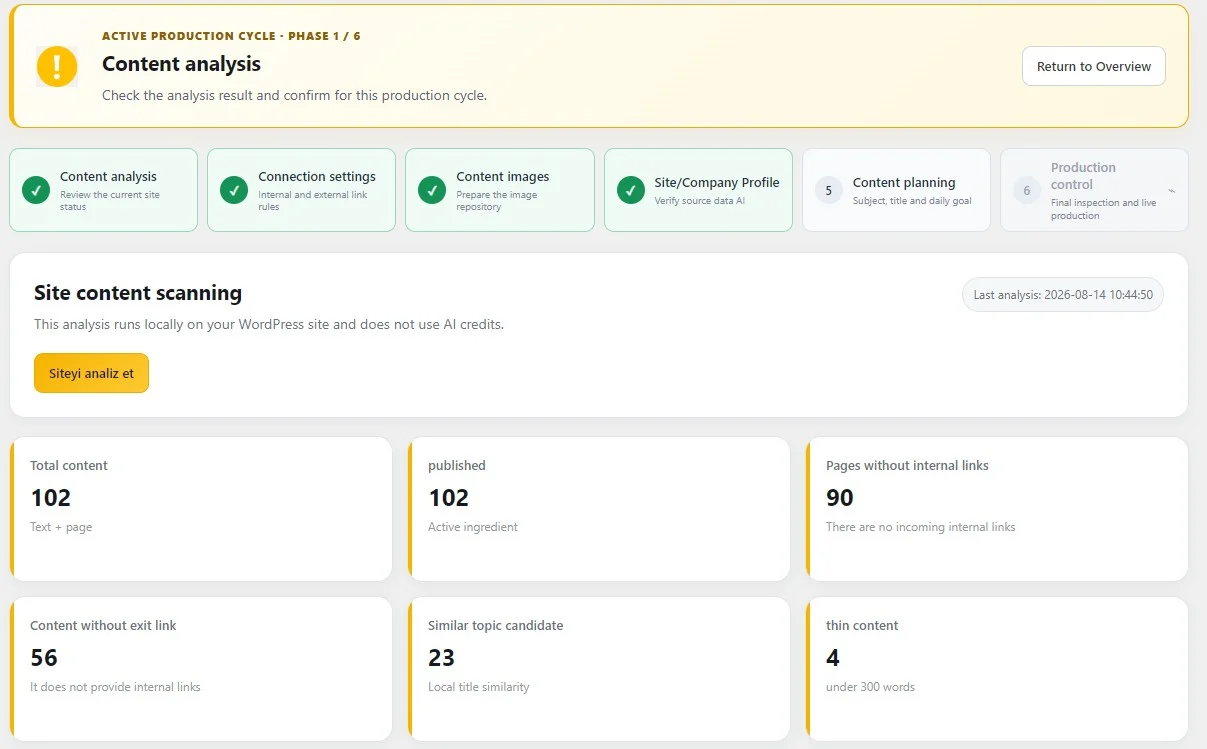
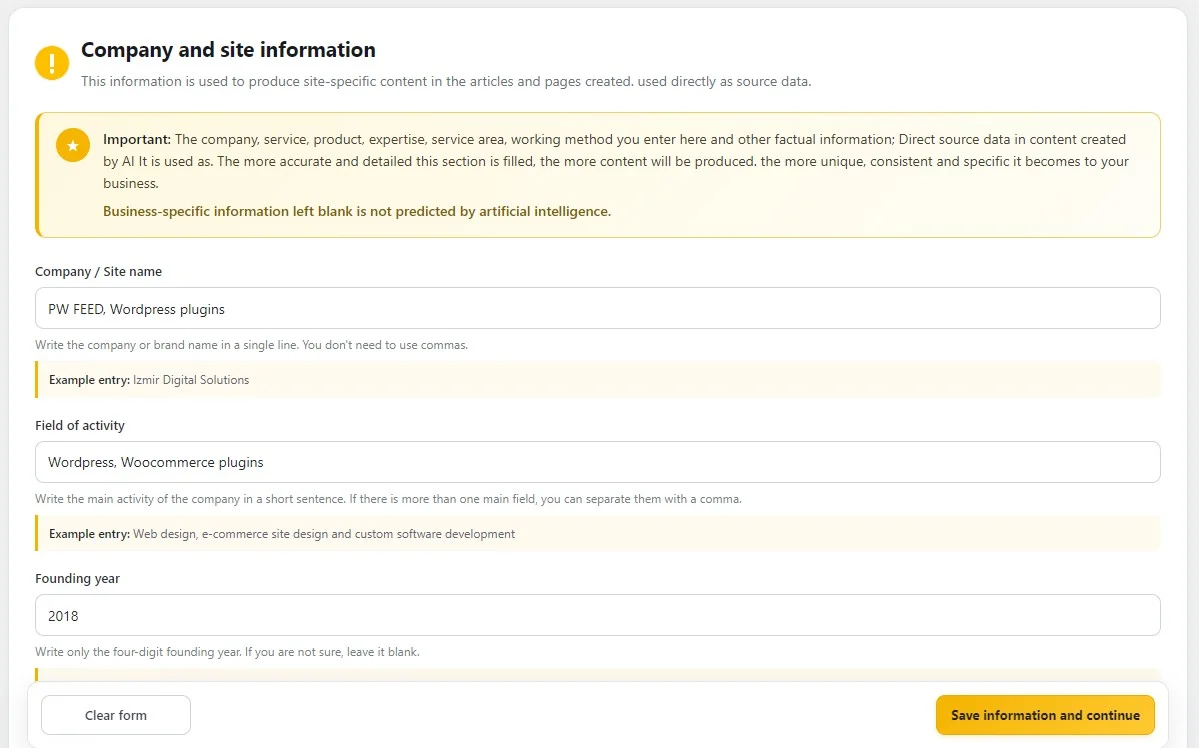
A business profile can help the content system maintain consistency across new pages.
A business profile improves automatic content quality
AI content becomes much more useful when it understands the company it is writing about.
A business profile can define essential information such as:
Business name.
Core services.
Industry.
Primary location.
Real service areas.
Target audience.
Preferred terminology.
Important website pages.
Subjects that should not be mentioned.
Brand language.
This context reduces generic output.
It also decreases the risk that AI will make incorrect assumptions about the business.
For local businesses, geographic accuracy is especially important.
If the system knows the real operating area, it can use locations appropriately instead of inventing them.
A wordpress plugin workflow can make this information part of ongoing content generation.
Automatic articles should not all have the same structure
Another risk of automation is excessive uniformity.
If every page begins with the same introduction, follows the same sequence, and ends with the same wording, the site may feel mechanically generated.
Local businesses should aim for variation.
One article might begin with a customer problem.
Another could begin with a common misconception.
Another may explain a choice between two options.
Another might describe a practical process.
Another could answer a direct question.
The SEO and GEO rules can remain consistent while the presentation changes.
This helps create more natural content and reduces similarity between pages.
Originality is not simply about changing words.
It involves changing the informational purpose and approach.
Content should reflect the language customers actually use
Businesses sometimes describe their services using technical terminology that customers rarely search for.
Customers may use simpler phrases.
A local content strategy should consider both.
The official service name can establish accuracy.
Common customer language can help capture natural search behavior.
AI can help integrate related terminology into an article without making the text unreadable.
For example, a specialist phrase can be explained alongside the everyday term customers use.
This improves accessibility.
It may also strengthen semantic relevance because search engines can connect different ways of describing the same concept.
GEO can benefit as well because the article provides clearer definitions and relationships.
A local blog should educate before it sells
Not every article needs to push the reader toward an immediate purchase.
Informational content should primarily answer the question that brought the visitor to the website.
This builds trust.
A potential customer may first discover the business while researching a problem.
If the article provides a useful explanation, the visitor may explore the website further.
This is where blog content can support the commercial journey naturally.
The information comes first.
The business opportunity follows.
For users researching PW Feed and AI-based WordPress content workflows, additional information is available through the PW Feed contact page.
Businesses that have already evaluated the solution and want to review available options can continue to the PW Feed buy page.
A clear next step is useful, but it should not overwhelm the informational purpose of the article.
Local content can help establish subject expertise
A local business may compete against several companies offering similar services.
Content creates an opportunity to demonstrate deeper knowledge.
A website containing only short service descriptions tells users what the company sells.
A website containing detailed educational content can also show what the company knows.
This distinction can matter.
A customer comparing providers may trust a business more when the website answers difficult questions clearly.
Search engines also gain more information about the company’s subject area.
AI systems can encounter a richer set of related explanations.
Over time, a focused content library can strengthen the association between the business and its specialist field.
Automation can help businesses publish consistently
Consistency is difficult when content depends entirely on spare time.
A local business may have busy seasons where no one can focus on the website.
AI automation can reduce this dependency.
A controlled list of topics can be prepared.
The wordpress plugin can support a defined publishing workflow.
Articles may be created as drafts for review or published according to predefined rules.
The business does not need to begin every article manually.
This can make regular publishing much more realistic.
The goal should not be daily publication unless the website genuinely has enough useful subjects.
A few valuable articles published consistently can be more effective than a large burst of weak content.
Draft mode helps protect local business details
Business-specific information requires accuracy.
A generated article may discuss services, locations, processes, or terminology.
Draft mode allows these details to be checked before the article becomes public.
This is particularly useful when implementing AI automation for the first time.
The business can review whether the system correctly understands its context.
Incorrect assumptions can be identified.
Instructions can then be refined.
Over time, the workflow can become more reliable.
Some categories may eventually be suitable for automatic publishing, while other topics may continue to require manual approval.
Flexibility is more useful than forcing one publication method on every article.
Content should avoid making unsupported local claims
AI should not invent claims such as being the best provider in a city, serving every district, having the lowest prices, or being the most trusted business unless these statements are properly supported.
Such language can damage credibility.
Local content performs better when it communicates specific and verifiable information.
Explain the service.
Describe the process.
Answer real questions.
Identify genuine operating areas.
Provide accurate company information.
This creates a stronger foundation than exaggerated marketing claims.
It also supports GEO because clear factual relationships are easier for generative systems to interpret than vague superlatives.
Internal links can create a local knowledge network
As more articles are published, related pages can be connected.
A blog post discussing a common customer problem can link to the relevant service page.
A service page may link to a detailed guide.
A guide may connect to another article answering a related question.
This creates a useful internal network.
Visitors can explore topics naturally.
Search engines can see relationships between informational and commercial content.
AI-powered systems may encounter consistent connections between the business, services, and related expertise.
Internal links should therefore be planned according to relevance.
Automatically adding links to every possible phrase can reduce usability.
Quality remains more important than quantity.
Local businesses can use AI without losing authenticity
Some business owners worry that automated content will make their website sound generic.
That risk exists when AI is used without context.
The solution is not necessarily avoiding AI.
It is providing better information and stronger rules.
A content system can use the business’s real services, preferred language, target audience, operating area, and expertise.
Articles can then remain connected to the actual company.
AI handles much of the writing workload.
The business supplies authenticity.
This combination can be more efficient than outsourcing all content to someone who has little knowledge of the company.
PW Feed can support a controlled local content system
PW Feed provides a framework for businesses that want to bring AI content creation into their WordPress workflow.
For local companies, the strongest use is not unlimited automatic publishing.
It is controlled content development.
Relevant topics can be selected.
Business information can provide context.
SEO can guide search intent.
GEO can improve clarity for generative discovery.
WordPress can manage the resulting articles.
A wordpress plugin can reduce the manual steps between content planning and publication.
This approach allows small and local businesses to create a stronger information base without turning content production into another major operational burden.
AI content can support growth into new service topics
Businesses evolve.
A company may introduce a new service.
Customers may begin asking different questions.
A new technology may affect the industry.
AI content automation can help the website respond.
New topic clusters can be introduced gradually.
Supporting articles can explain the new service.
Frequently asked questions can become individual resources.
Existing articles can connect to newer material.
This makes the website more adaptable.
Instead of requiring a complete content campaign every time the business changes, the company can extend the existing system.
Local content quality should be measured by usefulness
A page should not be considered successful simply because it contains the target city and keyword.
The better questions are:
Does the article solve a real information need?
Is it related to the company’s expertise?
Does it contain accurate geographic information?
Does it add something not already covered elsewhere?
Can a potential customer learn something useful?
Does it support an existing service or subject area?
Are the business and service relationships clear?
Can search engines and generative systems understand the topic?
These criteria create a much stronger standard for local AI content.
Final thoughts on AI content automation for local businesses
AI content automation can give local business WordPress sites a practical way to build a deeper online presence without requiring a large content team.
The technology can assist with topic development, long-form writing, SEO terminology, GEO clarity, content structure, draft creation, and publishing workflows.
However, local content requires discipline.
Geographic information should be accurate.
Service areas should be real.
Articles should answer distinct questions.
Location names should not be repeated artificially.
Existing content should be considered before creating new pages.
Customer questions should help guide topics.
Business expertise should remain the foundation.
PW Feed combines AI content generation with WordPress, SEO, GEO, and controlled wordpress plugin functionality to support this type of structured approach.
For local businesses, the greatest advantage of AI is not the ability to generate the largest number of pages.
It is the ability to communicate more of what the business genuinely knows.
Every useful article can answer another customer question, explain another service detail, strengthen another topic, and provide search engines and AI systems with additional context about the company.
When automation is guided by real business information and genuine geographic relevance, it can help transform a basic local WordPress website into a deeper, more informative resource for both customers and modern search environments.