
AI content generation for WordPress service pages
Service pages are among the most important pages on a business website.
A blog article may educate a visitor. A service page has a more direct responsibility. It needs to explain what the business offers, who the service is for, which problem it solves, how the process works, and what the visitor should do next.
For WordPress websites, creating strong service pages manually can require substantial time. A business may offer several services. An agency may manage service pages for many clients. A company may need to update older descriptions as its services evolve.
Artificial intelligence can make this work faster.
However, AI-generated service pages require more control than ordinary informational articles.
A service page contains business claims. It may describe expertise, geographic coverage, processes, features, limitations, pricing context, or expected outcomes. If AI invents these details, the result may be misleading.
The strongest approach therefore combines AI production with verified business information.
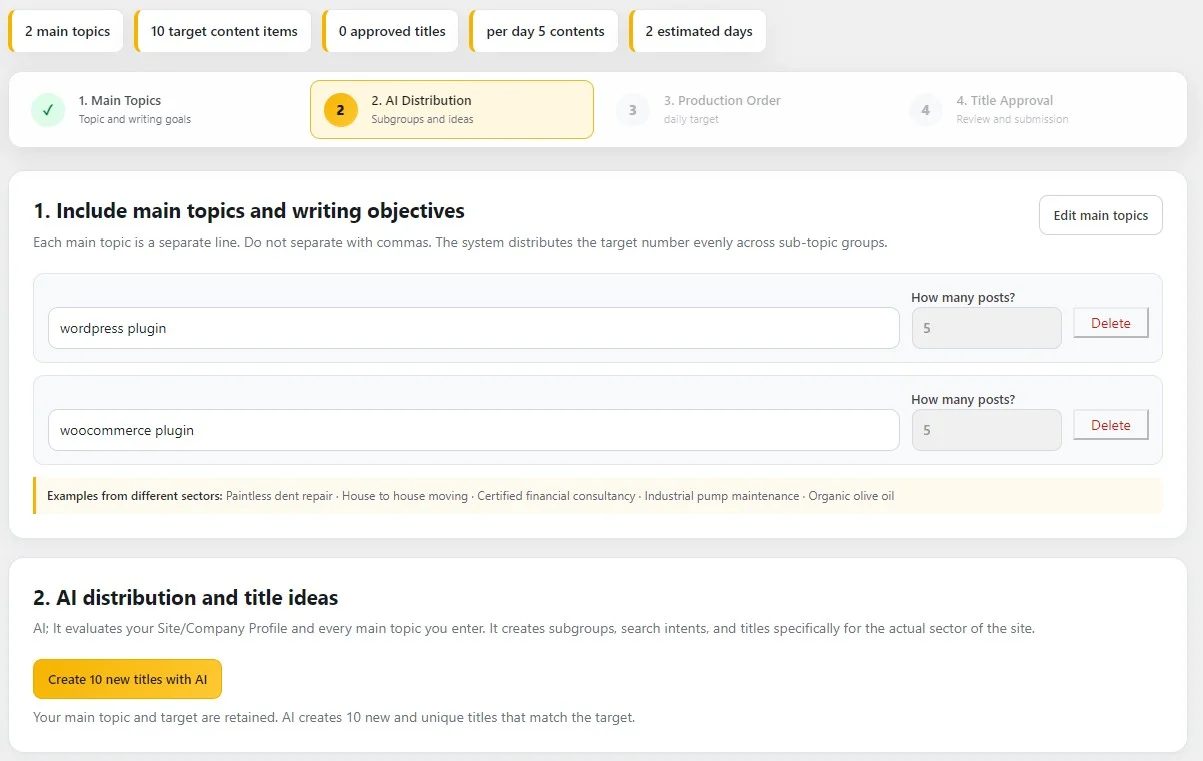
PW Feed can support this model by combining WordPress AI content generation, SEO, GEO, structured business context, and wordpress plugin functionality.
The objective is not to create generic service pages automatically.
The objective is to help businesses produce accurate, differentiated, search-friendly service content that reflects what they genuinely provide.
What makes a service page different from a blog article?
A blog article is usually informational.
It may answer a question, explain a concept, compare methods, or provide guidance.

A service page is usually commercial.
Its purpose is to explain an offering and help a potential customer decide whether that offering is relevant.
This changes the content structure.
A service page may need to answer questions such as:
What is the service?
Who needs it?
What problem does it solve?
How does the service work?
What is included?
What should customers expect?
Where is the service available?

Why should the customer contact this business?
These are different questions from those asked in a typical educational article.
AI should understand this distinction before generating the page.
AI should begin with verified business information
A service page should never be built entirely from assumptions.
The AI system needs reliable context.
Useful information may include:
Business name.
Service name.
Service description.
Target customer.
Real geographic coverage.
How the service is delivered.
Important features.
Limitations.
Preferred terminology.
Commercial priorities.
Relevant contact pages.
Statements that should not be made.
This context helps AI create a page based on reality.
Without it, the model may fill gaps with plausible but incorrect details.
That can be particularly risky for professional, technical, financial, legal, medical, or local service businesses.

Business profiles can make service-page automation safer
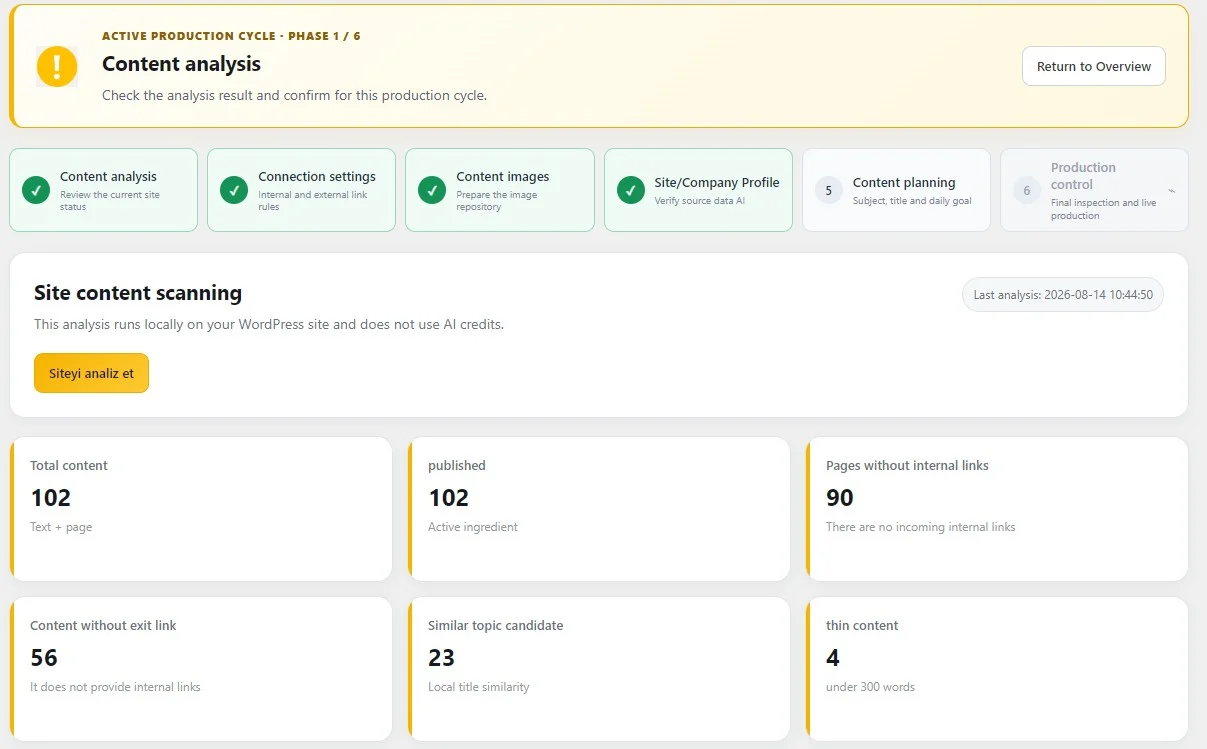
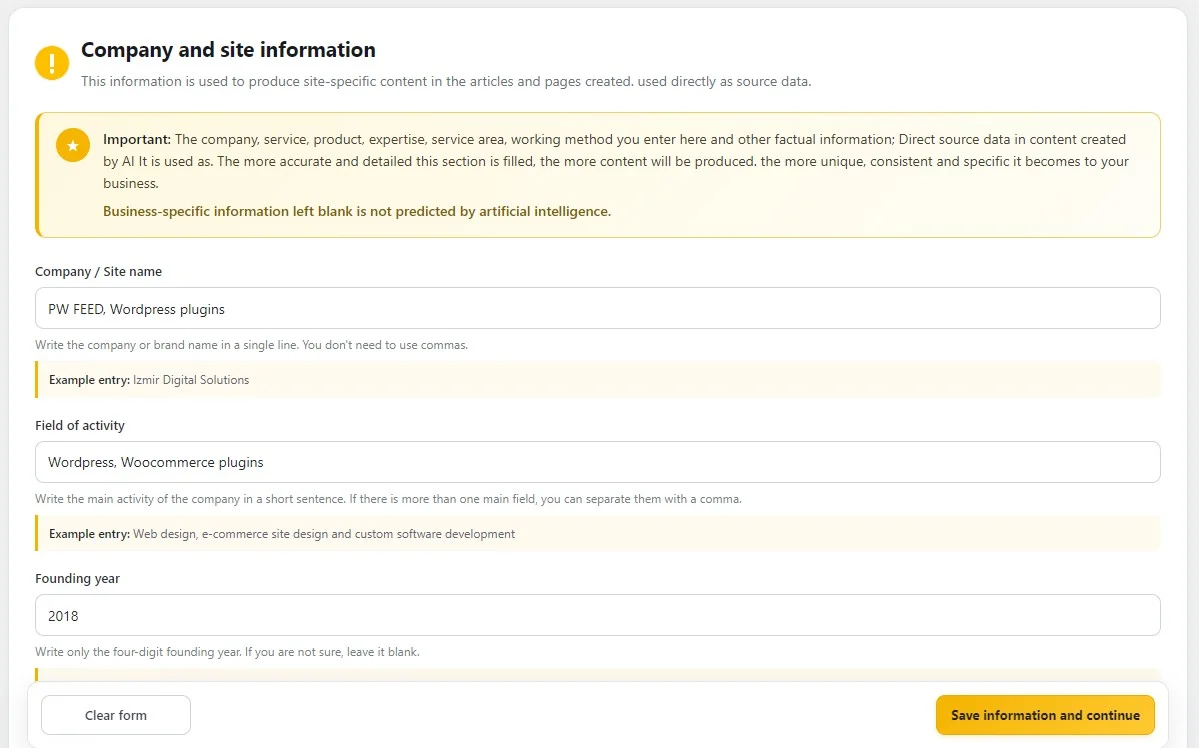
A structured business profile provides a reusable source of context.
Instead of entering the same company information for every new page, the website can maintain a defined profile.
AI can use that information when generating individual service pages.
For example, the profile may establish:
Which services the company actually provides.
Which locations it serves.
Which terms it prefers.
Which claims are allowed.
Which contact route should be used.
Which product or service names must remain consistent.
This can improve both efficiency and accuracy.
PW Feed can support a content workflow where business context helps guide AI generation rather than asking AI to invent the business from scratch.
Every service should have a distinct page purpose
Businesses often provide several related services.
This creates a risk of duplication.
Suppose a company offers:
SEO content creation.
AI content automation.
GEO content optimization.
WordPress content publishing.
These services are related.

If each page simply says that AI helps create better WordPress content, the pages may become almost identical.
Each service page needs a specific purpose.
The SEO page should explain search-focused content.
The GEO page should explain generative-search visibility and entity clarity.
The publishing page should explain workflow and automation.
The AI content page can focus on generation itself.
This separation helps users understand the offering.
It also improves search-intent differentiation.
Search intent should influence service-page structure
A user landing on a service page is often closer to a commercial decision than someone reading a blog article.
The page should therefore answer practical questions quickly.
For example:
Is this the service I need?
Does this company provide it?
How does it work?
What type of business is it suitable for?
What happens after I contact them?
A service page should not hide these answers beneath a long generic introduction.
AI can help structure the page around commercial search intent.
This improves clarity for users and can strengthen SEO relevance.
The main service should be understandable immediately
A visitor should not need to read several paragraphs before understanding what the company offers.

The opening section should establish the service clearly.
For example, a WordPress AI content service page might explain that the system helps generate and manage SEO- and GEO-focused content directly within WordPress.
The first section should not begin with a broad history of artificial intelligence.
Context can be useful, but the service itself should remain central.
This principle is especially important for users arriving from search results with a specific need.
AI can help convert technical services into understandable language
Many businesses offer services that customers find difficult to understand.
The company may use technical terminology internally.
Customers may search with simpler expressions.
AI can help bridge the gap.
A technical term can be introduced and then explained in practical language.
For example, GEO can be described as Generative Engine Optimization and then explained as an approach designed to make website information clearer and more useful for AI-powered search and answer systems.
This serves both expert and non-expert audiences.
The service page remains accurate without becoming unnecessarily complicated.
Preferred terminology should remain stable
Service names should not change randomly from page to page.
If a company calls a product PW Feed, AI should not invent new names for it.
If a service is officially called AI content automation, another page should not describe the exact same service as autonomous editorial intelligence unless the distinction is intentional.
Stable terminology supports:
Brand recognition.
User understanding.
SEO.
GEO.
Internal linking.
Content consistency.
AI can apply these rules automatically when they are part of the business profile.
SEO keywords should support the service naturally
A service page should include relevant search terminology.
However, keyword repetition should not dominate the writing.
A page for a WordPress AI content service may naturally include phrases such as:
WordPress AI content.
AI content automation.
SEO content.
GEO content.
wordpress plugin.
Automatic content publishing.
These terms belong to the subject.
They do not need to be repeated unnaturally in every paragraph.
Modern SEO benefits from clear topical relevance, useful information, and semantic coverage.
The page should read like a service explanation first and an optimization document second.
Long-tail service queries can provide stronger intent
Broad keywords can be highly competitive and ambiguous.
Long-tail searches often reveal more specific customer needs.
For example:
AI content generation for WordPress service pages.
WordPress AI SEO content plugin.
Automatic WordPress content creation for business websites.
AI SEO content automation for WordPress.
These searches communicate clearer intent than a broad phrase such as AI content.
Service pages can be created around these focused needs when they correspond to real offerings.
This can help the business attract visitors whose requirements are closer to the actual service.
Service pages should not be created for every keyword variation
A common SEO mistake is creating separate service pages for very similar phrases.
For example:
AI WordPress content service.
WordPress AI content service.
AI content service for WordPress.
Automatic WordPress AI content service.
These may represent the same underlying search intent.
Creating a separate page for each variation can create duplication and keyword cannibalization.
A stronger page can include the related terminology naturally.
Separate service pages should exist only when the service or customer need is genuinely different.
AI can compare proposed services with existing pages
Before generating a new page, the system can consider existing service content.
It can ask:
Does another page already explain this offering?
Is the proposed service truly different?
Could the existing page be expanded instead?
Would the new page target a different audience or use case?
This check can prevent the business from creating several near-identical commercial pages.
For growing WordPress websites, this becomes increasingly important.
GEO is particularly relevant for service pages
Service pages explain important relationships between the business and what it provides.
This makes them valuable for GEO.
A clear service page can establish:
The business entity.
The service entity.
The platform involved.
The customer problem.
The service function.
Relevant geographic coverage.
Related products or technologies.
For PW Feed, the website can consistently communicate relationships between PW Feed, WordPress, AI content generation, SEO, GEO, automated publishing, and wordpress plugin functionality.
These relationships should be expressed clearly rather than hidden behind vague promotional language.
Answer-focused sections can improve service clarity
Potential customers often have predictable questions.
A service page can answer them directly.
For example:
Can the content be saved as a draft?
Can content be published automatically?
Can SEO titles be created automatically?
Can the system help with GEO-focused content?
Can publishing limits be controlled?
These questions are useful because they correspond to real decision points.
Direct answers can improve user experience.
They can also support AEO and GEO by presenting information in a clear question-and-answer structure.
AI can generate useful FAQ topics from service context
FAQ sections should not contain invented questions simply to increase page length.
AI can help identify questions that naturally follow from the service.
The business can then review them.
Useful sources include:
Sales questions.
Customer support requests.
Implementation concerns.
Pricing questions.
Compatibility questions.
Process questions.
Limitations.
The resulting FAQ becomes more valuable when it reflects real customer uncertainty.
Service pages should explain the process
Customers often want to know what happens after they choose a service.
A process section can reduce uncertainty.
Depending on the business, the process may include:
Initial contact.
Requirement assessment.
Configuration.
Production.
Review.
Delivery.
Ongoing support.
A WordPress AI content product might instead explain:
Site setup.
Business profile configuration.
Topic definition.
AI generation.
SEO and GEO processing.
Draft or publication.
The process should reflect the real workflow.
AI can organize it clearly, but it should not invent steps that do not exist.
Service-page automation should preserve factual boundaries
One of the most important AI rules is knowing what not to claim.
If the company does not guarantee rankings, the page should not imply guaranteed search results.
If the business operates only in certain areas, AI should not claim nationwide service.
If a software feature does not exist, it should not be presented as available.
If a service requires manual approval, the page should not describe it as fully autonomous.
Accuracy protects trust.
It also improves long-term SEO and GEO consistency because the site does not contain contradictory claims.
Unsupported superlatives should be avoided
AI often generates phrases such as:
The best solution.
The most advanced platform.
The leading service.
The ultimate WordPress AI system.
These claims may be difficult to support.
A service page can be persuasive without exaggeration.
Specific capabilities are usually stronger than vague superiority claims.
For example:
Generate WordPress content according to predefined SEO and GEO requirements.
is more informative than:
Use the world’s most advanced WordPress AI technology.
Clear functionality builds stronger credibility.
Benefits should connect to real service features
Service pages often contain benefit sections.
These can become generic.
Save time.
Increase productivity.
Grow your business.
Improve results.
Such statements may be reasonable but are not very distinctive.
AI should connect benefits to specific functions.
For example:
Automatic draft creation can reduce repetitive content-entry work.
A defined business profile can improve terminology consistency.
Topic planning can reduce duplicate page creation.
Automatic metadata generation can reduce manual SEO tasks.
These benefits are easier to understand because the underlying mechanism is clear.
Features and benefits should not be confused
A feature describes what the service does.
A benefit explains why that matters to the user.
For example:
Feature: AI can generate WordPress drafts.
Benefit: The editorial team can review complete articles without writing every first draft manually.
Feature: The system can generate unique SEO titles.
Benefit: Large content libraries can reduce repetitive metadata work.
A strong service page can include both.
AI can help translate technical functionality into practical value.
Service pages should address who the service is for
Not every service is suitable for everyone.
Clarifying the target audience helps users evaluate relevance.
For example, a WordPress AI content system may be useful for:
Small businesses.
WordPress website owners.
Agencies.
Service companies.
Niche publishers.
Teams managing multiple sites.
The page can explain how different users may apply the system.
This provides more useful context than a generic statement saying the service is for all businesses.
Different audiences may deserve separate supporting pages
The main service page can explain the overall offering.
Supporting content can then explore specific use cases.
For example:
AI content automation for agencies.
AI content for local businesses.
AI content for niche websites.
AI content for service businesses.
These pages can support the central service without duplicating it.
This creates a service-centered content cluster.
The primary page describes what is offered.
Supporting articles explain how different audiences can use it.
Internal linking can strengthen service pages
A service page can connect to relevant informational content.
For example, a WordPress AI content service page may link to deeper articles about:
Automatic publishing.
Draft workflows.
SEO titles.
Meta descriptions.
Internal linking.
GEO.
Duplicate-content prevention.
These articles provide additional information without forcing the commercial page to explain every subject in maximum depth.
This creates a stronger information architecture.
Blog articles should also support service pages
The relationship should work in both directions.
Informational articles can link toward the relevant service or product page when a natural commercial connection exists.
For example, an article explaining automatic WordPress content planning can introduce PW Feed as a relevant product context.
This helps move users from education toward evaluation.
Internal linking therefore connects the informational and commercial parts of the website.
Service pages can act as cluster hubs
A service page may become the central page for an important commercial subject.
Supporting articles can answer related questions.
For example, a WordPress AI SEO content service page could be supported by articles about:
SEO-friendly automatic posts.
AI content workflows.
Automatic publishing.
Long-form content.
Unique SEO titles.
Meta descriptions.
Internal linking.
GEO.
The service page provides the commercial overview.
The articles create depth.
This can strengthen both user navigation and topic structure.
Calls to action should match user readiness
Not every visitor is ready to purchase immediately.
A service page can provide more than one route.
One user may want additional information.
Another may already understand the product and want to buy.
For PW Feed, visitors who need additional information about its WordPress AI content, SEO, GEO, or publishing capabilities can use the PW Feed contact page.
Users ready to review purchasing options can continue to the PW Feed buy page.
These paths support different levels of purchase readiness without forcing every visitor into the same action.
A strong call to action should follow useful information
Repeated calls to action after every section can make a service page feel aggressive.
A better approach allows the visitor to understand the service first.
The call to action then appears when the next step becomes logical.
This is particularly important for technical or higher-consideration products.
Users may need to understand:
What the service does.
How it works.
Whether it fits their needs.
What level of control they retain.
Only then are they ready to continue.
Service-page content should remain original
Businesses offering several related services can easily create repetitive pages.
AI can make this worse if every page uses the same template.
For example:
Introduction.
Benefits.
Why choose us.
How it works.
FAQ.
Conclusion.
There is nothing inherently wrong with this structure.
The problem appears when every service page contains essentially the same text with different service names.
The content should reflect the actual service.
Different services deserve different explanations, questions, examples, risks, and processes.
Page structure can vary according to the service
A highly technical service may begin by explaining the problem.
A local service may begin with customer needs and availability.
A software service may begin with workflow.
A professional advisory service may begin with the situation that creates the need.
AI can adapt the structure.
This reduces the appearance of mass-generated pages and makes the information more appropriate to the user.
AI should avoid repeating the homepage
A service page often becomes a smaller copy of the homepage.
This wastes an opportunity.
The homepage introduces the business broadly.
The service page should go deeper into one offering.
It can explain:
Specific functions.
Processes.
Who needs the service.
Relevant limitations.
Use cases.
Related questions.
The visitor should learn something additional.
This makes the page worth visiting independently.
Local service pages require geographic accuracy
Location can be extremely important for service businesses.
A page may target customers in a particular city or region.
AI should use only verified geographic information.
It should distinguish between:
A physical business location.
A service area.
A branch office.
A remote service.
These are not interchangeable.
A company should not appear to have an office in every city it serves.
Accurate wording protects user trust and supports local SEO and GEO.
Do not create artificial city service pages
AI can create hundreds of location pages quickly.
This capability should be controlled.
If every page contains the same service description with only the city name changed, the website gains little real value.
A dedicated local page should exist when there is meaningful geographic relevance.
Otherwise, a broader service-area page may be more appropriate.
Automation should not turn geographic targeting into repetitive doorway-style content.
Multi-location businesses can use separate verified profiles
A company with real branches in several locations may legitimately need multiple pages.
Each location can have its own structured information.
For example:
Address.
Contact details.
Opening hours.
Available services.
Local staff.
Specific service coverage.
AI can then create distinct pages based on real data.
This produces genuine differentiation rather than location-name substitution.
Professional service pages require extra care
Some service industries require stronger factual control.
Examples include:
Legal services.
Financial services.
Healthcare.
Tax services.
Engineering.
Technical compliance.
AI can assist with writing, but it should not invent professional advice, qualifications, guarantees, or legal interpretations.
The business should define factual boundaries clearly.
Draft review may also be more appropriate for these pages.
Automation should reflect the risk level of the content.
Draft mode is particularly useful for service pages
Because service pages contain commercial claims, saving AI-generated content as a draft can be a strong default.
The business can verify:
Service details.
Features.
Locations.
Terminology.
Pricing references.
Process descriptions.
Claims.
Contact routes.
SEO intent.
Once approved, the page can be published.
This creates a safer workflow than publishing all service content immediately.
Some lower-risk service content may be automated further
After a content system becomes mature, certain pages may require less review.
For example, standardized supporting service content based on verified profiles may be relatively predictable.
However, major commercial pages still deserve careful oversight.
The website can use different publication rules according to content type.
AI automation does not need to treat every page identically.
This flexibility is important for professional content workflows.
A wordpress plugin can reduce service-page production work
Traditional page production may require:
Preparing a brief.
Writing externally.
Copying content into WordPress.
Formatting the page.
Creating SEO metadata.
Adding internal links.
Saving the draft.
Reviewing.
Publishing.
A wordpress plugin can reduce some of these repetitive steps.
PW Feed can support AI content production within the WordPress environment so that generation, SEO, GEO, and publishing controls remain closer together.
This can be particularly valuable for businesses managing many service pages.
Service-page titles should clearly identify the offering
A title should help the visitor understand the service immediately.
Vague titles such as Solutions or What we do provide limited context.
A clearer title names the service.
Search-focused service titles can also include important terminology naturally.
However, the title should not become a list of keywords.
A page titled WordPress AI SEO content automation clearly establishes the subject.
A title containing every possible keyword variation would be much harder to read.
Clarity should remain the priority.
SEO titles and visible page titles can serve related roles
Depending on the WordPress setup, the visible page heading and SEO title may not need to be identical.
The visible page title can emphasize clarity and branding.
The SEO title can incorporate search terminology while remaining accurate.
Both should describe the same page.
AI can help generate these elements from a common content brief.
This keeps messaging aligned while allowing practical optimization.
Meta descriptions should summarize the actual service
Service-page meta descriptions should be specific.
A generic description such as Professional solutions for your business provides little information.
A stronger description can identify:
The service.
The target user.
The problem solved.
An important feature.
The goal is to distinguish the page from other service pages and from informational articles.
AI can create the description after the page content is generated so it reflects the final message accurately.
Schema and structured information should reflect reality
WordPress service pages may also use structured data where appropriate.
The structured information should match the visible content.
AI-generated text should not make claims that conflict with schema.
Similarly, schema should not introduce services, locations, or business details that do not appear accurately on the site.
SEO, GEO, structured data, and visible content work best when they describe the same business reality.
Service-page content can support AI-powered discovery
AI assistants may be asked questions such as:
Which type of tool can automate WordPress content?
Can a WordPress plugin generate SEO-friendly content?
How can a business create GEO-focused WordPress articles?
A clear service page can provide useful information for these questions.
Direct definitions.
Clear feature explanations.
Consistent product naming.
Well-defined use cases.
Accurate relationships.
These elements can make the page easier for generative systems to interpret.
This is where SEO and GEO begin to overlap.
Answer engines benefit from direct service explanations
AEO focuses on content that can answer user questions efficiently.
Service pages can support this by avoiding unnecessary ambiguity.
Instead of saying:
Our innovative technology transforms your digital strategy.
the page can say:
PW Feed helps WordPress websites generate AI-assisted SEO and GEO content according to predefined publishing rules.
The second statement communicates a specific function.
Users benefit.
Search systems benefit.
AI systems gain clearer information.
Direct language is often one of the strongest forms of optimization.
Case examples can improve service-page originality
Generic explanations can be strengthened with relevant use cases.
For example:
A small business may use AI to maintain a regular blog schedule.
An agency may use separate content profiles for multiple WordPress clients.
A niche publisher may use topic clusters to expand a specialist content library.
A local company may use verified service-area information to create geographically relevant articles.
These scenarios demonstrate practical applications without requiring unsupported claims.
They also help differentiate service pages from generic product descriptions.
Examples should not become fabricated testimonials
AI can generate realistic stories very easily.
That does not mean they should be presented as real customers.
If an example is hypothetical, it should remain clearly hypothetical.
Real testimonials should come from real customers.
Real case studies should use verified information.
This distinction protects credibility.
Automation should never manufacture social proof.
Pricing content should be controlled carefully
If service pricing changes frequently, AI-generated pages should not invent or guess prices.
The business can either provide verified pricing or direct users toward the appropriate purchase information.
For PW Feed, readers ready to review available purchase options can proceed to the PW Feed buy page.
This prevents outdated figures from being repeated across multiple articles or service pages.
Centralizing changeable commercial information can make maintenance easier.
Service content should be easy to update
Services evolve.
Features change.
Processes improve.
New capabilities appear.
A well-structured service page should therefore be maintainable.
Clear sections make updates easier.
AI can assist with revising specific parts without rewriting the entire page.
For example, if a new publishing option becomes available, the relevant workflow section can be updated.
This is another advantage of structured content.
Old service pages should be audited before creating new ones
Businesses sometimes create a new page because the old page feels weak.
Improving the existing page may be better.
An audit can identify:
Thin content.
Outdated terminology.
Missing FAQs.
Poor internal links.
Weak calls to action.
Old service descriptions.
Missing SEO metadata.
Unclear GEO context.
AI can help improve these elements.
Creating another URL is not always necessary.
Duplicate service pages should be consolidated when appropriate
If multiple pages represent the same service and search intent, consolidation may create a clearer structure.
The business can choose the strongest page.
Useful information from the others can be incorporated.
Internal links can be updated.
The result is one stronger commercial resource rather than several competing weak pages.
AI can assist with comparison and consolidation planning.
Service pages should connect to supporting expertise
A business should not need to place every educational detail on the commercial page.
Blog articles and guides can demonstrate expertise around the service.
The service page can link toward them.
For example, a WordPress AI content page may connect to detailed resources about:
GEO.
SEO titles.
Metadata.
Content planning.
Internal linking.
Duplicate prevention.
This makes the commercial page more useful without making it unnecessarily long.
Supporting content can increase commercial relevance without aggressive sales language
An informational article can answer a searcher’s immediate question.
A relevant internal link can then introduce the service.
This creates a more natural customer journey than turning every blog article into an advertisement.
Content automation should therefore consider the role each page plays.
Blog content attracts and educates.
Service content explains the offering.
Commercial pages allow the user to act.
These functions work together.
Agencies can automate service-page production for multiple clients
Service pages can be time-consuming for agencies because every client has different offerings.
AI can reduce first-draft production time.
However, each client needs a separate business profile.
The system should never assume that two similar businesses provide identical services.
Client-specific context should include:
Actual services.
Brand terminology.
Real locations.
Target customers.
Commercial claims.
Contact routes.
This allows agencies to scale production without turning different client websites into copies of one another.
Agency templates should define structure, not content
An agency may create a reusable framework for service pages.
For example:
Service definition.
Customer problem.
Process.
Benefits.
FAQ.
Next step.
This can improve efficiency.
However, the actual content should come from the client’s business.
A framework is reusable.
Business facts are not.
This distinction allows agencies to standardize quality while preserving originality.
Service-page automation should include approval rules
Some clients may allow the agency to publish routine pages directly.
Others may require approval.
A controlled workflow can reflect these differences.
AI generates the page.
The page becomes a draft.
The agency reviews it.
The client approves it if required.
Publication follows.
This is more scalable than managing each service page through an entirely manual writing process.
PW Feed and AI-generated WordPress service pages
PW Feed can support WordPress users who want AI content generation to extend beyond blog articles.
The same structured principles can be applied to service-oriented content.
Verified business information provides the foundation.
AI assists with production.
SEO guides search relevance.
GEO helps clarify entities, services, and relationships.
Internal linking connects the service with supporting information.
The wordpress plugin environment helps integrate these activities with WordPress publishing.
This creates a controlled workflow rather than an isolated AI writing task.
Service pages should remain useful even without search traffic
SEO is important, but a strong service page should still work when a user reaches it through:
The website menu.
An internal link.
An advertisement.
A referral.
An email.
A direct visit.
The page needs to explain the service clearly regardless of the traffic source.
This is a useful quality test.
If the page only makes sense as a collection of search keywords, it needs improvement.
The strongest service page reduces uncertainty
A potential customer arrives with questions.
The service page should reduce those questions.
What is this?
Is it relevant to me?
How does it work?
What does the business actually provide?
What control do I have?
Where can I get more information?
What is the next step?
AI can help organize these answers.
The business provides the facts.
This combination creates a page that serves both users and search systems.
Final thoughts on AI content generation for WordPress service pages
AI content generation can make WordPress service-page production significantly more efficient.
However, commercial content requires more control than generic article generation.
The AI should begin with verified business information.
Every service page should have a distinct purpose.
Search intent should guide structure.
SEO terminology should appear naturally.
GEO should clarify relationships between the business, its services, products, platforms, and locations.
Unsupported claims should be avoided.
Benefits should connect to real features.
Local information should be accurate.
Internal links should connect the service page with useful supporting content.
Calls to action should match the visitor’s level of readiness.
A wordpress plugin can integrate these processes more closely with WordPress.
PW Feed can support a structured AI content workflow in which service content, SEO, GEO, business context, internal linking, and publishing controls work together.
The goal is not to use AI to create as many commercial pages as possible.
It is to make the right service pages easier to produce and maintain.
When every page accurately explains a genuine service, addresses a distinct customer need, and fits logically within the wider website, AI can reduce production work without reducing trust.
That is the strongest role for AI in WordPress service-page creation.