
How to create content clusters automatically in WordPress
A WordPress website becomes much easier to understand when related articles are organized around clear subject areas.
Without this structure, content can grow randomly. One article discusses SEO, another explains AI content, another covers publishing, and another introduces GEO. Each page may be useful individually, but the relationship between them can remain unclear.
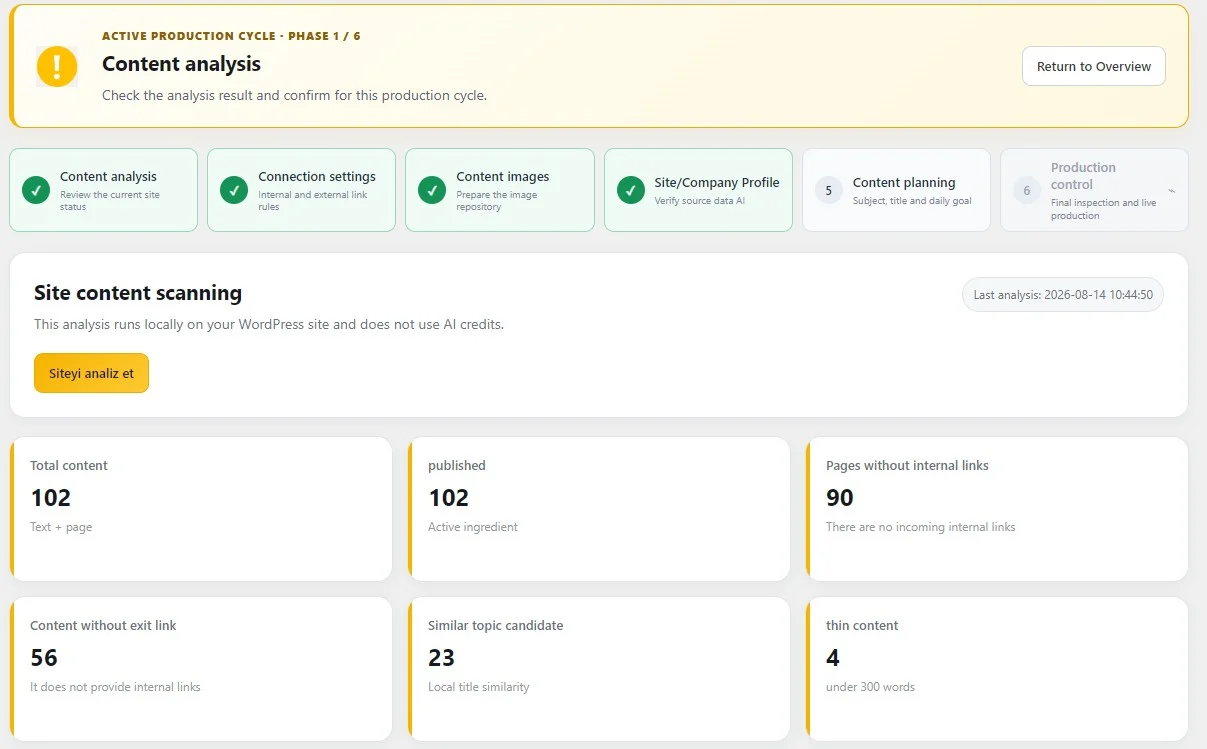
Content clusters solve this problem.
A content cluster organizes several related pages around a broader central topic. Instead of treating every article as an isolated piece of content, the website builds groups of pages that support one another.
Artificial intelligence can make this process easier to manage.
AI can analyze existing WordPress content, recognize semantic relationships, identify missing supporting topics, suggest cluster structures, and help generate new articles that strengthen those clusters.
PW Feed can support this type of strategy by combining AI content creation, WordPress publishing, SEO, GEO, internal linking, topic planning, and wordpress plugin functionality.
The objective is not simply to group similar keywords.
The objective is to build a clear information architecture in which every important subject has a logical place.
What is a content cluster?
A content cluster is a group of related pages organized around one broader subject.
The structure usually contains a central topic and several supporting topics.
For example, a WordPress AI content cluster might include a central page explaining AI content automation in WordPress.

Supporting pages could then cover:
Automatic blog publishing.
AI-generated WordPress drafts.
Long-form AI content.
SEO title automation.
Meta description generation.
Internal linking.
Duplicate-content prevention.
GEO optimization.
Each supporting article explores one part of the broader subject in greater depth.
The pages are related, but they are not duplicates.

Together, they create a more complete information environment.
Why content clusters are useful for WordPress
WordPress makes publishing easy.
That is one of its greatest strengths.
It can also create a problem.
Because adding a new article is so simple, websites often accumulate content without a clear architecture.
After several years, a site may contain hundreds of posts spread across categories, tags, and archives.
Users can find individual pages through search engines, but understanding the wider structure becomes difficult.
Content clusters introduce organization.
They help answer questions such as:
Which page is the main resource for this subject?
Which articles support that page?
Which important subtopics are missing?
Which pages overlap unnecessarily?
Where should internal links point?
These questions become especially important when AI increases publishing capacity.
AI makes cluster planning more practical
Manual cluster planning requires someone to review the entire website.
The editor must understand hundreds of titles and articles.
This becomes difficult as the site grows.
AI can assist by analyzing the semantic meaning of content.
It can recognize that an article about WordPress drafts belongs near content about publishing workflows even if both pages do not use identical keywords.

It can identify that SEO titles and meta descriptions belong inside a broader SEO automation group.
It can recognize that GEO, answer-focused content, and generative search visibility may belong within another related area.
This makes cluster discovery more scalable.
Content clusters should begin with real business topics
A cluster should not exist only because a keyword tool suggests a popular phrase.
The broader subject should matter to the website.
For a WordPress AI product such as PW Feed, useful cluster areas may include:
AI content generation.
WordPress publishing automation.
SEO automation.
GEO and generative search.

Content planning.
Internal linking.
Agency workflows.
Local business content.
These subjects align with the actual product and audience.
A completely unrelated cluster would provide little strategic value even if it attracted traffic.
The website should strengthen subjects connected with its real expertise.
One strong central page can anchor a cluster
Most clusters benefit from a broad central resource.
This page introduces the main subject and links toward more detailed supporting articles.
For example, a central page about WordPress AI SEO content may explain the overall relationship between:
WordPress.
AI content creation.
SEO.
GEO.
Publishing automation.
Content planning.
Supporting pages can then explore each component separately.
The central resource provides orientation.
The supporting pages provide depth.
This creates a hub-and-spoke structure.
The central page should not duplicate every supporting article
A common mistake is making the central page so detailed that the supporting pages repeat it almost entirely.
The central page should provide useful coverage of the broader subject.
However, detailed subtopics can remain on specialized pages.
For example, the central page may explain that automatic metadata can be part of AI SEO workflows.
The supporting article about meta descriptions can then explain:
Search intent.
Description uniqueness.
Semantic duplication.
Automatic generation.
Review rules.
This division helps every page maintain a distinct role.
Supporting articles should have clear individual purposes
A strong cluster is not simply a collection of keyword variations.

Each supporting page should address a different user need.
Consider these potential articles:
How to create SEO-friendly WordPress posts automatically.
How to generate unique SEO titles automatically in WordPress.
How to create unique meta descriptions with AI in WordPress.
How to prevent duplicate AI content in WordPress.
AI-powered internal linking for WordPress content.
All relate to SEO automation.
However, each addresses a distinct component.
This is a healthy content cluster.
If the cluster instead contained ten articles that all explained how AI creates SEO-friendly WordPress posts, the structure would be repetitive.
Search intent should separate cluster pages
Search intent provides one of the strongest methods for deciding whether two topics deserve separate pages.
Suppose two proposed articles are:
How to automate WordPress blog publishing.
How to automatically publish WordPress articles.
These may have almost the same intent.
The website might not need both.
Now compare:
How to automate WordPress blog publishing.
Should AI content be saved as a draft or published directly?
These subjects are related but distinct.
One focuses on publishing automation.
The other focuses on editorial workflow decisions.
Both can belong inside the same publishing cluster.
This is how clusters create depth without duplication.
AI can group existing articles semantically
Many WordPress websites already contain substantial content before they begin using cluster strategy.
AI can analyze existing pages and group them by meaning.
For example, it may identify that several articles belong to:
SEO.
Publishing.
Local content.
Agency use cases.
AI search.
Content strategy.
The site owner can review these groups.
Some may already form strong clusters.
Others may reveal gaps.
Still others may contain too much overlap.
This provides a useful starting point for reorganizing an established content library.
Automatic clustering can reveal hidden duplication
One important benefit of semantic grouping is duplicate detection.
Suppose AI places six articles into an extremely narrow group.
After review, the site owner discovers that all six pages answer nearly the same question.
This may indicate keyword cannibalization.
The correct action may not be creating more links between them.
It may be consolidating some of the pages.
Content clusters therefore help identify both strengths and structural weaknesses.
Clusters help identify content gaps
Once the existing content has been organized, missing topics become easier to see.
Imagine a WordPress SEO cluster containing:
SEO-friendly AI content.
Automatic SEO titles.
Meta descriptions.
Duplicate-content prevention.
But nothing about internal linking.
That missing subject represents a natural content opportunity.
Another cluster may contain many articles about content generation but nothing about updating older content.
The next article can fill that gap.
This is much stronger than selecting topics randomly.
AI can suggest supporting topics automatically
After defining a central subject, AI can propose possible supporting questions.
For example, a cluster about WordPress GEO may generate topics around:
AI search visibility.
Answer-focused content.
Generative search preparation.
ChatGPT search optimization.
Google AI Overviews.
SEO versus GEO versus AEO.
These subjects can then be reviewed before generation.
Not every suggestion needs to become a page.
The website owner should approve only topics that have a distinct purpose and enough depth.
AI assists with discovery.
Editorial judgment controls publication.
A content cluster should not become infinitely large
Broad subjects can produce hundreds of possible article ideas.
This does not mean every idea should be published.
The cluster should expand according to useful demand.
Once the major questions are answered, further content should add genuinely new value.
Very small keyword differences may not justify separate pages.
A healthy cluster can contain five strong pages or fifty.
The number depends on the subject.
Quality and distinct intent matter more than size.
Cluster depth should reflect the importance of the topic
Not every subject deserves the same amount of content.
A central product category may deserve many supporting articles.
A secondary feature may require only one or two pages.
Content resources should be distributed according to business importance and user demand.
For PW Feed, topics such as WordPress AI content, SEO, GEO, automation, and publishing naturally deserve substantial depth because they relate directly to the product’s purpose.
A peripheral subject should not receive the same attention simply to increase page count.
Internal linking makes clusters visible
A cluster is not created simply because several articles cover related topics.
The relationships should be expressed through internal links.
The central page can link to supporting articles.
Supporting articles can link back to the central page.
Related supporting pages can link to one another when useful.
This creates a network.
Users can navigate the subject naturally.
Search engines can recognize the relationships.
Generative systems can encounter a clearer structure.
AI-powered internal linking can make this easier to maintain.
Links should follow information relationships
Internal linking inside a cluster should remain meaningful.
A page should not link to every other page in the group simply because they share a category.
For example, an article about automatic SEO titles may naturally link to meta descriptions.
It may also link to duplicate-content prevention.
A link to an unrelated agency workflow page may not add much value in that specific paragraph.
Cluster membership provides possible destinations.
Context determines which links should actually appear.
This keeps the content readable.
Anchor text can reinforce cluster meaning
Anchor text helps explain what the linked page contains.
Instead of generic phrases such as read more, descriptive wording can provide context.
Examples may include:
Automatic SEO title generation.
AI-powered internal linking.
WordPress duplicate-content prevention.
Generative search optimization.
These phrases help users understand the next destination.
They also reinforce semantic relationships between pages.
Anchor text should remain natural and varied.
It should not be forced solely for keyword optimization.
A cluster can contain different content formats
Not every page inside a cluster needs the same format.
One article can be a tutorial.
Another can answer a question.
Another can compare two approaches.
Another can explain common mistakes.
Another can provide a strategic overview.
This variation creates a richer information environment.
For example, a publishing automation cluster might include:
A broad automation guide.
A draft-versus-publish comparison.
A tutorial about automatic drafts.
An article about publishing calendars.
A guide to quality control.
All belong to the same cluster while addressing different needs.
Different formats can target different customer stages
Clusters can also support the customer journey.
A beginner may enter through a broad educational article.
A more advanced visitor may read a technical workflow guide.
Another user may reach a comparison article while evaluating options.
A commercial page may provide the next step.
These pages can all belong to the same thematic environment.
Internal links help move users naturally between stages.
This creates a content system that supports both education and conversion.
AI can help determine cluster hierarchy
Some pages are broader than others.
AI can analyze article scope and suggest hierarchy.
For example:
WordPress AI SEO content may be a broad hub.
Automatic SEO titles may be a supporting article.
Avoiding duplicate SEO titles may be an even narrower subtopic.
This hierarchy can influence internal linking.
Broader pages often link down to specialized resources.
Specialized pages can link upward to their broader context.
The result resembles a structured knowledge tree rather than a flat archive.
WordPress categories are not the same as content clusters
WordPress categories can help organize articles, but they do not automatically create a cluster.
A category is usually a publishing taxonomy.
A cluster is a strategic information relationship.
Several articles may belong to the same category but target unrelated intents.
Conversely, related cluster pages may exist across different categories or page types.
Content clusters therefore require more than assigning category labels.
They depend on topic ownership, hierarchy, and contextual links.
Tags also should not replace cluster planning
WordPress tags can describe common concepts.
However, websites often create too many tags.
Hundreds of thin tag archives can make the structure more complicated rather than clearer.
A content cluster should be based on actual page relationships.
AI can analyze the content directly.
The cluster does not need to depend entirely on taxonomy.
Categories and tags can support organization, but they should not be treated as substitutes for strategic content architecture.
SEO benefits from clear topic coverage
Content clusters can strengthen SEO by creating comprehensive subject coverage.
A central page introduces the broad topic.
Supporting articles answer narrower questions.
Internal links connect them.
The website gains depth around the subject.
This does not guarantee rankings.
However, it creates a stronger information environment than publishing unrelated articles without structure.
It also reduces the need to repeat the same information across multiple pages.
Clusters can reduce keyword cannibalization
Keyword cannibalization often develops because the website does not know which page owns which topic.
Clusters help clarify ownership.
The broad page owns the broad intent.
Supporting pages own narrower intents.
Each page has a defined role.
This makes it easier to distinguish titles, metadata, and internal links.
When a new topic is proposed, the website can compare it with the existing cluster.
If another page already owns the intent, a new article may not be necessary.
SEO titles become easier to create inside clusters
A clear content structure makes metadata more distinctive.
Instead of creating several broad titles around WordPress AI SEO, each page can describe its specific function.
Examples include:
How to generate unique SEO titles automatically in WordPress.
How to create unique meta descriptions with AI in WordPress.
AI-powered internal linking for WordPress content.
How to prevent duplicate AI content in WordPress.
These titles share a broader SEO automation theme but remain clearly different.
This improves both editorial organization and search-result clarity.
Meta descriptions also benefit from cluster structure
The same principle applies to meta descriptions.
Each description can summarize the page’s individual contribution.
A description for an internal linking article can mention semantic links and content relationships.
A description for duplicate prevention can emphasize overlapping search intent.
A description for SEO titles can focus on title uniqueness.
This creates stronger differentiation even when the pages belong to the same broader topic.
GEO can benefit significantly from content clusters
Generative Engine Optimization is closely connected with information structure.
AI-powered systems need clear relationships between entities and concepts.
Content clusters provide repeated but distinct explanations around a central subject.
For PW Feed, a cluster can reinforce relationships between:
PW Feed.
WordPress.
AI content generation.
SEO.
GEO.
Content automation.
Publishing workflows.
wordpress plugin functionality.
Each article adds a different layer of context.
The cluster as a whole creates a richer representation of the subject.
Repeated concepts should remain consistent
Cluster pages will naturally share terminology.
This is useful.
The product name should remain the same.
Important feature descriptions should remain accurate.
Core concepts should not contradict one another.
However, shared concepts should not result in copied paragraphs.
The same entity relationship can be explained differently according to the page context.
Consistency exists at the factual level.
Originality exists at the content level.
This balance is particularly important for SEO and GEO.
Clusters can improve answer-focused content
Users increasingly search with complete questions.
AI assistants also respond to conversational queries.
A cluster can cover multiple questions around one central topic.
For example:
What is WordPress AI content automation?
How can it be published automatically?
Should content be saved as a draft first?
How can duplicate content be prevented?
How can SEO metadata be generated?
How should articles be linked?
Each page provides a focused answer.
Together, they create broad question coverage.
This can support traditional search, AEO, and GEO strategies.
AI can map questions to existing pages
Before creating another question-based article, AI can compare the question with current content.
If an existing page already answers it, the site can avoid duplication.
If the question represents a distinct intent, it can become a new supporting topic.
This makes cluster expansion more controlled.
The content system grows according to real informational gaps rather than endless keyword variations.
Clusters can support AI search visibility
AI search systems may retrieve information from specific pages rather than presenting a traditional list of results.
A website with clear, focused pages can provide useful source material for different questions.
A broad central page offers context.
Supporting pages provide detailed answers.
Consistent entity information connects them.
This structure is useful regardless of which individual page is discovered.
The website does not depend on one enormous article to answer every possible query.
Clusters create a stronger knowledge network
A mature content cluster can function like a small knowledge base.
Users may enter through any page.
Internal links allow them to explore related information.
The central page provides orientation.
Supporting pages provide detail.
Commercial pages provide solutions when relevant.
This can improve engagement because the site offers logical next steps.
It can also help users understand complex subjects gradually.
Commercial pages can be part of a cluster
Content clusters do not need to contain only blog posts.
A product page can serve as a commercial destination within the broader information architecture.
Educational articles can explain problems and workflows.
When relevant, they can connect users with the product that addresses those needs.
For PW Feed, readers who want additional information about the product and its WordPress AI content capabilities can continue through the PW Feed contact page.
Users ready to review purchase options can proceed to the PW Feed buy page.
These commercial paths should remain relevant rather than appearing mechanically on every cluster page.
A cluster should support the product without becoming promotional
A strong informational cluster provides real value independently.
The articles answer questions.
They explain concepts.
They discuss limitations.
They provide practical guidance.
PW Feed can appear naturally where its functionality is relevant.
However, the entire cluster should not read like repeated product advertising.
Informational value builds trust.
Commercial relevance can then emerge naturally from that information.
This creates a stronger long-term content strategy.
AI can automate cluster-based topic queues
Once clusters are defined, future content can be planned more systematically.
Each cluster can maintain a queue of approved topics.
For example:
SEO automation cluster:
Unique titles.
Meta descriptions.
Internal links.
Duplicate prevention.
Content audits.
GEO cluster:
Generative search.
Answer engines.
ChatGPT search.
Google AI Overviews.
SEO versus GEO versus AEO.
AI can help identify which cluster needs more depth and select the next approved topic.
This reduces random publishing.
Publishing frequency can be balanced between clusters
A website should avoid publishing twenty articles from one cluster while ignoring all others unless there is a strategic reason.
Automated planning can rotate between important subject areas.
One article may strengthen SEO.
The next may strengthen GEO.
Another may address publishing automation.
Another may focus on a specific business use case.
This creates a more balanced content library.
AI can help manage the schedule while maintaining the site’s priorities.
Clusters can prevent content drift
Content drift occurs when a website slowly begins publishing subjects outside its core expertise.
This can happen because keyword tools constantly suggest new opportunities.
A cluster-based strategy provides boundaries.
If a proposed topic does not belong naturally to an approved cluster, the site should ask whether it truly belongs.
Sometimes a new cluster is justified.
Often, the topic is simply irrelevant.
This helps protect topical focus.
Niche websites benefit particularly from clustering
Niche websites often cover a limited subject very deeply.
This makes content clusters ideal.
A WordPress AI content website can develop several deep clusters around:
Automation.
SEO.
GEO.
Publishing.
Agencies.
Local businesses.
Content strategy.
The entire site remains within its specialization.
At the same time, each cluster creates a different path into that niche.
This provides breadth without abandoning focus.
Local businesses can also use clusters
Content clusters are not limited to software or publishing websites.
A local service company might create clusters around its primary services.
A central service page can act as the hub.
Supporting articles can answer:
Common customer questions.
Maintenance questions.
Cost considerations.
Process explanations.
Local concerns.
Related problems.
Geographic content can also be included when it reflects real service areas.
AI can adapt the cluster model to different business types.
Agencies can build separate clusters for each client
Agencies managing multiple WordPress websites can use AI to create client-specific content maps.
Each client has different products, services, locations, and priorities.
The clusters should therefore remain separate.
A software client may have technology-focused clusters.
A local service client may have service and location clusters.
An e-commerce client may organize content around product categories and buyer questions.
AI can help manage the structure while preserving client individuality.
Cluster automation should never mix client identities
This is an important agency safeguard.
If several clients operate in similar industries, AI may identify similar topic patterns.
The strategic framework can be reused.
The actual content should remain client-specific.
Different:
Business names.
Service descriptions.
Examples.
Geographic information.
Internal links.
Commercial destinations.
Brand terminology.
The same cluster architecture does not justify duplicate content across different websites.
A wordpress plugin can bring clustering closer to the content
A WordPress-specific workflow has an important advantage.
The system can analyze actual posts and pages.
It can work with real titles.
It can identify real internal destinations.
It can evaluate existing publishing categories.
It can connect future articles with the current site structure.
A generic AI tool may suggest that a page should link to an SEO guide.
A wordpress plugin can potentially identify the actual SEO guide already present on the website.
This makes cluster recommendations far more actionable.
PW Feed can support site-aware content development
PW Feed can fit into a broader WordPress AI content workflow where generation is informed by site context.
The website does not need to treat every article as a separate prompt.
Topics can belong to defined clusters.
SEO can guide search intent.
GEO can guide information clarity.
Internal linking can connect supporting pages.
Publishing rules can determine whether content becomes a draft or is published.
The wordpress plugin environment provides the connection between strategy and execution.
Draft publishing can help validate new clusters
When a website introduces a new cluster, its first articles may benefit from manual review.
The editor can verify:
Does each article have a distinct role?
Are the internal links useful?
Is the central page clear?
Are topics overlapping?
Is the terminology consistent?
Does the cluster strengthen the website’s core subject?
Once the structure proves reliable, production can become more automated.
This creates a controlled expansion model.
Automatic publishing should respect cluster rules
Direct publishing becomes safer when the system already knows:
Which cluster the article belongs to.
What search intent it owns.
Which topics already exist.
Which internal pages are relevant.
Which terminology is approved.
Whether the topic is allowed.
Without these rules, automatic content production can create structural problems quickly.
Cluster-aware automation provides more context for every publishing decision.
Clusters should be reviewed periodically
A content architecture is not permanent.
New topics emerge.
Old pages become outdated.
Some clusters grow rapidly.
Others may no longer be important.
Periodic review can identify:
Missing pages.
Overlapping pages.
Weak central resources.
Broken internal links.
Outdated terminology.
Underdeveloped clusters.
Clusters that have expanded beyond their original purpose.
AI can assist with these reviews.
This makes content management more proactive.
Old articles can be reassigned to better clusters
As the website evolves, some pages may fit better under a different central topic.
That is normal.
For example, an older article originally placed inside general AI content may become more useful inside a GEO cluster after the website’s structure matures.
Changing the conceptual cluster does not necessarily require changing the URL.
The website can update internal links and navigation relationships.
Clusters are strategic structures, not rigid technical containers.
Weak cluster pages can be improved instead of replaced
If a cluster contains a weak article, the first response should not always be creating another page.
The existing article may be improved.
AI can help expand it.
Missing questions can be added.
The search intent can be clarified.
Internal links can be strengthened.
Outdated terminology can be corrected.
This preserves the existing URL and reduces duplicate-content risk.
Content clusters make these weak areas easier to identify.
Clusters can simplify future content decisions
One of the biggest operational benefits of clusters is reducing uncertainty.
Instead of asking what should we write about today, the website can ask:
Which cluster needs support?
Which important question is still unanswered?
Which page needs updating?
Which supporting article should be created next?
This creates a repeatable decision process.
AI can automate much of the analysis.
The business retains strategic control.
Clusters support long-term SEO rather than isolated keywords
Keyword-by-keyword publishing often produces a fragmented site.
Cluster strategy takes a longer view.
The website aims to explain an important subject comprehensively.
Keywords still matter.
Search intent still matters.
But each page contributes to a larger structure.
This creates stronger topical organization.
It also makes future expansion easier because every new article has a defined context.
Clusters support GEO through repeated semantic context
GEO benefits when a website repeatedly explains important relationships across distinct pages.
For example:
PW Feed is associated with WordPress.
PW Feed supports AI content workflows.
SEO is part of the content process.
GEO addresses generative discovery.
A wordpress plugin connects functionality with the WordPress environment.
These relationships can appear naturally throughout different cluster pages.
The text does not need to be copied.
The underlying meaning remains stable.
Over time, the site creates a coherent semantic environment around the product.
Content clusters can prepare a site for changing search behavior
Search behavior continues to evolve.
Traditional keyword searches remain important.
Conversational queries are growing.
AI-generated answers introduce new discovery patterns.
A well-organized cluster can serve all of these environments.
Broad pages provide context.
Focused pages answer specific questions.
Internal links connect related concepts.
Clear entity information supports AI interpretation.
This makes cluster architecture useful beyond any single search technology.
The strongest clusters are built around user needs
SEO tools can provide data.
AI can provide suggestions.
Business goals provide direction.
But the cluster should ultimately serve users.
A person should be able to enter the cluster through one page and find useful paths toward related answers.
If the structure exists only to manipulate keywords, it will eventually become repetitive.
User questions provide a stronger foundation.
What do people want to understand?
What decisions do they need to make?
What problems do they encounter?
What related information helps next?
These questions produce more useful cluster structures.
PW Feed and automatic content clusters
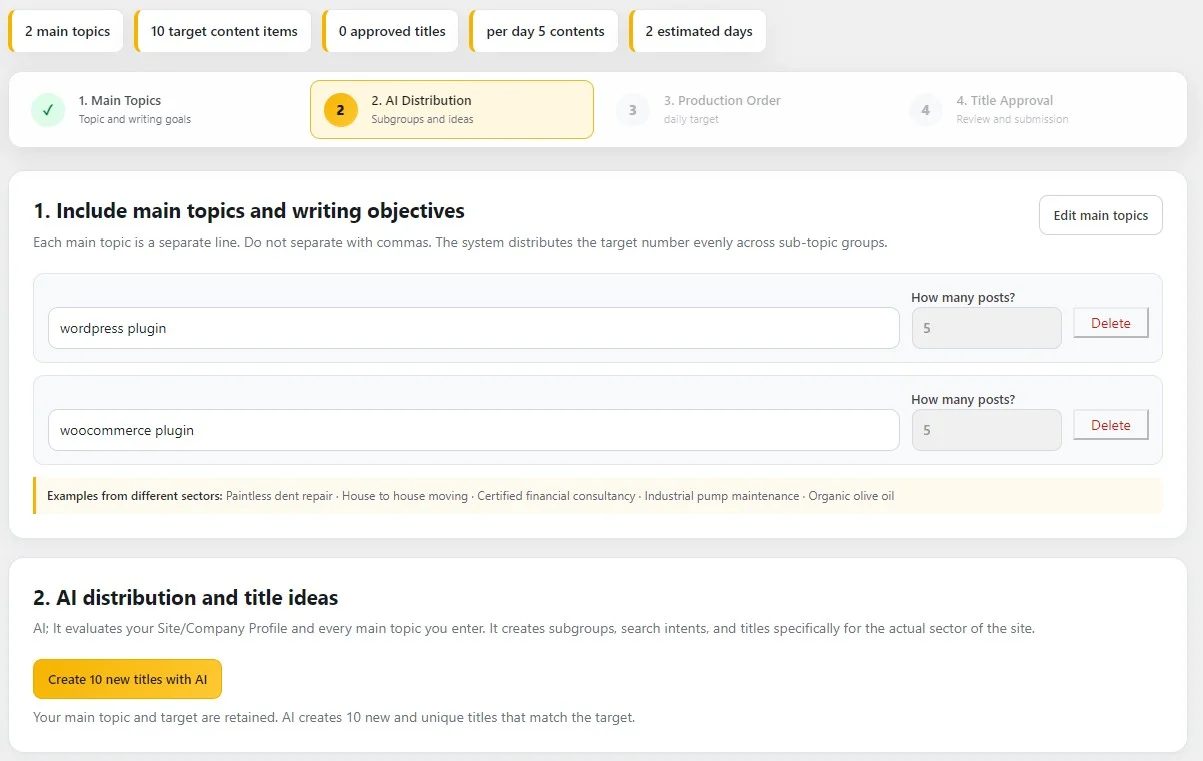
PW Feed can support WordPress website owners who want to move beyond isolated AI-generated articles and build a structured content system.
The process can begin with existing content.
AI can help identify subject groups.
Missing topics can be discovered.
New articles can be generated according to approved cluster plans.
SEO can guide search-intent separation.
GEO can reinforce clear entities and relationships.
Internal links can connect relevant pages.
A wordpress plugin can bring these activities closer to the WordPress publishing environment.
The website becomes more organized as content volume grows.
Automation should strengthen architecture rather than accelerate disorder
This is the central principle.
AI makes production faster.
Without architecture, faster production can create:
More duplicates.
More orphan pages.
More overlapping topics.
More random categories.
More inconsistent metadata.
More maintenance work.
Content clusters provide a framework that turns speed into structured growth.
Automation is valuable when every new article has a known place.
Final thoughts on creating content clusters automatically in WordPress
Creating content clusters automatically in WordPress can help transform a growing website into a structured knowledge network.
AI can analyze existing pages.
It can identify semantic relationships.
It can group related content.
It can reveal duplication.
It can identify missing topics.
It can suggest supporting articles.
It can assist with internal linking.
It can help maintain SEO and GEO consistency across the cluster.
The central page provides broad context.
Supporting pages answer narrower questions.
Search intent keeps those pages distinct.
Internal links connect the information.
A wordpress plugin can integrate this architecture with the WordPress content workflow.
PW Feed can support a system where AI generation, SEO, GEO, internal linking, topic planning, and publishing work together.
The strongest cluster is not the one with the greatest number of articles.
It is the one that explains an important subject clearly from multiple useful angles without unnecessary repetition.
Every page should contribute something distinct.
Every link should represent a meaningful relationship.
Every new topic should fill a genuine informational gap.
When these principles guide automation, WordPress content clusters can help a website grow in depth without becoming disorganized, repetitive, or difficult to navigate.