
How to scale WordPress content production without a writing team
Publishing more WordPress content usually creates a simple operational problem: someone has to produce it.
For large organizations, this may involve writers, editors, SEO specialists, content managers, researchers, and developers. Small businesses, independent publishers, agencies, consultants, and growing online companies often do not have access to this type of team.

They may still need dozens of useful articles, supporting pages, educational resources, and search-focused content, but hiring a dedicated writing department may not be practical.
Artificial intelligence creates another option.
Instead of increasing content production by continuously adding writers, a WordPress website can build a structured AI-assisted system that converts approved topics, business knowledge, SEO priorities, and publishing rules into new content.
This does not mean removing quality control or publishing unlimited AI-generated pages.
It means designing a production process that can scale without requiring a person to manually write every article.
PW Feed can support this model through AI content generation, WordPress automation, SEO, GEO, and wordpress plugin functionality.
The important shift is from individual article production to content system design.
Why traditional content production becomes difficult to scale
Manual writing works well at small volumes.
If a website needs one article every month, a business owner or employee may be able to produce it.
The challenge changes when the site needs broader topical coverage.
Ten articles require more planning.
Fifty articles require organization.
Hundreds of pages may require an entire editorial operation.
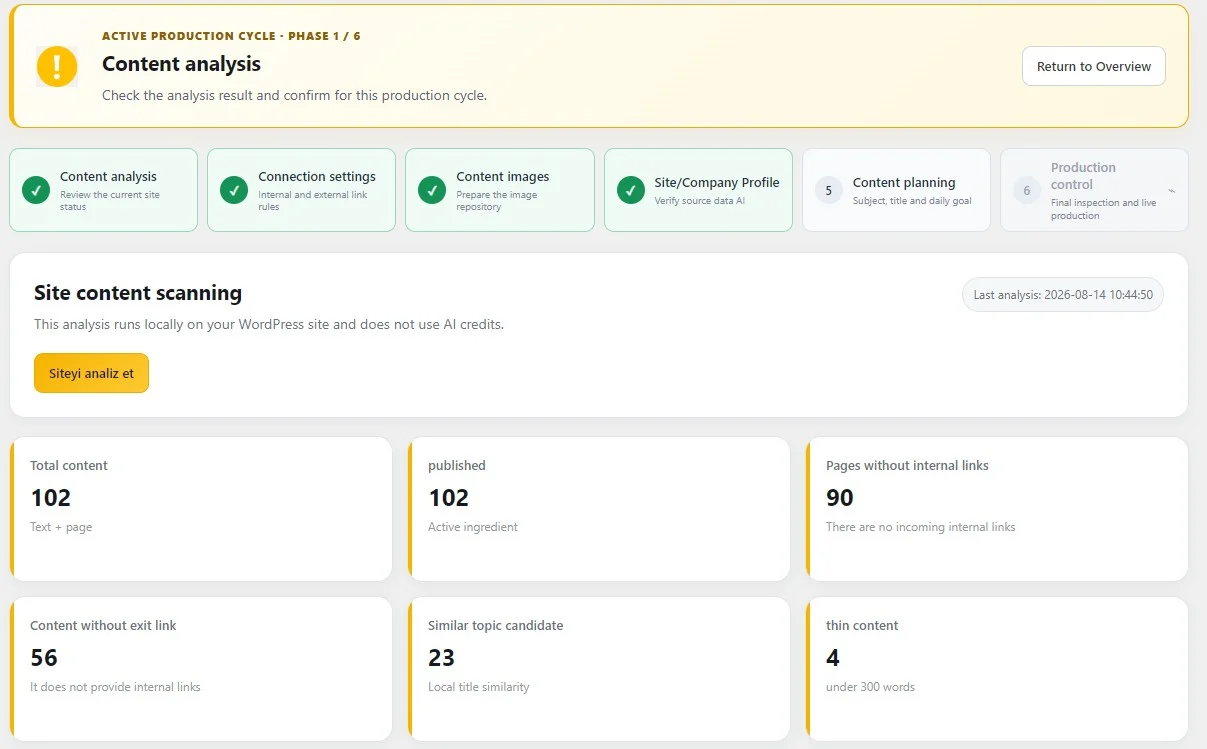
Each article can involve topic research, keyword selection, outlining, writing, editing, metadata preparation, internal links, publication, and later maintenance.
Increasing article volume usually increases labor almost proportionally.
This creates a scaling limit.
A small company may recognize many valuable content opportunities but be unable to pursue them because production capacity is too low.
AI can change the relationship between content volume and manual labor.
The website still needs strategic decisions, but repetitive writing work can be reduced significantly.
Scaling should begin with a content system, not more articles
The first mistake businesses make when trying to scale content is focusing immediately on production volume.
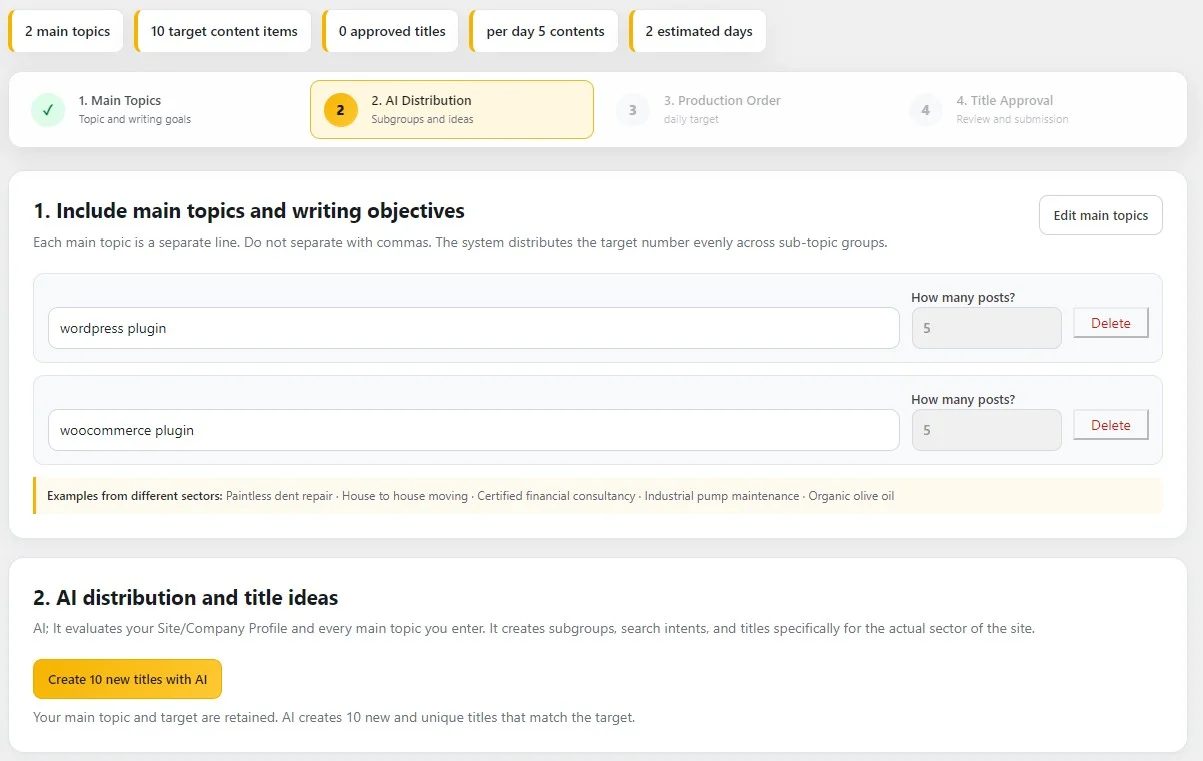
They ask how to create twenty articles instead of asking which twenty articles should exist.
A scalable strategy begins with organization.
The website needs defined subject areas.
It needs a clear relationship between commercial pages and informational content.
It needs rules for topic uniqueness.
It needs publishing limits.
It needs quality expectations.
Only after these foundations exist should production increase.
Without them, AI can simply create confusion faster.
A site may end up with many pages targeting similar keywords, repeating the same ideas, and competing with one another.
Scaling poor planning does not create a strong content strategy.

It creates a larger version of the same problem.
Create content pillars before increasing production
One practical way to scale without a writing team is to organize content into pillars.
A pillar represents an important subject connected to the website.
For PW Feed, examples of broad areas may include:
WordPress AI content generation.
SEO content automation.
GEO optimization.
Automatic publishing.
Content planning.
AI search visibility.
Internal linking.
WordPress content workflows.
Each pillar can support many distinct articles.
This creates a controlled universe of topics.
Instead of asking AI for random ideas every day, the website can expand these predefined areas gradually.
The content remains focused.
SEO relationships become clearer.
GEO context also becomes stronger because the same business is consistently associated with a coherent set of subjects.
Use content clusters to create depth efficiently
A content pillar can be divided into narrower supporting topics.
For example, a WordPress AI automation cluster might include articles about automatic drafts, direct publishing, content scheduling, content freshness, long-form generation, and reducing manual work.

Each article answers a different question.
Together, they build depth around the broader subject.
This is more efficient than creating unrelated pages.
It also makes planning easier.
Once the cluster is defined, AI can help produce the supporting articles systematically.
The business no longer needs a writer to invent the entire strategy for every individual page.
The strategy is established first.
AI handles much of the execution.
Separate topic planning from article writing
One of the most useful ways to scale content is to separate high-value decisions from repetitive tasks.
Topic planning requires strategic judgment.

Writing every paragraph often does not.
A business owner may spend one session defining twenty useful article topics based on customer questions, product features, search opportunities, and existing content gaps.
Those approved topics can then feed an AI content workflow.
This is more efficient than repeatedly stopping to plan, write, format, publish, and then start again.
Batch planning creates consistency.
It also allows the website owner to identify overlap before content is generated.
For example, three proposed topics may initially look different but target the same search intent.
This can be corrected at the planning stage.
Build an approved topic queue
A scalable WordPress content system benefits from an approved topic queue.
This can contain upcoming article subjects in priority order.
Each topic may include:
Primary search intent.
Target keyword.
Supporting terminology.
Relevant business information.
Related existing pages.
Publication priority.
Draft or direct publishing status.
The AI system works from this queue.
This avoids random production.
It also allows the website owner to control the direction of future content without manually writing the articles.

A wordpress plugin can make this approach especially practical because generation and publication can remain close to the WordPress environment.
AI can replace repetitive first-draft work
The most obvious advantage of AI is first-draft production.
A professional long-form article can take substantial time to write manually.
AI can generate an initial complete version much faster when provided with sufficient context and rules.
This changes the economics of content production.
The business does not need one writer for every increase in output.
Instead, one person may oversee a larger number of AI-generated drafts.
Human effort can focus on:
Topic approval.
Business accuracy.
Strategic editing.
Quality checks.
Important examples.
Final publication decisions.
This creates leverage.
The human remains involved where judgment is valuable while AI handles repetitive language production.
Scaling without writers does not mean removing human expertise
A writing team and business expertise are not the same thing.
A company may not employ writers but still possess extensive knowledge.
Employees understand products.
Technicians understand processes.
Support staff understand customer questions.
Sales teams understand objections.
Managers understand business priorities.
This information can become the source material for AI content.
Instead of requiring specialists to write complete articles, the system can capture their knowledge in simpler forms.
A technician might provide several important points.
A support team may provide common questions.
A manager may define the intended audience.
AI can then transform these inputs into structured WordPress content.
This can make more of the organization’s existing knowledge visible online.
Customer questions can supply an almost continuous topic source
Businesses often search externally for content ideas while ignoring information already available internally.
Customer questions are one of the strongest examples.
A company may answer the same questions repeatedly through email, phone calls, support tickets, or sales meetings.
Each recurring question can represent a content opportunity.
Instead of relying on a writing team to identify these ideas, the business can maintain a simple question list.
AI can turn appropriate questions into detailed articles.
This creates content directly connected to real user concerns.
It can also improve SEO because many customer questions resemble long-tail search queries.
For GEO, direct answers provide clear information that generative systems can interpret more easily.
AI can maintain structural quality at larger volumes
Scaling manually can introduce inconsistency.
Different writers may use different terminology.
Some articles may be detailed while others are shallow.
One writer may understand SEO well while another ignores search intent.
AI can help maintain a defined baseline.
The website can establish rules for:
Content depth.
Tone.
Keyword use.
SEO focus.
GEO clarity.
Brand terminology.
Internal links.
Calls to action.
Publication status.
These rules can apply repeatedly.
This does not mean every article should look identical.
The informational approach should still vary.
The advantage is that essential standards can remain consistent even as production increases.
Avoid turning scale into content duplication
The faster content can be produced, the more important uniqueness becomes.
A website without a writing team may use AI to create many articles, but those pages should not become variations of the same subject.
Consider these hypothetical titles:
AI content creation without writers.
AI writing without a content team.
Automated content without writers.
WordPress content creation without a writing team.
These may all represent nearly identical search intent.
Publishing separate long-form articles for each variation may add little value.
A scalable workflow should identify semantic overlap before generation.
One comprehensive article can address the main intent.
Production capacity should then be used to cover a different content gap.
This expands search visibility rather than creating internal competition.
Scale by search intent, not keyword variations
Keyword lists can contain hundreds of phrases.
Many are simply different wordings of the same idea.
A scalable SEO strategy should group them by search intent.
For example, several phrases related to automatic WordPress publishing may belong to one page.
Another group may relate to AI drafts.
Another may focus on GEO optimization.
Another may concern content freshness.
This grouping reduces unnecessary article production.
It also creates stronger pages.
AI can then use several relevant keyword variations naturally within one comprehensive article.
The result is a broader semantic footprint without creating thin pages for every phrase.
SEO should be part of the production rules
A website without a dedicated writing team may also lack a full-time SEO editor.
This makes predefined SEO rules particularly important.
AI content generation can incorporate SEO considerations from the start.
The system can work from a defined primary topic.
Related terminology can appear naturally.
Search intent can determine content coverage.
Titles can remain distinct.
Metadata can be created alongside the article.
Internal relationships can be considered.
This reduces the need for a separate optimization process after every draft.
The business still needs to monitor strategy, but repetitive SEO preparation can become part of the workflow.
GEO should scale with the content system
Generative Engine Optimization becomes increasingly relevant as AI-driven search environments expand.
A scaled content system should not create pages that are only keyword-focused.
Information should also be clear, contextual, and understandable.
AI-generated articles can define terms directly.
Products and services can be connected clearly to their functions.
The business entity can remain consistently described.
Important questions can receive direct answers.
For PW Feed, scaled content should maintain recognizable relationships between PW Feed, WordPress, AI content generation, SEO, GEO, content automation, and wordpress plugin functionality.
This consistency can help both traditional search understanding and generative interpretation.
A business profile reduces editing workload
One of the reasons AI content requires manual editing is missing business context.
A general AI model does not automatically know every important company detail.
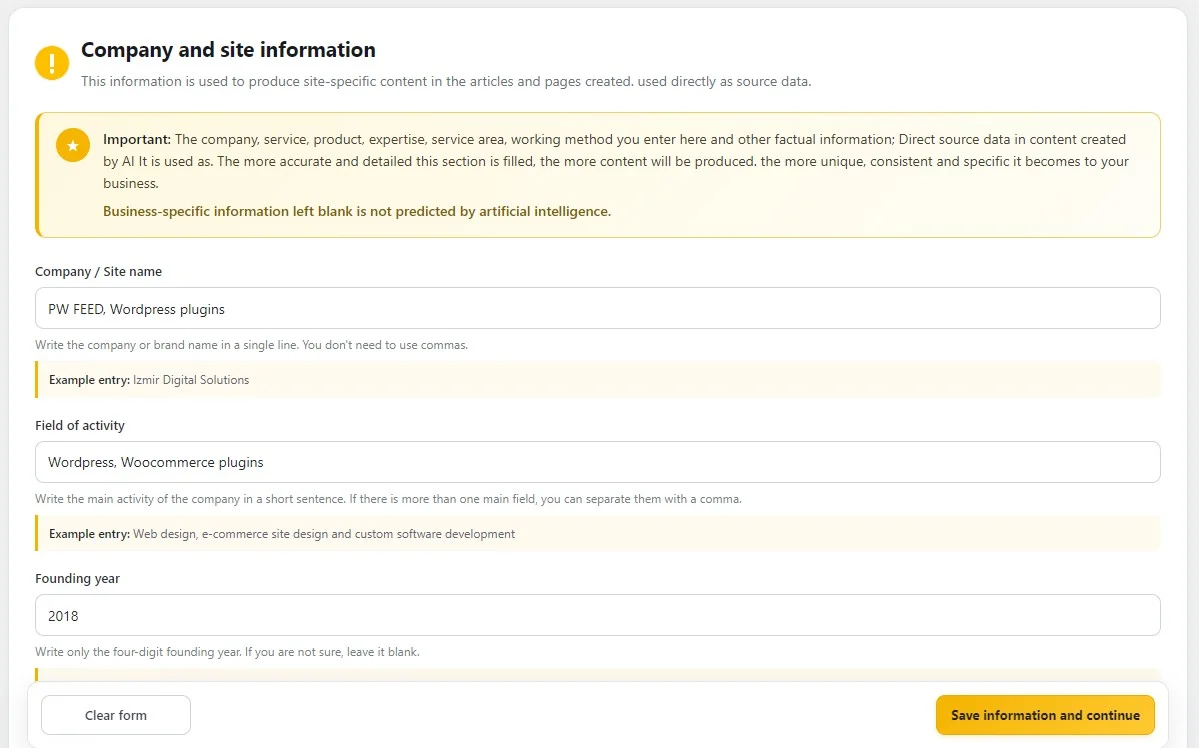
A structured business profile can reduce this problem.
The profile can contain:
Company name.
Product names.
Services.
Target customers.
Industry.
Geographic information where relevant.
Preferred terminology.
Important links.
Content restrictions.
Statements that should not be made.
When AI receives this context consistently, drafts can require fewer corrections.
This becomes increasingly important as production scales.
Correcting one generic article manually may be manageable.
Correcting the same mistake across fifty articles is inefficient.
Better context prevents repeated errors.
Templates should define rules without making every article identical
Scalable production often uses templates.
Templates can be valuable, but they should not dictate identical article structures.
A template may define requirements such as:
Minimum content depth.
Required SEO context.
GEO principles.
Brand mentions.
Relevant calls to action.
However, the actual informational structure should adapt to the topic.
An article about content strategy should feel different from an article about local business automation.
An article about metadata should develop differently from an article about long-form writing.
This is how automation can preserve originality at scale.
Rules provide consistency.
Topic-specific reasoning provides variation.
Draft-first workflows can scale safely
A business does not need to move directly from manual writing to automatic publication.
A scalable intermediate model is automatic draft generation.
AI creates the article.
WordPress stores it as a draft.
One person reviews several drafts together.
This is much more efficient than writing each article manually.
The reviewer can focus on high-value checks.
Does the topic match the plan?
Is the business information correct?
Is the article distinct from previous pages?
Are links appropriate?
Is the content useful?
This model can support significant production growth while preserving human oversight.
Direct publishing can be introduced selectively
Once AI output becomes reliable, some categories may no longer require individual review.
Evergreen informational content around approved subjects may be suitable for direct publishing.
More sensitive material can remain draft-only.
This creates a hybrid system.
For example:
General educational articles may publish automatically.
Commercial pages may require review.
Regulated topics may always remain drafts.
New content types may begin in draft mode until tested.
This selective automation makes scaling safer.
A wordpress plugin can support such rules without requiring a large editorial team.
Publishing limits matter when production becomes easy
The ability to generate fifty articles does not mean fifty articles should be published.
Production capacity and publishing need are different things.
A website should establish limits based on strategy.
These may be daily, weekly, or monthly.
Limits encourage topic prioritization.
They also reduce the risk of flooding the site with weak content.
For PW Feed users, controlled generation can provide a more sustainable approach than unrestricted publishing.
AI makes scale possible.
Publishing rules make scale manageable.
Content quality should be measured by contribution
When production grows, reviewing every sentence manually may become impractical.
A higher-level quality question becomes useful:
What does this article add to the website?
A strong page should do at least one meaningful thing.
It may answer a new customer question.
It may support an important service.
It may fill a search gap.
It may explain a new concept.
It may expand a topic cluster.
It may improve GEO clarity around a product or service.
If the article adds nothing new, it may not deserve publication.
This contribution-based approach helps control quality at larger volumes.
Internal linking becomes more important as the site grows
A site with ten pages is easy to navigate manually.
A site with hundreds of articles requires more organization.
Internal linking helps maintain relationships between content.
Supporting articles can connect to broader pillar pages.
Related articles can reference one another.
Informational content can connect users naturally with relevant commercial pages.
AI can assist with identifying potential relationships.
However, links should remain contextual.
Automated linking should not create excessive or irrelevant connections.
A scalable website needs a clear structure, not simply more links.
Content clusters reduce editorial complexity
When content is organized into clusters, future planning becomes easier.
The website owner can see which areas are already well developed.
Gaps become more visible.
For example, one cluster may already contain ten strong pages while another has only two.
The next production cycle can prioritize the weaker area.
This prevents random expansion.
It also helps distribute content effort strategically.
Without a writing team, this structure becomes especially useful because the person overseeing content can manage the system at a higher level instead of tracking every article independently.
PW Feed can help reduce dependence on external writers
External writers can remain valuable for specialized projects, brand campaigns, thought leadership, or high-stakes content.
However, a business may not need professional writing resources for every informational article.
PW Feed can help create a hybrid model.
Routine SEO and GEO-oriented content can be produced with AI.
The business can reserve human writers or specialists for content where their involvement provides greater value.
This can reduce cost while maintaining flexibility.
Readers interested in understanding how PW Feed can fit into a WordPress AI content strategy can continue through the PW Feed contact page.
Businesses ready to examine purchase options can use the PW Feed buy page.
The goal is not necessarily to eliminate professional writers.
It is to avoid making content growth completely dependent on hiring additional writers.
Agencies can scale client content more efficiently
Agencies face a particularly strong scaling challenge.
Adding new clients traditionally means adding more production workload.
If each client requires ten articles per month, doubling the client count can double writing requirements.
AI can change this model.
Each client website can have a separate business profile.
Topics can be approved individually.
Different SEO targets can be defined.
GEO context can remain specific to each brand.
AI can then generate drafts within those rules.
Agency staff can focus on strategy and quality rather than writing every paragraph.
This can make client growth more manageable without producing identical content across different sites.
One content manager can oversee more production
A scalable AI workflow changes the role of the person managing content.
Instead of acting primarily as a writer, the person becomes an editor and strategist.
They may spend time on:
Choosing topics.
Reviewing content gaps.
Checking performance.
Approving important drafts.
Updating business profiles.
Improving prompts and rules.
Monitoring duplication.
Managing internal links.
This role can oversee far more output than manual writing would allow.
The result is not zero human involvement.
It is more efficient human involvement.
Scaling should not remove subject-matter experts
Some topics still require expert input.
Technical details, professional advice, specialized processes, and business-specific knowledge may not be appropriate for generic generation.
The scalable solution is not to ask experts to write entire articles.
They can provide the essential information.
AI can perform the editorial expansion.
For example, an expert may supply five technical points.
The AI system turns those points into a structured long-form draft.
The expert then verifies the final content.
This uses expert time more efficiently.
Automation can create a reusable production pipeline
A mature WordPress AI system can function as a pipeline.
The process may look conceptually like this:
A topic is approved.
Relevant context is selected.
AI generates the article.
SEO and GEO rules are applied.
The content is checked.
The post becomes a draft or is published according to its category.
The website moves to the next approved topic.
Once this pipeline exists, adding more content does not require rebuilding the process each time.
This repeatability is what makes real scaling possible.
The website should continue learning from published content
Scaling should not be a one-way process where content is produced indefinitely.
Published pages provide information that can improve future strategy.
Some topics may attract qualified traffic.
Others may receive little attention.
Some clusters may grow strongly.
Certain customer questions may lead to more conversions.
This information can influence future topic priorities.
The content system therefore becomes iterative.
Plan.
Publish.
Observe.
Adjust.
AI supports execution, while the website owner continues to refine direction.
Old content can be part of the scaling strategy
Scaling content production does not always require new URLs.
Existing pages can be expanded or updated.
A short article may already rank for a relevant query but need more depth.
Another may contain outdated terminology.
A third may need stronger internal links.
AI can assist with these improvements.
This can sometimes provide more value than generating another new page.
A mature content system should balance creation and maintenance.
The objective is increasing useful information, not simply increasing page count.
A smaller team can create a larger knowledge base
This is perhaps the most important consequence of AI content automation.
Historically, a small business’s website content was often limited by its available writing resources.
AI reduces that limitation.
A company with deep expertise but no editorial department can gradually create a substantial knowledge base.
The knowledge still comes from the business.
AI provides the production capacity.
SEO helps connect the information with traditional search.
GEO makes important concepts clearer for generative systems.
WordPress provides the publishing environment.
A wordpress plugin can connect these elements into a manageable workflow.
Scale should increase topical depth rather than topical randomness
A website with fifty closely related, useful articles can create a stronger subject identity than a website with five hundred unrelated posts.
The direction of scale matters.
New content should deepen the website’s important areas.
For PW Feed, additional content should strengthen associations with WordPress AI content, SEO automation, GEO, publishing workflows, and related subjects.
This repeated topical context builds a clearer information environment.
Random expansion can dilute it.
A scalable system therefore needs boundaries as much as it needs production capacity.
SEO and GEO can provide a common quality framework
SEO and GEO can help define what useful scaled content should look like.
For SEO, each page should have distinct search intent, semantic relevance, sufficient depth, and clear internal relationships.
For GEO, the information should be direct, consistent, contextual, and easy for AI systems to interpret.
These principles are compatible.
Clear, useful, well-organized content can support both.
Scaling does not require abandoning either goal.
They can become part of the standard rules applied to every article.
The real objective is leverage
The reason to use AI is not simply that AI can write quickly.
The strategic benefit is leverage.
One person can plan more content than they could manually write.
One expert can contribute knowledge to more articles.
One agency manager can oversee more client content.
One business can build a larger knowledge base without creating a full editorial department.
This changes what smaller organizations can realistically accomplish online.
PW Feed is designed around this type of WordPress content automation, where technology handles repetitive production while the website owner maintains control over direction.
Final thoughts on scaling WordPress content without a writing team
Scaling WordPress content production without a writing team is possible when content is treated as a system rather than a collection of individual writing assignments.
The website should begin with clearly defined subject areas.
Topics should be grouped by search intent.
Content clusters should organize expansion.
Real customer questions should help supply ideas.
Business expertise should provide context.
AI can create first drafts and long-form articles.
SEO should guide search relevance.
GEO should improve clarity for generative discovery.
A wordpress plugin can bring generation closer to the WordPress publishing workflow.
Draft and direct publishing rules can determine how much human review each content type requires.
PW Feed can help businesses bring these elements together without making every increase in content output dependent on hiring additional writers.
The strongest scalable system does not attempt to remove humans completely.
It changes where human effort is used.
People define strategy.
Experts supply knowledge.
Editors protect quality.
AI performs much of the repetitive production work.
This makes it possible for a smaller team, or even a single website owner, to build a much deeper WordPress content library than traditional manual production would normally allow.
The result should not be more content for its own sake.
The result should be more useful information, broader search coverage, stronger topical depth, clearer GEO signals, and a publishing operation that can grow without requiring a writing department to grow at the same speed.